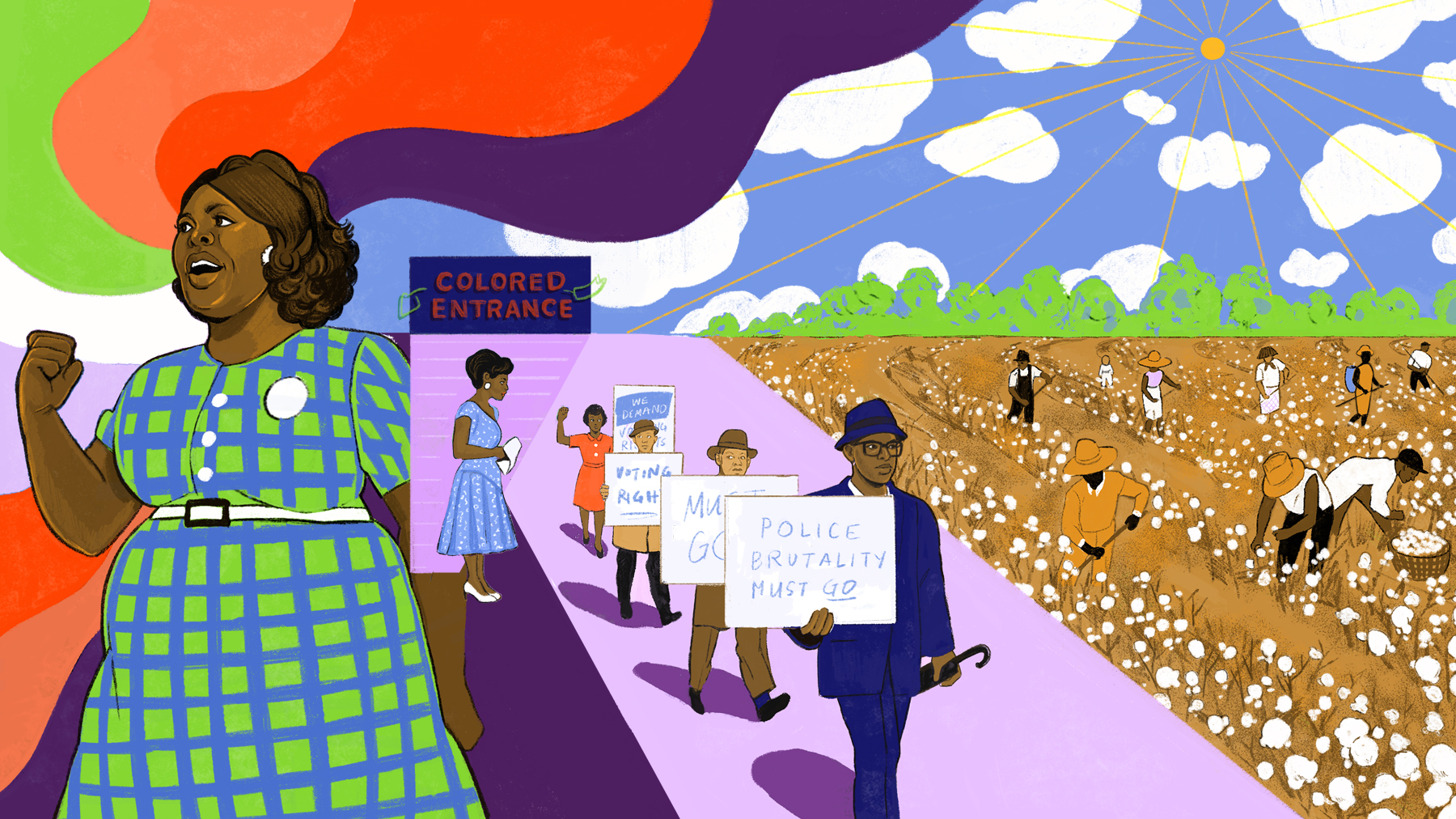
Hasan Kwame Jeffries: Get it right. That’s what Beverly Robertson, the Executive Director of the National Civil Rights Museum in Memphis, Tennessee, told us at the start of the Museum’s five-year $27 million renovation. You are here to tell the story of the African American freedom struggle from slavery to the present. Make sure you get it right. Everyone on the exhibit redesign team took her charge to heart.
The National Civil Rights Museum is located at the Lorraine Motel where civil rights leader, Dr. Martin Luther King Jr., was assassinated on April 4, 1968. So, it is more than just a place where history is told or even just a place where history happened. It’s hallowed ground, a sacred space that draws a quarter of a million visitors annually. So the design team’s responsibility to get it right, to tell the historical truth, was a responsibility to everyone who would ever walk through the museum’s doors.
As the lead historian for the renovation, I was often asked to explain design decisions usually to the Board of Directors. The questions were simple enough, as were the answers. I will never forget though, the time I was asked to respond to a major donor’s concern that the new exhibits just didn’t give him that same uplifting, feel-good spirit that he had with the old exhibits. I remember thinking, “Lord have mercy, this dude,” and I remember saying, “If he wants to be happy, tell him to go to Disney World.” I mean, our charge wasn’t to make people happy, it was to get the history right, and that’s exactly what we did. We didn’t sanitize slavery, we rendered visible the horrors of the Middle Passage and the auction block and made plain to see the culture of Black resistance. We didn’t perpetuate the myth that segregation was some kind of minor inconvenience. We made it abundantly clear that Jim Crow was designed to degrade and humiliate Black people for the purpose of controlling their labor, and we didn’t freeze Dr. King on the steps of the Lincoln Memorial, dreaming about how his children might be judged. We explained how he organized to end poverty and died in Memphis fighting alongside sanitation workers, because he believed that all labor had dignity.
The Civil Rights Movement is like American slavery. It’s hard history. It’s hard to think about, it’s hard to discuss, it’s hard to teach, and it’s hard to learn, but it’s also essential history. It’s essential that we study it and talk about it, to understand the past and to make sense of the present. So, despite how uncomfortable hard history makes us, whether we’re dealing with slavery or civil rights, we have no choice but to get it right.
I’m Hasan Kwame Jeffries, and this is Teaching Hard History: American Slavery. It’s a special series from Teaching Tolerance, a project of the Southern Poverty Law Center. This podcast provides an in-depth look at how to teach important aspects of the history of American slavery. In each episode, we explore a different topic, walking you through historical concepts, raising questions for discussion, suggesting useful source material and offering practical classroom exercises. Talking with students about slavery can be emotional and complex. This podcast is a resource for navigating those challenges, so teachers and students can develop a deeper understanding of the history and legacy of American slavery.
Okay, so how do we teach hard history? Throughout this series we suggest methods for doing just that, and in this episode, we’re going to explore ways to create an environment that is conducive to teaching and learning about slavery. Steven Thurston Oliver is a professor of education who trains teachers how to teach sensitive topics. He’s going to share with us some of the practical classroom strategies that he has developed over the years. I’ll see you on the other side. Enjoy.
Steven Thurston: I teach at Salem State University in the department of secondary and higher education, specifically within our teacher preparation program, so, working with students that aspire to be teachers. And I’m often asked, even by people who are currently working as teachers in middle school and high school, how they should go about bringing up a subject like slavery with their students, in particular if it’s a multicultural classroom. I find that many teachers feel ill-equipped to handle these discussions and, unfortunately, engage in what can only be described as an act of avoidance: doing everything possible to talk around the issue, not wanting to bring up the fact that this happened. This discomfort that so many feel in being forthright and honest about the ways in which the United States has in times fallen short of its ideals, I find, is rooted in fear, and I find that the only way to deal with this is to address these issues head-on.
Teachers are so fearful about bringing up these issues in this current era that could be described as having a heightened sensitivity around issues of race, and so many teachers have witnessed where one mistake can end a career, so they’re wise to be cautious. But the unintended consequence here is that teachers are so immobilized by this fear that they end up not addressing these issues at all for fear that they’ll create extreme discomfort for themselves and for their students.
Again, in classrooms where you have students who are coming from diverse backgrounds, and if the teacher happens to be white, the fear that they’re going to stir up racial and ethnic tensions and perhaps even give students new language to use against each other. And many teachers, in particular white teachers, can be fearful of making mistakes that could somehow implicate them as being racist, or at the very least, unprepared to facilitate difficult dialogues.
So again, the only way to deal with fear is to address it head-on. One of my mentors, or at least I wish he had been an actual mentor of mine, someone whose work I draw on a lot, James Baldwin, always used to say that the only way to get through life is to understand all of the worst things about it, and that has always stayed with me.
Another story that I sometimes share with students is a story of a Buddhist monk, and if you can imagine a Buddhist monk sitting still, meditating, very peaceful and serene, and he happens to look up and he sees that there’s a wild animal just charging directly at him, and then I’ll ask students, what do you think the Buddhist monk did when he looked up and saw this wild, ferocious animal charging at him? Invariably, they’ll laugh and say, “Well, he probably got up and ran away,” or yelled for help, or figured this was the end, and they’re always surprised when I say, “No, what the Buddhist monk did, in fact, was he got up and ran directly at this animal that was charging at him.” And then I’ll ask students “What do you think the animal did?” and in turn they’re surprised when I say, “Well, the animal actually cowered away in fear.” And this becomes an analogy I find very useful, that oftentimes at things that we’re afraid of, when we face them head-on, when we run directly at those things and we’re intentional about grappling with them, those things tend to fade and aren’t as ferocious as they initially appeared.
So for us as educators, the essential goal here is to cultivate in our students, and in fact ourselves, the ability to stay in the conversation and to avoid the temptation to water down, to avoid, or to just run away altogether. This is critically important because the very discomfort that we’re seeking to avoid, and perhaps shield our students from, can in fact be a powerful catalyst for growth and transformation. So, increasing the capacity to stay in the conversation is so important.
I also have found that it’s important to invite students to be part of imagining a better reality and that this is a real gift that educators can offer. We have to tell our students the truth. We’re not doing our students any favors by not addressing things that have occurred. And after we tell students the truth, we have to create a safe space for students to process the truth, and lastly, we have to provide clear examples of how they can become part of history by making things better for everyone.
The reality is that students are already contemplating these issues. They’ve already thought about issues of race. If you’re a fan of hip-hop, you know that it’s in almost every song that’s out there. The students have already heard all of the racial slurs and insults, but what I find is that students often don’t have a good understanding of where those slurs have come from or why particular words are so loaded. So I spend some time unpacking with them, “What is the history of these words? What is the history of the ‘N’ word?” Get into conversations and dialogue with them about, “Well, should we just ban this word altogether? Maybe make it so that nobody is able to use it in society.” It’s really interesting to hear how students relate to that set of questions, and it really has always shown me that we don’t give students enough credit for things that they’re grappling with and thinking about. So, we don’t have to be fearful of introducing students to a lot of these topics, but I would argue that school needs to be a place that allows students to make sense of what they’re hearing, and that that’s our responsibility as educators.
Some strategies that I found are really helpful for teachers who are grappling with how to address these issues or engaging in the process that I’m describing of sitting with the discomfort, staying in a conversation, not avoiding these sets of issues—that it’s very helpful to form learning communities with other educators who are also doing the same work. It’s often helpful to share strategies and stories about what did and didn’t work in classrooms with people who are like-minded. I find that that’s really powerful.
Team-teaching also is critically important for these kinds of dialogues. It’s often very helpful to have an extra set of eyes on these issues, and in particular, where it’s a class that has students from various backgrounds. If possible, if you are able to team-teach with somebody who holds a different racial and ethnic identity than the one that you hold, then that’s really powerful for students and gives them places of safety to be able to put their ideas out into the space.
One thing that I found very helpful also, particularly when teaching about slavery, is to use slave narratives. With students, I love to use the actual audio recordings, and now there’s such a rich body of interviews that were done in the 30’s and 40’s with individuals who were still living at that time who had actually been slaves. And now with the technology, they’ve been able to clean up those recordings so they sound crystal-clear, as if you’re listening to someone … This could’ve just been recorded yesterday, and they may sound like people that you know. I think it’s so powerful for students to actually sit and hear the voices of people that were enslaved.
And I’m being intentional about using a word like “enslaved” versus “slaves,” because I think that students have heard enough of this that there’s almost a disconnect. They don’t connect with the fact that these were people. They imagine this is something that happened a long, long time ago, and when you hear these slave narratives, really brings home the human cost of slavery. This was not the totality of who they were. These were human beings with thoughts and feelings and intellect.
One of the narratives I use frequently is an interview done with a gentleman by the name of Fountain Hughes, and he just very matter-of-factly is telling his story, his memory, of having been a slave, of being a young boy, having been enslaved, and says, you know, “Yeah, we were sold. Bought and sold the way you might sell cows or horses,” and really details what a difficult struggle it was being a slave. In his narration, he says, “We didn’t know anything because we were never allowed to look at a book.” That is so powerful and really brings home for students the fact that these were human beings, that if those who were enslaved were ignorant, that was not something innate to them, or a product of biology, that this was something that was done to them by withholding the opportunity to become educated. The impact of withholding an education from individuals.
He also talks about what happened when slavery ended and the ways in which people really had nowhere to go, were just sort of put out like wild cattle, he says, and even that some people, after slavery ended, commented that they actually had it better before, when they were enslaved. There’s this really powerful moment where the interviewer asks him, at one point he’s asked, “Which was better? Being a slave or being free?”, and he says, “No, no, if I even thought for a moment that there was any possibility that I would ever be a slave again, I would just go out and get a gun and end it right away, because you’re nothing but a dog,” he says, “Nothing but a dog.” The moral authority of someone like a Fountain Hughes just hangs in the room and is such a powerful catalyst for transformation with the students that I work with.
Another powerful tool that I often use, again back to the work of James Baldwin, I often use this, readily available on YouTube, famous debate that James Baldwin did with William Buckley in the UK in the mid-1960’s. He does a wonderful job of laying out the case of when people talk about the original sin of the United States. He talks about … And a lot of students, they’ve never heard of James Baldwin before, he’s a very dynamic character, very animated in his delivery, coming out of that rhetorical tradition of the Black church, and at one point he sort of lays it out there that, quite literally he says, “I picked the cotton and I carried it to market under somebody else’s whip for nothing. For nothing.” And then lays out the case that the United States could not have become as wealthy as it did in the period of time that it did had it not had access to all of this labor. That’s something else that I think that students don’t really think about in terms of the historical and cultural continuum that we find ourselves in.
So in addition to these strategies or examples that teachers might use, it’s really important that we create spaces for students to make sense of everything that we’re telling them, because if we don’t do that, if we don’t make space for students to make sense of what they’re hearing, then we find that students will just become defensive and they’ll shut down. We have to be clear in saying the reason to have these conversations, the reason to sit with the realities of what happened, is that we can be certain as a society that these things never happen again. And so that we as educators, again, can think about how we can position ourselves to be part of continuing to make the society better.
I find that one way that helps me to create safe space as an educator, and in particular for myself … I’m an African-American man. The majority of the students that I work with, especially those who are wanting to be teachers, are white students, mostly young women, and I’m aware of the fact that I may be the first Black professor they’ve ever had. We kind of come into this scenario with them at times, having to make sense of who I am, and I’ve always used something that people refer to as “Teacher as Text,” sharing my own stories. I often lay out for them examples to illustrate, from a generational sense, how close we still are to the legacy of slavery.
So, for example, I’ll lay out the year that I was born, 1968, followed by the year my father was born, 1931. His father, my grandfather, 1905, and his father right as slavery was ending in the U.S. It’s interesting, I find … I’ll ask students, “When do you think slavery ended in the United States?”, and I’ll get a wide range of answers, everything from the 1700’s to the 1930’s. So again, it’s very important to fill in the gaps in students’ knowledge in terms of where we are in that historical and cultural continuum. But in sharing those stories I’m able to illustrate the ways in which, even though we’re living in 2017, that we’re really talking about the span of three or four human lifetimes, so it becomes easier for them to make sense of how these issues, how we’re still living with the imprint and legacy of these issues in the present time.
Back to this idea of why it’s important to create space. We have to deal head-on, we’re talking about dealing with fear head-on. We also have to deal with this issue of guilt, and I find that this is particularly a struggle for white students. I can remember teaching my course, “Culturally Responsive Teaching,” having a student at the end of the class saying how much they enjoyed it and that, at first, they were fearful that the course was going to be the “White people are bad” course, and we had a good laugh about that. But there’s a lot of truth that was kind of in that joke, so I deal with the issue of guilt head-on, because I understand that it’s a real thing that students are grappling with. And I find that one thing that’s helpful, particularly for white students, is to lay out for them this idea that we didn’t do this. All of us sitting in a particular classroom, we didn’t do this, we’ve inherited this mess that we find ourselves in: racism, sexism, homophobia in all the institutional forms. Institutionalized forms of all those “isms.” We’ve all been born into this sort of catastrophe, so I don’t want students to expend a lot of energy feeling guilty for societal dynamics that they didn’t have a direct hand in creating.
But what follows that very quickly is this notion that all of us, although we didn’t create these dynamics, we now have a responsibility and an opportunity to consider the ways in which we might be upholding some of these systems of oppression, how we might be benefiting from some of these dynamics, and most importantly, how we can be part of undoing these systems of oppression. I think that laying it out that way helps students wrap their minds around it.
I also don’t present it as something that white people need to do only. So, for myself as a person of color, again back to the idea of “Teacher as Text,” I’m often saying to students that I am a person of color, but I have my own biases and assumptions that I continually need to interrogate and make sense of. I have my own sets of work to do. So, it becomes a dynamic of saying “I’m going to do my work, you’re going to do your work, and let’s be in conversation with each other about how this work is going.” I find that not prioritizing whiteness in this way opens up a dynamic to say that we’re all in this together.
As I was mentioning earlier, there’s a huge fear that people have now that they’re going to say something or do something that will cause someone to say that they’re racist, and again, being immobilized by that fear such that we don’t do anything at all. I am often laying out this idea that I have found very helpful, which is to say that human beings are porous, meaning that we absorb all these messages from the larger society. So human beings are porous, so whatever things we find in society, if there’s racism in society we’re going to find racism in our institutions. If there’s sexism in the society we’re going to find those things in our institutions, and we can go down the line. But specifically around issues of racism, if there’s racism in the society, we’re going to find those things within our institutions (so, schools), and if we’re really doing the work of being introspective and interrogating our own stances and biases, if these things exist in the society, we’re going to find those things within ourselves.
So, for me it becomes less an issue of pointing out all the ways in which an individual may or may not be racist—for me that’s not the issue—the issue is when we find racism within ourselves, what do we do with that? For most of us, to get those things out of ourselves requires a fair amount of scrubbing, and I would argue that having these dialogues and addressing these fears head-on and these challenging topics is part of that kind of scrubbing process to get these negative messages out of ourselves.
I think it’s important that, again, that we invite students and we encourage them to become part of making the society better, and we have to give them examples of individuals that have done that throughout time. So when teaching about slavery, it’s often important to talk about abolitionist movements and point out the fact that there have always been people of all races in the country who have been against the institution of slavery and have worked very hard to end it, telling the history. I’m currently living in Massachusetts, and there are many examples of places that were stops on the Underground Railroad, and those are important for students to hear so that they can think about the ways in which people have been part of making society better and how they might continue in this legacy doing something similar.
Many educators miss out on that critical point, because if we don’t give students examples of how they can be part of changing the society, and if all we do is lay on them this heavy story of everything that’s happened in the U.S., then they’re just going to shut down or they might become defensive. I have found in doing this work that if you introduce all these ideas to a student that hasn’t ever thought about these things before, and if you’re going to shatter their perceptions in that way, sometimes the reaction that you get is actually anger. Again, if there’s nowhere for this energy to go, sometimes that can be the unintended consequence.
One of the examples that I always use, or using as an analogy, is this children’s story of Humpty Dumpty, which now that I’m an adult I realize is a horrible story that we tell to children. So Humpty Dumpty sat on a wall, Humpty Dumpty had a great fall, someone pushes Humpty Dumpty off the wall, I suppose, and he shatters into a million pieces. And oftentimes when we’re having students confront these difficult topics, we’re taking their worldviews, their perceptions, and we’re shattering them into these million pieces. But we can’t stop there. We have to be willing to get down on the ground with them and help them put all of these pieces back together and to build something new, to be able to see a way forward. If we’re not going to be willing to do the work of getting down on the ground with students and helping them do this, then in some ways it might be better not to go there at all.
One thing that’s been interesting me of late is this broader field of contemplative pedagogy, anything that requires students to be introspective, to think deeply, to sit with their thoughts and emotions, I find is very useful when working with students around a topic as challenging as slavery. Anything that takes students in that direction I find is very helpful, and in particular contemplative writing. So earlier when I was talking about using Baldwin, either James Baldwin’s writings or some of the things that are available on YouTube, I find it’s very helpful to have students just look at a short video clip and then be able to write about their thoughts, their reactions to what they’ve just heard. I’m often saying to students, “Don’t overthink it. I just want you to get words out on the page,” and in doing this, I find that even the students who are very reluctant to talk in class, when I provide these opportunities for students just to get their thoughts out there, we find that even the most quiet students, in fact, have oceans within them. And then once they’ve had a chance to do some contemplative writing, then I can have them in small groups and talk with each other about what they’ve written and to notice the similarities and differences that exist in different points of view.
This also lets me as a teacher get to know where students are at, where there might be some misunderstandings, and lets me know where I might have some more work to do. I’m always saying to students that the classroom has to be a place where we can make mistakes, that I would rather have students make mistakes in the context of our classroom than to have them go out in their career and make a mistake or say something that may be inappropriate or not appreciated.
I guess maybe a final thing I would say is important for educators is to be really clear about your intention as to why you’re having students look at a topic like slavery, something that will undoubtedly evoke so many charged emotions for all students, regardless of their backgrounds. So, if you’re going to take students there, and if you’re going to evoke all these feelings and all this discomfort, which I’ve argued is necessary for growth, if you’re going to do that, you have to be really clear and intentional about why. What’s the reason for doing this? To be able to say we’re spending time thinking about this, and history is important so that we can be sure that these things never happen again.
This is a particularly important question I get asked a lot, particularly by white teachers that are working with students of color, really important, this clarity of intention. I can remember very clearly being in the third or fourth grade and being very, very uncomfortable when topics of slavery came up and watching teachers of mine read through some of the historical texts or literature, thinking about things like Huck Finn, things that were riddled with all of these racial slurs, and reading them with energy. I can remember sitting there and wondering, well, what is this person doing? Are they talking about how bad this was? Are they talking about it as like, these were the ‘good ole days’? I remember having conversations with other students, other Black students in particular, and we knew the professors for whom we were like, “I think they may be enjoying that particular chapter a bit too much.” I know it sounds bad to put it in those terms, but I’m saying that to hopefully be clear that students are sitting with the question of “Who are you? What does this topic mean to you? Why are you introducing this?” And that’s why I want teachers right out of the bat to be very clear about their intention in bringing this up and where they stand. It’ll go a long way towards engendering trust and creating a classroom environment where the relationships are strong enough to be able to hold such a challenging conversation.
Unfortunately, I can’t give you ten easy steps for working effectively with students from diverse backgrounds. I can’t give you a toolkit of things you can use in your classroom tomorrow. I wish we could get rid of the word “toolkit” altogether from our vocabulary as educators—that the only way to work effectively with students from diverse backgrounds, from multicultural backgrounds, is to become more multicultural yourselves.
I’m reminded of, years ago, going out to give a presentation at a school district that was struggling with issues of disproportionality and being asked a question by an audience member, who happened to be a white woman, and she was interested in knowing more about African-American culture and wanted to know how she could learn more about it. So, I started listings for her, books and things that she could read that would help fill in the gaps in her knowledge, and I tapped into the reaction that comes up from time to time, which was anger. She said, “You mean if I want to learn more about this, I have to go out and read a,” just fill in the expletive, “book?” I’ve become, over the years, kind of used to the idea that what seemed to me to be straightforward ideas might evoke this kind of reaction, but to say, yes, when it comes to this you have to do the work, which means yes, you have to read and you have to read more, and this idea that none of us will ever arrive. There’s always going to be something more, something more nuanced to understand.
So, what I’m really gearing for with educators is not this idea of becoming culturally competent, which suggests a final point, but simply to remain open and willing to engage across differences and to lean into things rather than back away from them. I think it’s really powerful and really important.
One analogy that I often give that I think helps teachers when thinking about this notion of a learning curve, or the learning curve that all of us as individuals might be on, is something that I gleaned from something that actors do when they have to play a part that’s very different than who they actually are as individuals, and it’s almost an act of trying to put yourself in somebody else’s shoes or situations. So for myself, I might say, for example, that I am not a woman. But if I were a woman, these would be the sets of issues I would be concerned about, these would be the things that would rise to the surface as being most salient and most important. And when I find gaps in my knowledge, then I commit myself to doing my own work to fill in those gaps. For a lot of us, we may need to say, you know what, I am not African American, but if I were … let’s sit with that … If I were, well, these would be the issues and concerns, these would be the things that would be most salient. And when I find the gaps in my knowledge, I do the work to fill in those gaps.
What I find, unfortunately, is that a lot of people, they can acknowledge that there are gaps in their knowledge, but they’re not willing to do the work to fill in those gaps. There aren’t enough periods of professional development in the world that teachers could experience to do this work. We have to engage in it and to see it as sort of a lifelong process and a lifelong journey. I think that if we can do that and if we can position ourselves with our students to say, “Look, I’m on this journey, I am still in the process of learning,” there are times … At the end of every class I’ll say to students, “If there are things that you enjoyed about this class, I’m glad. And if I did anything wrong, I hope you will forgive me,” and that just goes a long way and helps them see that if we’re still on a journey and we’re still learning, we still make mistakes, it opens up space for them to make space and begin their journeys as well. Again, it’s this idea of, if we’re going to grapple with an issue as charged as slavery, then we have to create the environment and the relationships that are strong enough to hold that topic. So, I just want to encourage everybody, we can do this.
So I think all these ideas about increasing one’s capacity to stay in the conversation, to grapple with these hard truths, or as I’ve heard others describe, what it means to be able to sit down in the middle of the whole catastrophe and understand that we’re all sort of in this together.
I think it’s important in doing this work that, as educators, that we’re gentle with ourselves and with others. Again, this idea that we never arrive, there’s always something more to learn that we’re going to make mistakes, that if we do make a mistake, if someone is offended somehow or put off by something that we say, that we apologize, that we learn from that and that we don’t make that mistake again. I really want to encourage us, as educators, to be okay with the messiness of it. I think that if we can do that and model that willingness to engage, and in some cases, even that vulnerability with our students, then we make it okay for them to do that, too. If we think of it in terms of, this is a situation that we’ve inherited, that we’ve been born into, but now we’ve got this amazing opportunity to make things better and that it’s going to require all of us, with all of our perspectives and all of our unique offerings and gifts, to make a change—that if we can do that, then I think it pulls students in in ways that don’t happen otherwise. So, I want to encourage everybody to lean into it, tell students the truth, create those safe spaces.
Hasan Kwame Jeffries: Steven Thurston Oliver is an associate professor of secondary and higher education at Salem State University. His research explores how issues of race, class, gender and sexual orientation impact access to educational opportunity and life outcomes.
Teaching Hard History is a podcast from Teaching Tolerance, with special thanks to the University of Wisconsin Press. They’re the publishers of a valuable collection of essays called Understanding and Teaching American Slavery. In each episode, we’re featuring a different scholar to talk about material from a chapter they authored in that collection. We’ve also adapted their recommendations into a set of teaching materials available at Tolerance.org. These materials include over 100 primary sources, sample units and a detailed framework for teaching about the history of America slavery. Teaching Tolerance is a project of the Southern Poverty Law Center, providing free resources to educators who work with children from kindergarten through high school. You can find those resources online at Tolerance.org.
Thanks to Dr. Oliver for sharing his insights with us. This podcast was produced by Shea Shackelford with production assistance from Tori Marlin and Gregory Dann at Rockpile Studios. Our theme song is “Kerr’s Negro Jig” by the Carolina Chocolate Drops, who graciously let us use it for this series.
If you like what we’re going, please share it with your friends and colleagues, and consider taking a minute to review and rate us on iTunes. We appreciate the feedback, and it helps us get more visibility among potential listeners.
I’m Dr. Hasan Kwame Jeffries, associate professor of history at the Ohio State University and your host. You’ve been listening to Teaching Hard History: American Slavery.