
National identity centers around a set of shared values that are woven into the fabric of society, shaping our daily lives in a variety of ways. In the United States, the ideals of democracy are at the core of our shared values and identity. But what are democratic values? How are human rights foundational to democracy? And how do these values help us understand our politics, government and country today?
In this module, participants will engage in critical thinking, reflection, dialogue and concrete practice to:
- Identify personal values and recognize influences on our civic identity.
- Analyze the values of democracy.
- Discuss and analyze fundamental rights.
- Discuss inclusion and exclusion in U.S. history.
- Cultivate personal civic values, commitments and community responsibilities.
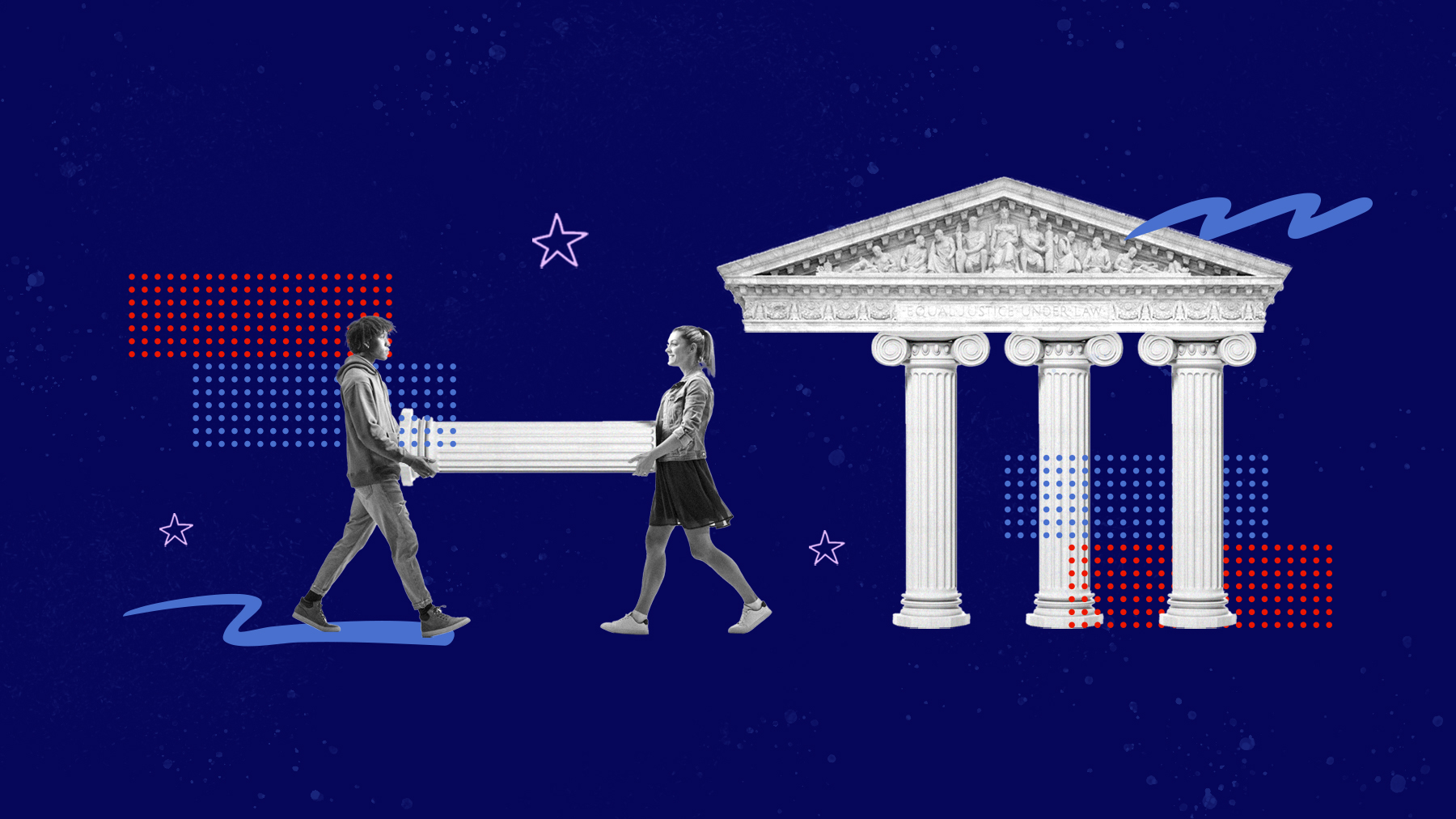
The ideals of democracy are at the core of our shared values and national identity. This resource examines our democratic values as a step in understanding our politics, government and country today. Learn more with LFJ’s Civics for Democracy series.
I. Your Civic Identity — Who Are You? What Is Important to You?
As we become active civic participants in our democracy, we need to examine our own values and identity and make connections to our vision for society.
Values are the beliefs, ideals and principles that guide our decisions and actions and shape our character and outlook on life.
Your Personal Compass
As a personal compass, our values are often influenced by our experiences and social and cultural background and affect how we engage with others and the world in which we live.
Reflect on your values and those of your family and community. What is important to you?
Mind mapping is a visual method to brainstorm and organize information around a central idea, with thoughts radiating outward. Building mind maps around questions can be a helpful visual way to represent your thoughts and make connections.
- Think about principles and ideals (e.g. justice, kindness, honesty, etc.) that have meaning to you. Make a list, then sort and categorize them to identify five primary values that are the core of who you are and are reflected in your decisions, behavior and actions.
- Add a circle around your values, then brainstorm the people, beliefs and cultural traditions, and influences that have shaped your life, who you are, and your values.
- What are the values of your community? Add them in an outer circle to your mind map. To what extent do your values align with those of your community?
II. What Are the Values of Democracy?
What are the consequences of values being reserved for some while excluding others? Consider, for example, the value of “respect” in your community. What if respect was only guaranteed for some — maybe one gender or race; what would that mean for your community?
If a value or idea excludes some people, can it truly be a value of that community or nation?
1. Read “What Are the Values of Democracy?”
2. Reflect, discuss and map your thinking:
- What values connect us and are at the core of our shared national identity? What values guide our ideas about good governments?
- Summarize the definitions of “natural rights” and “popular sovereignty and limited government.” How are these values relevant to the relationship between government and people in society today?
- In our democracy, who has power? Who doesn’t? Historically, who had power and who was excluded from equal participation? How is power related to the tension between exclusion and inclusion?
- Review the section: “Reflecting on Our Democratic Values. ”What resonates with you? Why is the concept of expanding democracy to those previously excluded an essential goal for truly living up to the values of democracy and the foundations of our nation?
- Consider to what extent the values of democracy align with your personal values.
III. What are Fundamental Rights?
1. Read the following excerpt from “Exclusion Is Unconstitutional” by Khiara Bridges (Learning for Justice magazine, Spring 2023):
“The Constitution — the foundational document of American democracy — institutes limits on the will of the political majority. The Bill of Rights — the Constitution’s first 10 amendments — identifies certain fundamental rights that should not be infringed except in the most compelling of circumstances. These rights include the right to practice one’s religion, the freedom to speak, and the right to be free from unreasonable searches and seizures, to name just a few.
“The Supreme Court has interpreted the Constitution as protecting other fundamental rights not explicitly named in the first 10 amendments, like the right to the care, custody, and control of one’s children, the right to access contraception, the freedom to have consensual sex with an adult of the same sex, and the right to marry someone of the same sex.
“The theory behind fundamental rights is that there are aspects of life that are too important to an individual — too central to human dignity — to make the individual’s ability to enjoy them contingent on the outcome of an election.”
2. Reflect, discuss and map your thinking:
- What are some fundamental rights? How are fundamental rights related to human rights?
- Why are not all issues decided by elections or majority popular vote? Why was it important for the Constitution to put limits on majority rule?
- How are ideas of representation, majority rule and mechanisms to protect minorities connected in a democracy?
- How are fundamental rights critical to our democratic values?
3. Read more about “Fundamental Rights” from the Legal Information Institute.
- Go back to the questions above and refine or add to your ideas.
IV. Civic Engagement — Who Are You? What’s Your Story? Who Are Your People?
Movement-building is a collaborative process built around people working together and realizing their power to address issues. It involves identifying a group of people who share common values, transforming them into a community who can work together for a common purpose, and creating commitment for action toward common goals.
1. Watch the short video: “There’s Good People Out There: A Conversation With Charles Person.”
In this 2023 interview, Charles Person, one of the original Freedom Riders of 1961, talks about his experiences during the Civil Rights Movement and offers some recommendations to us today.
- What about Person’s words and experiences resonates with you?
- Based on the interview, what were some of Person’s values? How do Person’s story and his actions reflect his values?
- How did Person connect with others who shared his values to engage in civic action for a common purpose? Who were his people? What were their strengths and resources?
2. Who are you?: Communicating who we are and our values and stories can begin to address “Why me?” “Why us?” “Why now?”
In the movement for justice, our identities play an important role, positioning us in particular ways to undertake this work and make a difference in our communities. Likewise, our community context is important because our communities have different needs and environments in which we are planning action. Knowing our particular community is crucial for success.
- Create an identity chart of all the intersecting aspects of your identity. How do your identities position you for this work? This gets at the question of “Why me?”
3. Our stories matter: Think about the stories from your own life and experiences that illustrate your values and how you acted on those values. Consider where you come from, the people who inspired you, your interests and your life experiences — especially moments in which you made choices or decisions based on your values.
- How do your personal values move you to action? Who are the people, or what are the experiences, that inspire and motivate you?
- Draft your personal story in a format to share (narrative writing, video/audio recording, mind mapping or pictures). How might telling your story and sharing your values help you connect with others for civic action?
4. Who are your people? How would you describe the community (or communities) to which you belong? Who are the people who share your values and interests?
- What does your community celebrate? What do people enjoy? What are your community’s strengths? Who are the resources in your community?
- How can you connect with others in your community? What are some ways to bring people together? What can you do and who can you work with?
5. Research and look for organizations that work to address challenges in your community. Reach out or review their website for ways you can get involved.
V. Living Our Democratic Values
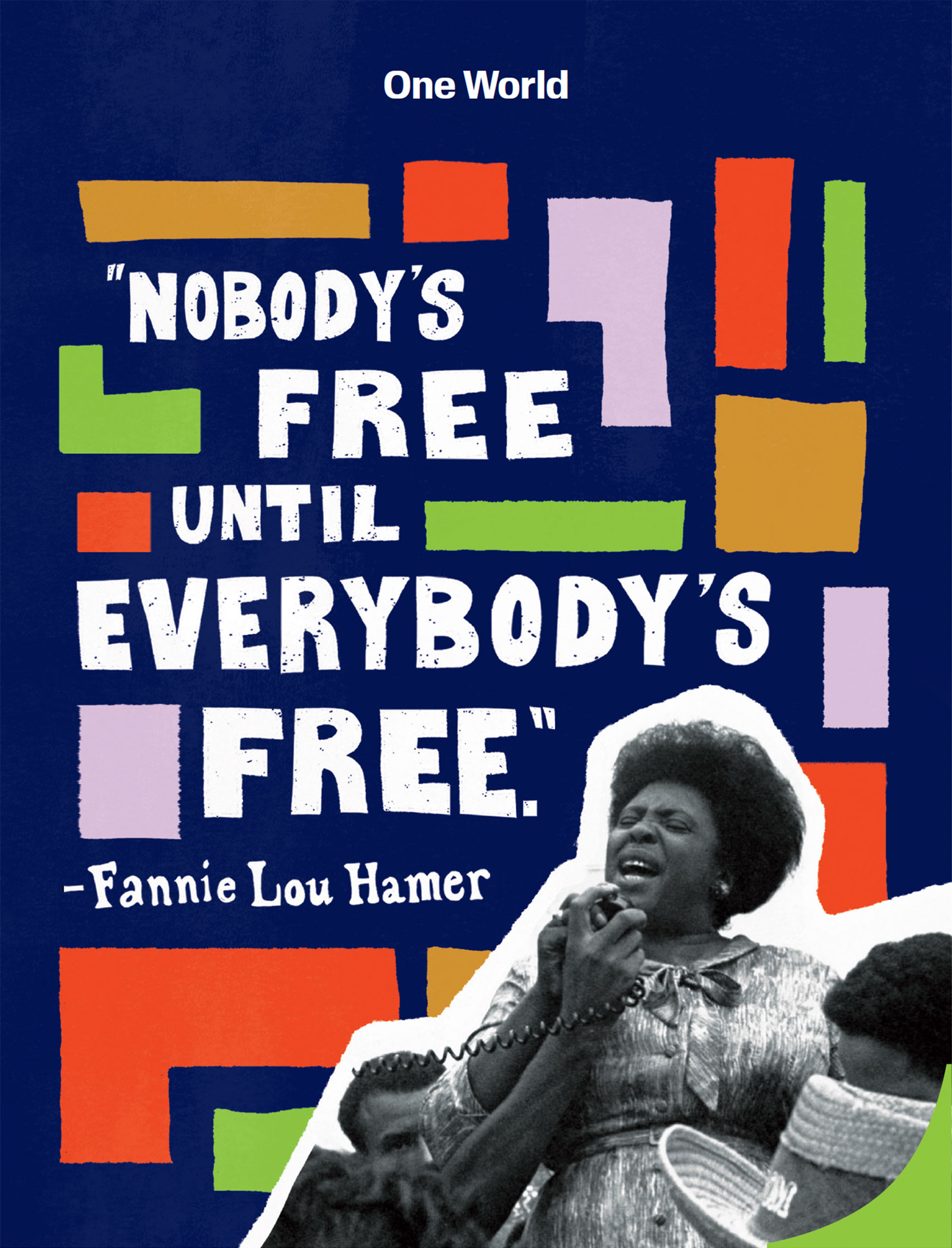
1. Reflect on this poster and quote: “Nobody’s free until everybody’s free.”
Fannie Lou Hamer’s powerful words remind us that in the movement for freedom we are connected to the struggles of others. We must not only advocate for justice on issues that affect us personally, but also on those that affect others in our communities and our nation.
2. Think about the issues and civil rights concerns in your community. Consider the ones that affect you personally or for which you feel strongly connected. Then think about issues that do not affect you but for which you can be an ally.
- How are the issues in your community related to the values that are important for democracy to thrive? How can these issues be addressed to further realize democratic values in practice?
- How are you living your values? How can you take democratic action to help others live democratic values?
- Use our Action Planning Guide to begin planning a civic action project in your community for the common good.