Contextualizing the 1963 March on Washington and the complex history of the struggle associated with it is important as we make connections to the ongoing movement for equality and justice.
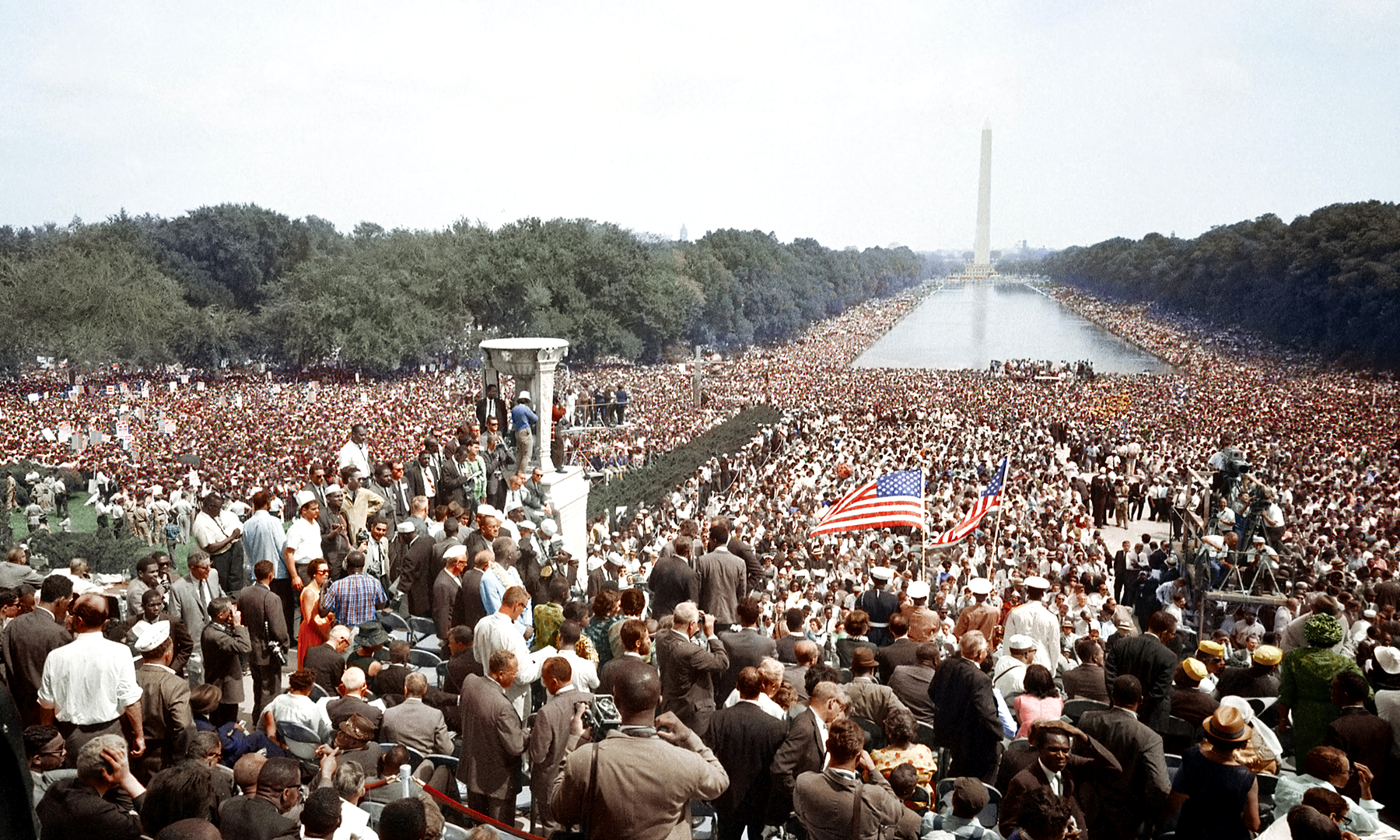
On Aug. 28, 1963, the March on Washington for Jobs and Freedom, during which Martin Luther King Jr. gave his famous “I Have a Dream” speech, drew a crowd of more than 250,000 people from across the United States. The march has become one of the most iconic events from the Civil Rights Movement. Contextualizing the march and the complex history of the struggle associated with it is important as we make connections to the ongoing movement for equality and justice.
Background of the March on Washington
Veteran civil rights activist A. Philip Randolph first put forward the idea for a march on Washington in 1941, during World War II, to address employment discrimination. That march didn’t happen because the threat of a march on the National Mall during the war pressured President Franklin D. Roosevelt to issue Executive Order 8802, which banned discriminatory practices by federal agencies and national defense industries. The idea of such a march, however, remained an important strategy for visibility and galvanizing the Civil Rights Movement.
The 1963 March on Washington was initiated by Randolph, who brought together a coalition of major civil rights organizations: the National Association for the Advancement of Colored People (NAACP), the National Urban League, the Southern Christian Leadership Conference (SCLC), the Conference of Racial Equality (CORE), and the Student Nonviolent Coordinating Committee (SNCC). The goals of civil rights and desegregation were combined with the demands for economic justice.
Organizing the March
Bayard Rustin, a close associate of Randolph’s and an adviser to Martin Luther King Jr., planned and handled the details of organizing the march. Rustin was an experienced civil rights activist and organizer who believed deeply in the power of nonviolent protest. As an openly gay Black man, Rustin faced discrimination, both in society and in the movement, over his sexual orientation.
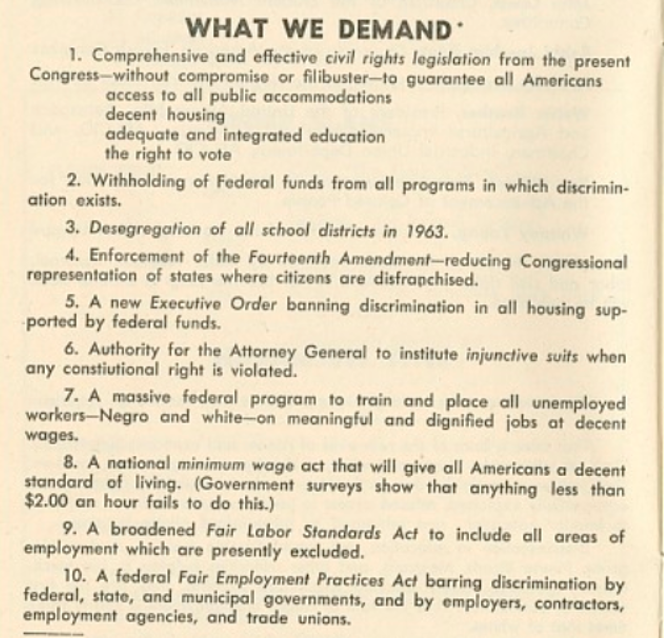
Rustin and his organizing team produced the March on Washington for Jobs and Freedom Organizing Manual, which laid out the philosophical reasons for the march and the goals along with all the practical details for the event. The section “What We Demand” lists the 10 goals of the march, which ranged from demands for legislation to ensure civil rights, access to housing, integrated education and voting; to enforcement of protections against discrimination; to programs for job training, national minimum wage and expanded protections in employment. Economic justice was a foundational demand for the march from Randolph’s initial planning.
The March on Washington for Jobs and Freedom
That summer day at the National Mall shines a spotlight on the strategy of marches and protests to draw attention to the movement.
The march was a high point for many, bringing together people of different races in support of civil rights. Martin Luther King Jr.’s “I Have a Dream” speech was inspiring in eloquently giving an affirmative vision of American democracy. While Martin Luther King Jr.’s speech is the most famous from the march, it is important to remember that the march was not King’s work alone. Along with King, speeches by John Lewis (representing SNCC), Randolph and other male leaders of the major civil rights organizations are often remembered to mark the historic day.
Even though the March on Washington drew a crowd of a quarter of a million people, some people and organizations in the movement dismissed it as ineffective. They argued that while the event helped build white public support for the Civil Rights Act of 1964, it did little to influence congressional votes or to support events on the ground in the freedom struggle. Others have credited the march with helping increase visibility for the movement and adding pressure that resulted in civil rights legislation. Historical analysis will continue, and so too will the lessons learned from the march and the strategies of the organizers.
Women Civil Rights Leaders: Missing Voices
The movement was much more than the March on Washington and the vision of the men who were on the program to speak that day. In thinking about the more complex history, the march is insightful in what was missing that day – the perspectives of women leaders in the movement.
Women movement leaders such as Dorothy Height and Anna Arnold Hedgeman worked to help organize the march and raised concerns about the limited presence of women in the program. Talented leaders and organizers, like Fannie Lou Hamer and Ella Baker, for example, were not included as speakers.
Historical Context: Events in 1963
Finally, several significant events surrounded the march, marking 1963 as a year of dramatic change in the United States. Knowing about key events of 1963, both before and after the march, can help us contextualize the time and the march.
Learning and reflecting on the March on Washington amid this history encourages us to not simply examine famous historical moments in isolation but to consider them in all their complexity and historical context. By doing so, we are encouraged to keep learning more and to connect lessons from the past to challenges of the present.
In exploring the March on Washington and its context in the Civil Rights Movement, we can learn both from the organizing strategies and strengths and from the challenges and missing voices at the march.