The Collapse of American Democracy
Democracy in the United States is not in decline; it is in collapse.
Courts are retreating from the defense of basic civil and human rights. State legislatures are eroding civil protections. Long-standing federal programs meant to level the playing field are being dismantled. Voting rights are being rolled back. Libraries are being censored. Teachers are being silenced. And universities — long presumed to be bastions of critical thinking and civic engagement — are increasingly capitulating to political pressure, purging programs, muzzling faculty, and turning away from the hard work of truth-telling.
American democracy is failing because the institutions designed to serve as guardrails against tyranny — Congress, courts, state legislatures, the press and public education — are crumbling under the weight of a presidency and a conservative movement that have embraced authoritarianism. Rather than serving the people, these institutions are acquiescing to the powerful.
This democracy’s rapid unraveling exposes a fundamental design flaw in the American project — the institutions meant to protect democracy were built to privilege the few at the expense of the many. From the founders’ determination to preserve slavery to the creation of a racial caste system after emancipation, exclusion has been a central feature, not an accident, of American democracy. It is little wonder, then, that institutions designed to serve a narrow elite rather than the broad public are crumbling under authoritarian pressure.
The myth of universal liberty has long obscured how democracy has actually functioned in the U.S. Across history, there has never been a time when all people enjoyed equal rights, equal protection under the law, and equal political power. Instead, the story of American democracy is one of restriction and resistance — long stretches when rights were denied punctuated by brief, hard-fought expansions led by those who refused to accept exclusion. Each expansion was met with backlash, and many gains were rolled back.
The hard history of American democracy is that it was never self-correcting or self-expanding. It grew only through struggle, sacrifice and the relentless determination of those who demanded inclusion.
Three defining moments in U.S. history illustrate this pattern: the Revolution, which proclaimed freedom while preserving slavery; Reconstruction, which expanded basic civil and human rights for African Americans only to have them violently stripped away; and the Civil Rights Movement, which dismantled Jim Crow policies and reimagined the meaning of democracy. Each reveals how those who were most excluded have been democracy’s truest architects, forging progress in the face of fierce opposition.
These three moments of struggle reshaped the meaning of citizenship, liberty and justice. They illustrate that even in the darkest times, ordinary people have found ways to redefine freedom and expand the boundaries of belonging. They also remind us that democracy’s rebirth always depends on those who have been most excluded from it.
We find ourselves in a similar moment now — at another crossroads in the long struggle for justice and inclusion. The idea of multiracial democracy hangs in the balance as forces of exclusion grow more emboldened. Yet within this danger lies a profound possibility: The quick erosion of the institutions that were supposed to safeguard democracy is an invitation to imagine a democracy resilient enough to resist authoritarianism and inclusive enough to serve all.
The past offers the blueprint to build a democracy where power is shared, justice is tangible, and belonging is universal. This is not an abstract exercise in civic nostalgia but an urgent act of construction. The historical analysis that follows traces how previous generations confronted crisis and reshaped democracy’s foundations, revealing not only how the American democratic project has fallen short but how we might, at last, make it whole.
Revolution and Exclusion: Founding Ideals, Founding Betrayals
The American Revolution was full of contradictions, producing the soaring rhetoric of freedom while preserving a brutal system of human bondage. The founders spoke of liberty and equality even as they denied it to the majority of people living within the colonies.
Thomas Jefferson, in the Declaration of Independence, proclaimed that “all men are created equal.” James Madison, the architect of the Constitution, wrote in Federalist No. 10 that a republican government must be built on the consent of the governed. These were radical claims in an age of monarchy. But they were also deeply hypocritical.
Both men were enslavers. Jefferson enslaved more than 600 people in his lifetime. Madison, too, held more than 100 people in bondage. They never intended the Revolution that they championed to include African Americans.
Yet African Americans — free and enslaved — grasped the meaning of the revolutionary rhetoric with extraordinary clarity. They saw not just aspirational ideals but actionable claims. They were not naive and knew the rhetoric was not intended for them. But they perceived a powerful opportunity: The lofty claims of the Revolution could be used to advance abolition.
In 1781 Elizabeth Freeman (Mum Bett) sued for her freedom in Massachusetts, citing the state constitution’s guarantee that “all men are born free and equal.” Her legal claim reflected deep insight into the contradiction between American principles and American practices. She not only secured her own freedom but also helped lay the groundwork for the abolition of slavery in Massachusetts.
In Connecticut in 1779, a group of enslaved African American men petitioned the General Assembly for their freedom, writing, “altho[sic] our Skins are different in Colour, from those who we serve, yet Reason & Revelation join to declare, that we are the Creatures of that God who made of one Blood, and Kindred, all the Nations of the Earth.” They explicitly rejected gradual emancipation proposals, urging instead the immediate abolition of slavery. Their words were a moral indictment of the state’s complicity and a clear demand for justice at that moment, not at some indeterminate time in the future. The General Assembly was unmoved and rejected the petition.
These early acts of resistance, which were neither isolated nor symbolic, reflected a sophisticated understanding of the legal and moral contradictions of the new republic. African Americans saw the hypocrisy of the founding generation and sought to expose it, not with cynicism but with conviction. They were not simply responding to the rhetoric of the founding; they were reshaping it.
Given the opportunity to implement the lofty ideals articulated in the Declaration of Independence, the founders chose not to. Instead, they made a conscious decision to embed white supremacy into the structure of American governance by safeguarding the institution of slavery.
When they drafted the Constitution, the founders codified exclusion into law. The Three-Fifths Clause, the Slave Trade Clause and the Fugitive Slave Clause collectively protected the institution of slavery and magnified the political power of enslavers. By counting enslaved people for representation without granting them rights, delaying the end of the transatlantic slave trade, and mandating the return of freedom seekers to bondage, the framers ensured that white supremacy would be embedded at the nation’s core. The Constitution did not simply tolerate slavery — it protected it at every turn. By safeguarding the interests of enslavers and legitimizing racial domination, the Constitution betrayed the ideals of freedom and equality it claimed to embody.
This contradiction between ideals and implementation must be confronted directly. The choice to enshrine exclusion in the national charter is why each generation since has had to struggle to win rights that should have been guaranteed from the start, and why those rights remain so vulnerable today.
But the local and state-level efforts by African Americans during this era reveal another story — one of political vision and moral clarity. Even in a time of profound contradiction, African Americans seized the moment to push the country toward justice. They engaged the founding documents not as sacred texts to be revered, but as political tools to be wielded.

Civil War and Reconstruction: A Second Reckoning; A Second Retreat
Southern enslavers wielded the Constitution as a political weapon — not to expand justice, but to entrench injustice. They invoked the Fugitive Slave Clause to extend slavery’s reach into free states and fortify its grip across the nation. For them, the Constitution was not a flawed but redeemable document; it was a covenant to protect power and human bondage.
This dynamic fueled the sectional crisis. Seeing their dominance threatened, enslavers seceded, formed the Confederate States of America, and launched a bloody war to preserve and expand slavery. At the war’s outset, President Abraham Lincoln fought not to end slavery but to preserve the Union. His aim was restoration, not transformation. But African Americans — enslaved and free — saw the conflict differently. Amid national rupture, they recognized an opening to redefine the very meaning of freedom and democracy. For them, the war was not about preserving the Union but about remaking it.
Lincoln’s thinking evolved; out of necessity and moral awakening, he began to recast the war’s purpose. In his Gettysburg Address, Lincoln spoke of “a new birth of freedom” and a government “of the people, by the people, for the people.” That shift, combined with the service of nearly 200,000 Black soldiers after the Emancipation Proclamation, helped secure Union victory, the surrender at Appomattox, and the ratification of the 13th Amendment, which abolished slavery.
Reconstruction that followed marked the first attempt at multiracial democracy in the U.S.. The 14th and 15th Amendments extended citizenship, equal protection and voting rights to African Americans, laying the foundation for a new social order. Freedpeople built schools, churches and civic institutions; they ran for office and reimagined public life. Democracy, they understood, required more than rights on paper — it demanded power in practice.
But those who sought to enshrine white supremacy struck back with ferocity. The Ku Klux Klan and other paramilitary groups used terror to dismantle Black political power, while state governments rewrote their constitutions to institutionalize disenfranchisement through poll taxes, literacy tests and grandfather clauses. Federal withdrawal sealed this betrayal. The Supreme Court sanctioned segregation in Plessy v. Ferguson (1896), and by 1900, the South had replaced Reconstruction’s promise with Jim Crow’s oppression.
The result was not merely a setback but a rupture: The dream of a multiracial democracy gave way to American apartheid. Yet African Americans did not relent. Even in defeat, they kept alive the vision of an inclusive republic, passing it forward for the struggles to come.
The Civil Rights Movement: Restoring Democracy
At the dawn of the 20th century, the situation for African Americans was worse than at any point since emancipation. In the South, convict leasing reproduced slavery by another name, while Plessy v. Ferguson (1896) made segregation the law of the land. Voting rights were stripped away through literacy tests and poll taxes, and beyond the South, redlining, employment discrimination, and unequal education reinforced racial inequality under a veneer of legality. Everywhere, state power and white vigilante violence enforced racial hierarchy. The 1955 lynching of 14-year-old Emmett Till was not an isolated act of brutality but a message meant to preserve white supremacy.
Yet amid repression, African Americans renewed the efforts for democracy, armed with new constitutional tools. Slavery was gone, and citizenship and equal protection were enshrined in the 14th Amendment, while the 15th Amendment extended the franchise to Black men. These guarantees — though undermined in practice — provided the legal and moral foundation for a new movement to redefine American democracy.
Central to this modern freedom struggle was a strategy of wielding the Constitution as an instrument for justice. Charles Hamilton Houston and his cadre of Howard-trained lawyers, including Thurgood Marshall, launched a decades-long campaign to dismantle Jim Crow’s legal architecture, culminating in Brown v. Board of Education (1954), which struck down school segregation. But as Martin Luther King Jr. later wrote in “Letter from Birmingham Jail,” courtroom victories were insufficient — it would take mass protest to force the nation to confront its contradictions.
From Montgomery to Nashville, Birmingham to Selma, African Americans used nonviolent direct action to expose injustice and compel federal response. The Montgomery bus boycott, student sit-ins, Freedom Rides, the Birmingham campaign, and the Selma marches forged a blueprint for grassroots organizing and moral pressure that shook the conscience of the nation. These acts of disciplined defiance widened cracks in Jim Crow’s foundation and forced the federal government to act.
At the heart of this movement was political education — a commitment to teaching ordinary people how democracy works and how to claim it. In Septima Clark’s Citizenship Schools and countless community workshops, people studied their constitutional rights, practiced literacy tests and learned how power functioned at every level of government. These programs transformed communities into classrooms and citizens into leaders, making democracy a lived practice rather than an abstract ideal.
The sustained activism of these years yielded sweeping legislation — the Civil Rights Act (1964), the Voting Rights Act (1965), the Immigration and Nationality Act (1965), and the Fair Housing Act (1968). These were not mere anti-discrimination measures; they were structural reforms that expanded who could belong and participate. Though imperfectly enforced, they marked the first time American democracy had legal mechanisms capable of promoting inclusion and protecting rights on a national scale. For a brief moment, the nation moved closer to the promise of equality before the law.
Modern America: Progress and Pushback
The Civil Rights Movement reshaped the very architecture of American democracy. But laws alone are not self-executing: Their power depends on the courage of individuals to act on the rights they confer, as well as the will of government to uphold and enforce them.
African Americans gave meaning and force to civil rights legislation. Over the next several decades, they expanded voter registration work, fought discriminatory election laws and built local political power. But at the same time, Ronald Reagan’s Republican Party — which had become a haven for whites resentful of civil rights gains — led a powerful counterrevolution, in which laws once meant to secure equality were reinterpreted to justify inequity.
The backlash intensified after the election of the nation’s first Black president in 2008. The Tea Party insurgency of 2010 injected a virulent form of racism back into national politics. Republican-controlled states rushed to erect new barriers to voting — most notably voter ID laws, which began in Indiana and quickly spread. These antidemocratic measures were greenlit by a Supreme Court that had veered sharply to the right. In Shelby v. Holder (2013), the court gutted the Voting Rights Act’s oversight provisions, clearing the way for widespread voter suppression. Just as consequentially, the court refused to rule against even the most egregious partisan gerrymanders. The goal of this coordinated campaign wasn’t just to win elections but also to remake democracy by shrinking the electorate and muting the voices of those long denied power.
The conservative campaign to roll back democracy slowed briefly in 2020, when COVID-19 voting accommodations dramatically increased participation and swept liberals and progressives into power. But momentum, and the moment, were soon lost. Since President Donald Trump’s reelection, the federal government has not only abandoned its role as a defender of civil rights and liberties, but has also become the primary agent in dismantling them. The Department of Education has been gutted. The Justice Department has been weaponized against civil rights advocates. Colleges, media outlets and major law firms have been pressured into silence. For the first time in U.S. history, the federal government itself has become the principal threat to democracy.
Laying the Foundation for a New Democracy
Rebuilding democracy requires more than restoration — it demands transformation built on three essential and nonnegotiable principles: inclusive participation, institutional accountability and equitable representation.
These are not just guiding ideas; they are the foundation upon which the new democracy must be built. Every voice must count, and barriers to civic engagement — whether structural, legal or economic — must be dismantled. Power must be transparent and answerable, grounded in public trust rather than private gain. And systems of governance must reflect the full diversity of the nation so every community is represented, and none marginalized.
These principles are not abstract aspirations, but concrete commitments that demand courage and collective will. Achieving them requires more than policy — it requires a radical reimagining of how we understand the purpose and power of government itself.
Building a new democracy begins with a cultural transformation as profound as any constitutional reform: a complete rejection of white supremacy and the exclusionary values that have long defined American life.
This transformation demands that we replace a culture of dominance with one of radical inclusivity in which equity is not an afterthought but the organizing principle of public life. It calls for expanding civic education, protecting an independent press, and reasserting that government exists to ensure justice and belonging for all. Only by shifting our collective understanding of democracy’s purpose — from the preservation of privilege to the pursuit of equality — can we create a system capable of serving everyone.
There is no single route to this democratic renewal. The work will unfold through many pathways, each shaped by local realities and collective imagination. Stacey Abrams, for example, offers one model through her 10-step framework for building a fair and inclusive democracy — focused on voter registration, participation, protection and reform. Her road map is practical and clear, showing that democracy-building is both structural and everyday work.
While the paths may differ, each one must rest on the same bedrock of inclusive participation, institutional accountability and equitable representation. These are the essential conditions for democracy’s rebirth — the solid ground from which a just and lasting democracy can finally rise.
Educators as Architects of the New Democracy
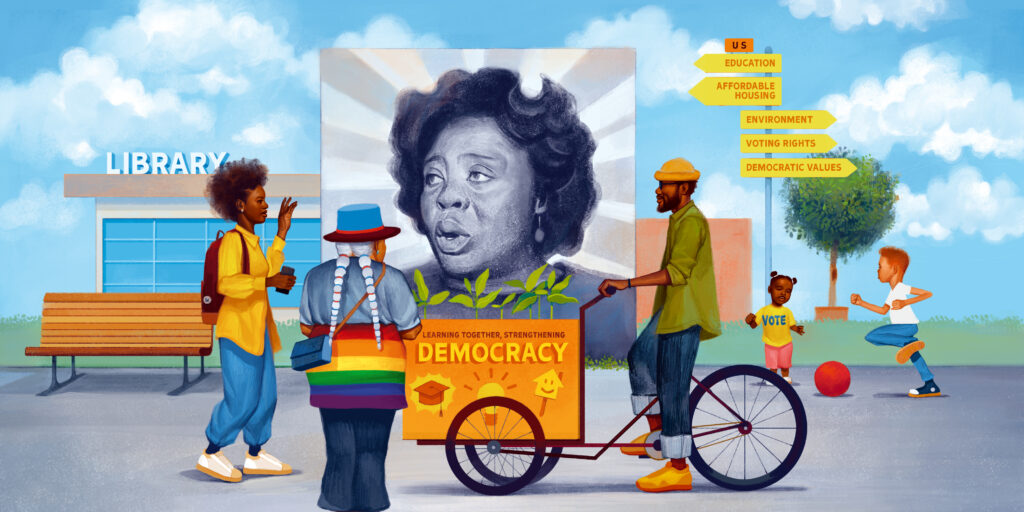
Educators — including teachers, librarians, parents, mentors, artists, storytellers and activists — stand at the forefront of the reconstruction of American democracy. Together, they shape civic imagination and sustain public consciousness. Every lesson taught, every story told, every truth defended helps fortify the foundation of a new democracy.
Teaching, in this expansive sense, is not passive instruction but an act of resistance that challenges false narratives, cultivates critical thinking and prepares people to participate fully in public life.
How we teach, whether in classrooms, community spaces or cultural institutions, shapes our democracy. Education is not merely preparation for citizenship, but citizenship in action. To teach history honestly, to engage students in difficult conversations, to center justice in the act of learning — these are radical acts in an era of pervasive misinformation and disinformation.
Educators hold the blueprint for the new democracy because they teach the very skills and values — critical thought, compassion, cooperation — that democracy requires.
Out of the Ashes
The foundational flaws of American democracy — the exclusions written into its charter and the betrayals embedded in its implementation — have never been fully confronted. They have been patched over, reinterpreted and occasionally challenged, but they have endured and evolved, shaping every generation’s experience of freedom and inequality. This moment of reckoning requires us to confront the full sweep of the story that has brought us here. The rise and collapse of American democracy, its recurring cycles of progress and retreat, demand that we face the truth of how freedom has been defined and denied across generations.
That is why the movement for democracy must be renewed by every generation. We must take our turn in that struggle — to build a new democracy rooted in equity and sustained by the full participation of all people. This work is not symbolic; it is structural. It means expanding the electorate, ending voter suppression, dismantling systemic racism and protecting the rights of every person, regardless of race, gender, immigration status or economic standing.
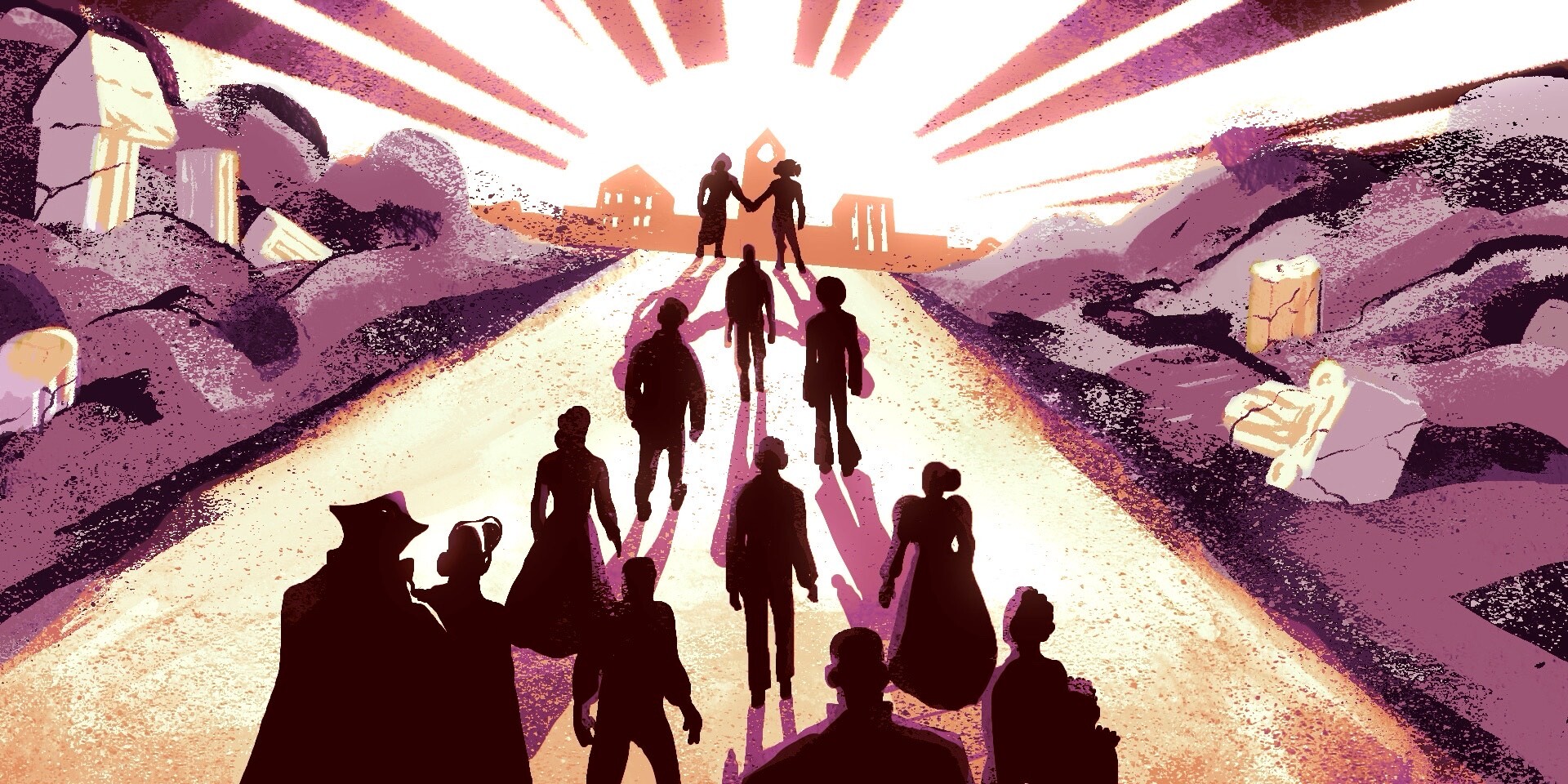
Collapse and creation are inseparable forces in the American story. Every ending carries within it the possibility of a beginning. The task before us is to make that beginning intentional — to build, not merely to recover. The collapse of the old order has opened space for creation, giving us the rare opportunity to imagine a democracy that has never yet existed, one grounded in inclusion, equity and shared power.
This moment demands more than faith in renewal; it requires our collective resolve to construct something that transcends what came before. Collapse and creation are not cycles to endure but forces to harness, calling us to envision a democracy that finally fulfills the promises so long deferred. The work ahead is not restoration but invention.
Out of the ashes, something new can and must rise — built by those with the courage to imagine what has never been and the will to make it real.
Democracy for the 21st century
Our nation’s 250th anniversary challenges us to imagine and build a more inclusive and resilient democracy for the next generation and beyond.
This first volume of the new Learning for Justice Anthology examines the foundations and future of democracy in the United States and education’s crucial role in building a more inclusive multiracial society that expands opportunities for civic and political participation. This volume offers articles to frame the conversation, an introductory civics and democracy course and additional resources for learning and teaching.