
The tension between exclusion and inclusion — between the compromises that denied freedom to some and the struggles to ensure our country truly lives up to the ideals of democracy and equality for all — is built into the nation’s foundation.
Hasan Kwame Jeffries, Ph.D., emphasizes that “Building a new democracy begins with a cultural transformation as profound as any constitutional reform: a complete rejection of white supremacy and the exclusionary values that have long defined American life.”
So, how do we build a democracy that includes rather than excludes? How can historical models and freedom struggles guide us in understanding citizenship and belonging? And why must we understand our past to contextualize current events today?
In this module, participants will engage in critical thinking, reflection, dialogue and concrete practice to:
- Discuss ideas of belonging, inclusion and exclusion, and citizenship
- Define democracy and evaluate to what extent the United States has lived up to its democratic principles
- Analyze the ways those most affected by exclusion sought to expand the boundaries of belonging
I. Liberation Dreaming: Belonging
“Without new visions we don’t know what to build, only what to knock down. We not only end up confused, rudderless, and cynical, but we forget that making a revolution is not a series of clever maneuvers and tactics but a process that can and must transform us.”
— Robin D.G. Kelley, Freedom Dreams: The Black Radical Imagination
Can you envision a society in which everyone belongs even as our differences are respected and our diversity is celebrated — an inclusive democracy?
Liberation or freedom dreaming (based on the writings of Robin D.G. Kelley, Ph.D.) encourages us to imagine the future we want to build and apply the resources to make our vision a reality. It is the idea of focusing on what we are for instead of what we are against. So, let’s practice community liberation dreaming with the idea of belonging.
1. What does it mean to belong? Map out a list of spaces and groups in which you feel a sense of belonging. What makes you feel like you belong?
- Reflect and discuss. How are people included in families, local communities, or at the national level?
- In what ways are people excluded? Consider, for example, how race or ethnicity, gender, sexual orientation and LGBTQ+ identity, disability, class or socioeconomic background, religion, and immigration status affect inclusion and exclusion in our communities and country.
- Why is belonging important? To what extent is belonging essential to a democratic society?
2. Imagine and plan an inclusive community that fosters belonging.
- Envision your community as an inclusive space that fosters belonging for everyone while respecting our differences.
- What would your community look like? How would it function? What characteristics are important for inclusiveness? Feel free to think creatively using images, words, narrative, art, or prose to express your ideas.
II. Connecting Through Shared Values
1. How does the golden rule relate to ideas of being “inclusive” versus “exclusive”?
Reflect, discuss and map your thinking about the golden rule: “Treat others the way you would like to be treated.”
- How is this rule connected to Dr. Martin Luther King’s principle of “sameness made legal” (just laws that apply to both majority and minority groups with equal benefits and consequences) versus “difference made legal” (unjust laws that target a minority group or those who had no vote in the law)?
- In our daily lives, we make many decisions about which groups we choose to belong to, or who to include in our private social circle. How are our private feelings and beliefs separate from the public application of law and civil rights?
- What are some current examples of just and unjust laws? Consider who is affected and the purpose of the law. And consider Dr. King’s statement that “Sometimes a law is just on its face and unjust in its application.”
- How does injustice (either through unjust laws or unjust application of laws) create a sense of not belonging?
2. Elaborating on the golden rule. Reflect on and discuss the following ideas that elaborate on the golden rule.
What we want for ourselves and our families (e.g. rights and liberties, protections, economic benefits, opportunities, and more), we should want for others.
The freedoms and benefits we have in society, we should demand and ensure for others. This holds especially true if we belong to a majority group in relation to an issue and have the privileges of that status.
Based on the above ideas elaborating on the golden rule, what are our responsibilities as individuals and communities to one another?
The golden rule alone is not sufficient for addressing systemic injustices. But it’s a starting point for reflecting on empathy and considering our responsibilities in recognizing injustice.
3. Analyzing Dr. Martin Luther King’s ideas on mutuality and justice. Read the quote from “Letter from Birmingham Jail (1963).”
“Injustice anywhere is a threat to justice everywhere. We are caught in an inescapable network of mutuality, tied in a single garment of destiny. Whatever affects one directly, affects all indirectly.”
- Discuss and explain the concept of “mutuality.” What does Dr. King mean in the quote above?
- Reflect, discuss and map your thinking: How is this idea relevant to issues of just and unjust laws and current events?
III. Defining Democracy
1. How would you define democracy?
- Watch the short video: “Conversation with Margaret Huang, former president and CEO of the Southern Poverty Law Center” for some ideas about democracy and our communities.
- Research descriptions of democracy from people and organizations that value democracy. Here are a few resources to consider: “A Time of Transformation and Possibility” by Margaret Huang; “Reflections on a Dream Deferred” by John Lewis; United Nations, Global Issues: Democracy page; Freedom House, Perspectives: “What Is Democracy, and Why Does Defending It Matter?” by Nicole Bibbins Sedaca.
- Draft a definition of democracy that captures the relationship between government and people. Compare your definition to the discussions of democracy in the resources above.
IV. Evaluating and Strengthening Democracy
1. To what extent is the United States living up to its democratic principles?
- Review the section “Elements of a Thriving Democracy” from “What are the Values of Democracy?” and the characteristics excerpted from United Nations.
- For each crucial element of a thriving democracy listed, discuss and evaluate to what extent the U.S. — and/or more specifically, your state and community — honors these characteristics.
2. How is exclusion unjust? What’s the impact of exclusion?
Exclusion does not only involve not including someone physically in an activity or event. It can also be censorship or silencing of a community’s history, a family’s culture, or the people’s experiences and narratives. Exclusion can also mean inviting people into spaces but not accommodating their needs, thus preventing full participation.
And, importantly, exclusion involves laws that target historically marginalized communities or the unequal application of laws and protections.
- Discuss and map your thinking: What are some examples of exclusion in the U.S. today?
3. Review the video interview with Margaret Huang in which she provides ideas for developing and sustaining a healthy democracy and strong communities.
- What does Huang offer as ideas towards an “inclusive democracy” that benefits all people? (00:47) How do you see the role of civics education in an inclusive, multiracial democracy? (01:35)
- (At 02:08), Margaret is asked, “What elements of democracy would you like to see lifted up in regard to civics literacy?” Discuss how the following ideas put forth can provide more inclusivity in our democratic society today and in the future:
“We need residents to engage in dialogue with our elected officials”
“We need citizens to participate in the electoral process by observing elections, by serving as election administration officials, by running for public office.”
4. To what extent are you and your community helping to further democratic principles?
- What are some challenges to democracy in your community?
- What civic actions can you take to strengthen the elements necessary for a thriving democracy? (Consider, for example, how you engage with media and information: Are you careful about engaging with accurate information? Are you conscientious about not spreading disinformation?)
- What are some ways you can collaborate with others in your community to strengthen one of the elements of a thriving democracy?
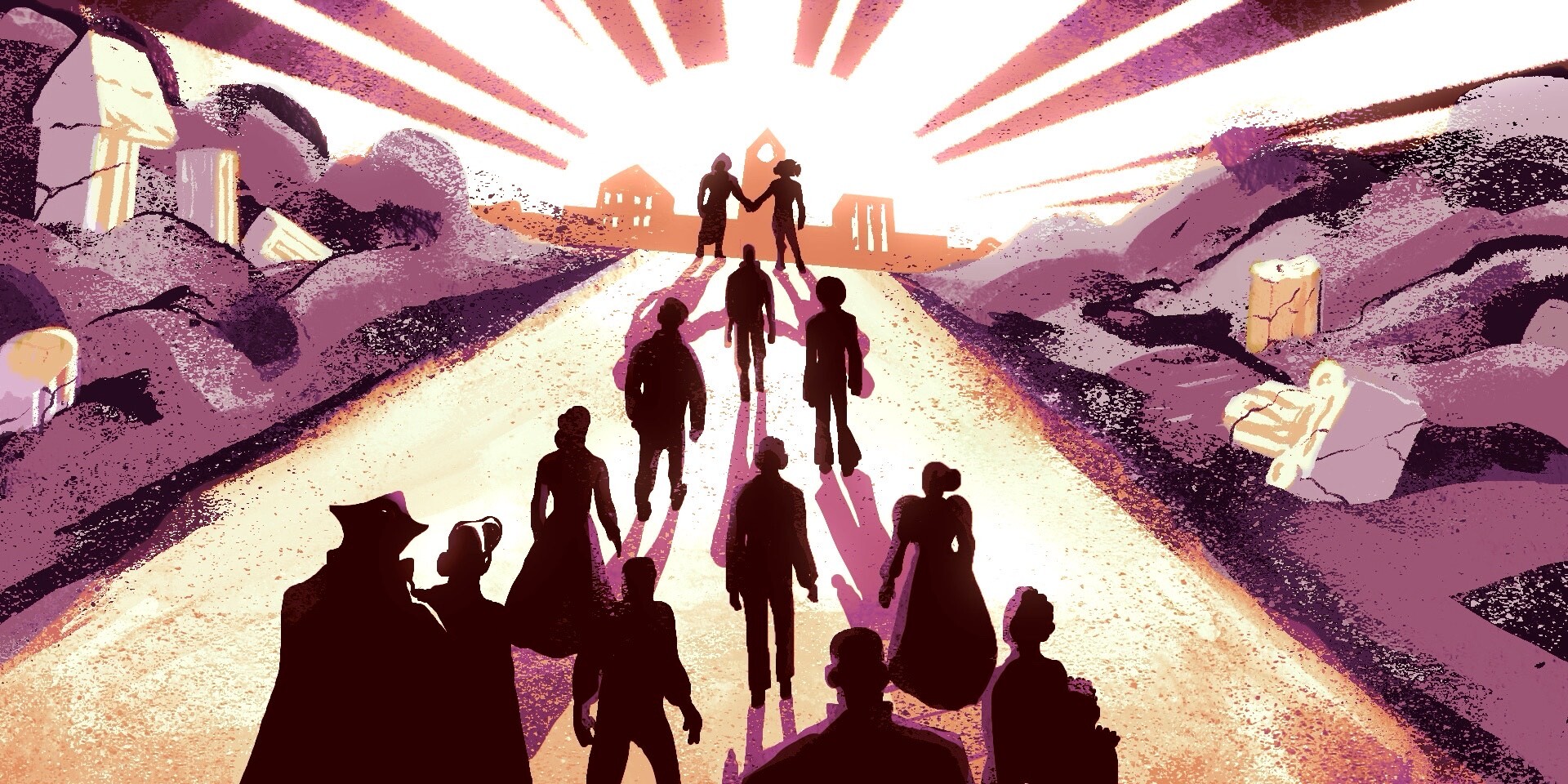
The erosion of institutions to safeguard democracy is an invitation to imagine a new democracy resilient enough to resist authoritarianism and inclusive enough to serve all.
V. Building a Democracy for the 21st Century
How can historical models and freedom struggles guide us in understanding citizenship, belonging and democracy?
1. Read “Out of the Ashes: Building a New American Democracy” by Hasan Kwame Jefferies.
- As you read, watch for themes across time periods and ways that the specific periods connect to each other. Make note (or highlight) how people excluded by the system sought to reshape democracy for all.
- In what ways did each of the three periods demonstrate the contradictions between ideals and reality? How do you see these contradictions in society today?
2. Democracy’s truest architects: Throughout the nation’s 250-year history, the actions of ordinary people have shaped — and continue to shape — democracy in the U.S.
- Read the following excerpt. How does Elizabeth Freeman’s case exemplify agency, education and dedication toward a more just society?
“In 1781 Elizabeth Freeman (Mum Bett) sued for her freedom in Massachusetts, citing the state constitution’s guarantee that ‘all men are born free and equal.’ Her legal claim reflected deep insight into the contradiction between American principles and American practices. She not only secured her own freedom but also helped lay the groundwork for the abolition of slavery in Massachusetts.” - Reflect, discuss and map out your thinking: In each of the three historical periods (Revolution, Reconstruction, and Civil Rights Movement), how did ordinary people “expand the boundaries of belonging?”
- What are some examples of ways the most excluded have been “democracy’s truest architects, forging progress in the face of fierce opposition”? What can we learn from their actions for our lives today?
Visit the Teaching Hard History podcast, Season 1, Episode 10: Slavery in the Constitution, with host Hasan Kwame Jefferies and guest Paul Finkelman. As you listen or read, look for examples of how the system was designed to be exclusionary and ways that those excluded stood up for an inclusive democracy.
3. Laying the Foundations of a New Democracy: What is needed for democracy to thrive in the 21st century and beyond?
“Out of the ashes, something new can and must rise — built by those with the courage to imagine what has never been and the will to make it real.”
- Dr. Jeffries points out “the institutions meant to protect democracy were built to privilege the few at the expense of the many.” He mentions historical examples, but how do institutions privilege certain groups today?
- Reflect on the problems with having a government that privileges the few. What are the issues that arise for you?
- Reread the section “Laying the Foundation for a New Democracy.” What do each of the three nonnegotiable principles (inclusive participation, institutional accountability and equitable representation) mean to you?
- Collaborate in a group to map out ideas for a 10-step plan for building an inclusive democracy. Consider the elements of a thriving democracy and Dr. Jeffries’ three nonnegotiable principles. You may also consider frameworks such as the one proposed by Stacey Abrams. What are your key ideas for what is needed?
4. Think about the ideas of belonging and citizenship: Reflect on what history tells us about belonging and who can be a citizen. How do you see these connections to history within our society today?
- How is the struggle for inclusion still ongoing? Consider what communities and groups are still demanding full inclusion and who is still excluded.
- Extend your learning: Research changes in citizenship and political participation laws in the U.S. How have historical movements for inclusion expanded democratic participation to previously excluded groups?
4. Revisit your definition of democracy. Has your definition changed after reading “Out of the Ashes?” If so, how? If not, discuss how the article aligns with your definition and understanding of democracy.
- Engage in an exercise of liberation dreaming. What does a new, more inclusive democracy in the U.S. look like to you? Feel free to think creatively using images, words, narrative, art, or prose to express your ideas about a democracy grounded in inclusion, equity, and shared power.