
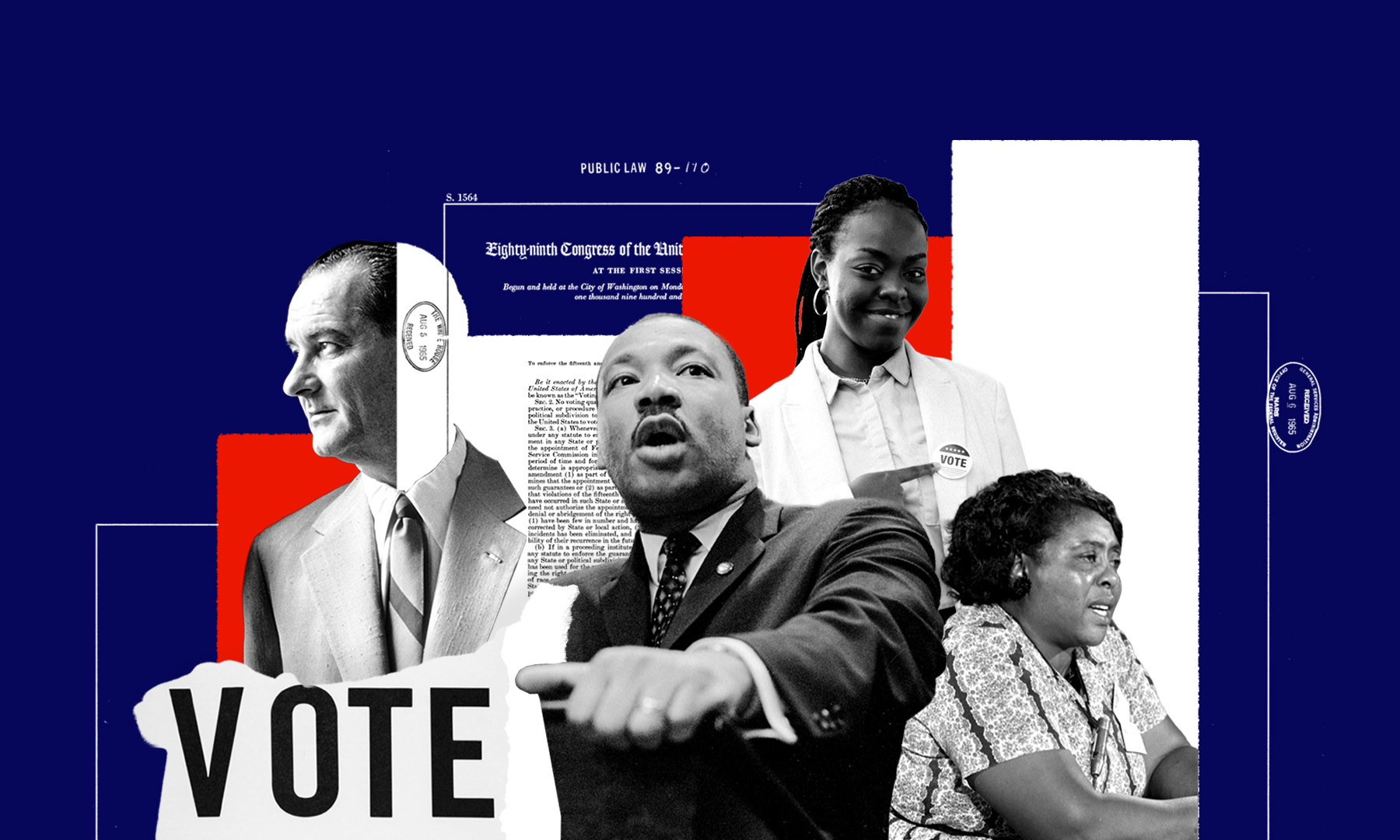
In April 2026, the U.S. Supreme Court’s ruling in Louisiana v. Callais severely weakened crucial protections of the 1965 Voting Rights Act (VRA). In her dissent to the court’s decision, Justice Elena Kagan emphasizes that this decision will allow states to “systematically dilute minority citizens’ voting power.”
Following this decision, conservative legislators in several Southern states quickly moved to weaken the representation rights of Black Americans and other communities of color. In Tennessee, just one week after the court’s ruling, the state’s majority conservative legislature passed a new congressional map signed by Gov. Bill Lee that splits up Memphis, the state’s only majority-Black and Democrat-held U.S. House seat, thus diluting Black Americans’ political power.
As Justice Kagan points out, the Louisiana v. Callais decision is not only about the specific district in Louisiana but also “the many other districts, particularly in the South, that in the last half-century have given minority citizens, and particularly African Americans, a meaningful political voice. … If other states follow Louisiana’s lead, the minority citizens residing there will no longer have an equal opportunity to elect candidates of their choice. And minority representation in government institutions will sharply decline.”
The 1965 Voting Rights Act (VRA) is a landmark federal law and a significant victory of the Civil Rights Movement. Enacted to remove the barriers of racist Jim Crow era policies, the VRA affirmed the right to vote for millions of African Americans. Enforcement of this law expanded political opportunities for Black Americans and other people of color.
But as more diverse and pluralistic participation in politics and society has increased, conservative backlash against equality and attacks on voting rights and the VRA have also intensified. For over a decade, the Supreme Court has gutted significant provisions of the VRA, resulting in increasing voter suppression. Louisiana v. Callais is the latest court decision to erase gains in voting rights and the political representation of Black Americans and other communities of color.
We need to not only reinstate the protections of the VRA but also strengthen voting rights to achieve a thriving democracy in the United States. The VRA is more than a legacy of the Civil Rights Movement; it remains essential for ensuring equal access to the ballot.
Understanding the VRA’s protections and why they remain so important is a first step. Why was the Voting Rights Act enacted? What are the VRA’s essential protections? And why is the VRA crucial for democracy today?
Historical Background: Why Was the Voting Rights Act Enacted?
Black Americans have continuously engaged in a long and arduous struggle for equal participation in our nation. An essential point in the Teaching the Civil Rights Movement framework emphasizes: “As a response to African Americans gaining political power during Reconstruction, Southern states systematically disenfranchised Black voters by rewriting state constitutions to include a wide range of new legal measures, such as poll taxes and literacy tests, designed to restrict access to the ballot.”
Despite its ratification in 1870, the 15th Amendment was ignored after Reconstruction ended in 1877, and many states instituted policies and Black Codes to restrict Black Americans’ freedom and disenfranchise Black voters. In addition to discriminatory laws and segregation policies, organized white groups, particularly the Ku Klux Klan, used intimidation and violence to reinforce white supremacy. Black voters who tried to vote were often turned away from the polls or faced violence. For example, in Ocoee, Florida, on Election Day in 1920, Black Americans’ attempt to vote was met with murderous violence and a rampage of destruction that became known as the Ocoee Massacre.
In the decades after Reconstruction, Black Americans were not passive; they engaged in a long struggle for freedom and equality against institutionalized white supremacy that reached a pivotal moment in the Civil Rights Movement of the 1950s and ’60s. Nonviolent action during the Civil Rights Movement was central to the effectiveness of the struggle for equality. Organizers across the South tirelessly pressured local, state and federal governments for much-needed reform. In 1964, the Freedom Summer project sought to bring attention to the dire situation in the South, especially in Mississippi. Freedom Summer activists’ efforts were met with hostile opposition from the white community, including several murders.
The struggle for equal access to the ballot culminated during the march from Selma to Montgomery, Alabama, in March 1965. There, peaceful marchers were attacked by police while crossing the Edmund Pettus Bridge as news crews recorded the violence. These brutal assaults left many severely injured, including women and children, and became known as Bloody Sunday.
Coverage of these events left the nation shocked and outraged, prompting President Lyndon Johnson to urge immediate national action from Congress. In his address to Congress, Johnson declared: “Many of the issues of civil rights are very complex and most difficult. But about this there can and should be no argument: Every American citizen must have an equal right to vote. There is no reason which can excuse the denial of that right. There is no duty which weighs more heavily on us than the duty we must ensure that right.”
The outcome of that struggle was the Voting Rights Act of 1965, which was signed into law on Aug. 6, 1965, one day after its bipartisan passage in Congress. The VRA moved the onus to comply with federal law to the states and placed extra oversight on states with an egregious history of discriminatory behavior.
Essential Protections of the Voting Rights Act of 1965
The VRA banned racial discrimination in voting policies and practices and included provisions to ensure that states act in accordance with the 15th Amendment, which prohibited federal or state governments from denying the right to vote based on race.
As scholar and author Carol Anderson points out in her book One Person, No Vote: How Voter Suppression Is Destroying Our Democracy, the VRA was proactive in its protections: “Rather than waiting for locales to violate voting rights and for people to make formal complaints, the VRA put the responsibility for obeying the Constitution onto state and local governments.”
- Section 5 of the VRA requires states with a history of racial discrimination to receive approval — a process known as “preclearance” — from the Department of Justice or United States District Court for the District of Columbia prior to implementing any changes in voting laws.
- The formula for states to be placed under the scrutiny of obtaining preclearance for new voting laws is established in Section 4 of the VRA, and the formula focuses on jurisdictions with a severe history of discriminatory practices.
- In the decades after the passage of the VRA, Section 5 has consistently prevented changes in the law and redistricting that would have adversely affected Black and Brown communities. Between 1965 and 2006, the DOJ blocked more than 1,000 proposed changes to voting laws.
- Section 2 of the VRA prohibits voting policies and practices that deny or abridge the right to vote based on race or color. In 1982, Congress amended Section 2 to clarify and strengthen protections. This section allows for court challenges against any voting laws that may be racially discriminatory.
- The interpretation of Section 2 has allowed for lawsuits brought by individuals or with the assistance of the Department of Justice. The right of individuals to sue is critical to ensuring voting rights. This ability has allowed people (separate from the Justice Department) to challenge racially discriminatory voting policies in many states since the enactment of the VRA in 1965.
The VRA was successful in protecting citizens against state and local policies that attempted to restrict or dilute the voting strengths of Black and Brown communities. The latest reauthorization of the VRA — known as the Fannie Lou Hamer, Rosa Parks, and Coretta Scott King Voting Rights Act Reauthorization and Amendments Act of 2006 — acknowledged the progress made toward voting rights for all voters but also sought to address continued obstacles.
Attacks on Voting Rights: How the Supreme Court and Congress Are Weakening the VRA
Current attempts at voter suppression and policies with racially disproportionate impact are a serious challenge to the future of democracy in the U.S. Significant provisions of the VRA were gutted by the Supreme Court decisions in the 2013 Shelby County v. Holder, 2021 Brnovich v. Democratic National Committee and 2026 Louisiana v. Callais cases.
The Supreme Court ruling in Shelby County v. Holder struck down the formula used for preclearance, effectively making Section 5 inoperable. Following this ruling, new voting policies were quickly passed in states previously under Section 5 scrutiny. These new rules have led to a quick reversal in the voter turnout trend that saw the gap narrowed significantly. It was no accident that the white voter turnout quickly surpassed that of Black voters by over 15 percentage points.
And voter suppression efforts have continued to intensify, with recent laws to make absentee and vote-by-mail harder, purge voting rolls, and create challenges to access to the ballot. Without the formula and application of Section 5 of the VRA, civil rights groups have relied on Section 2 to bring litigation to protect voting rights. However, in 2021, the Supreme Court’s ruling in Brnovich v. Democratic National Committee severely weakened the VRA by making it more difficult to challenge discriminatory voting laws in court under Section 2.
Attempts to weaken protections continued with the 2025 Safeguard American Voter Eligibility Act, or SAVE Act, a “dangerous and deceptive legislation in Congress that would make it harder for millions of eligible people to register and vote, year after year.” Additionally, restrictive voter registration policies threaten Black Americans’ civil rights advocacy and the traditions of voter registration drives in many communities of color.
With the 2026 ruling in Louisiana v. Callais, Justice Kagan points out: “Under the Court’s new view of Section 2, a state can, without legal consequence, systematically dilute minority citizens’ voting power.” The decision opens the door to widespread gerrymandering that will disenfranchise voters — especially Black Americans in the South.
Our Votes Matter
The ongoing attacks on the 1965 Voting Rights Act and the state-level actions to weaken the political representation of Black Americans remind us of where we’ve been and the struggles ahead to ensure voting rights for all citizens. The late Rep. John Lewis emphasized: “The vote is precious. It is almost sacred. It is the most powerful nonviolent tool we have in a democracy.”
The Voting Rights Act is the legacy of civil rights activists and the ordinary people who participated through nonviolent action in the Civil Rights Movement, often risking their lives in the struggle for equal access to the ballot. We must continue to build on and strengthen that legacy. Our nation has yet to live up to the full potential of the values of democracy. The VRA and our continued efforts to ensure equality in civic and political participation move us closer to the ideals of a thriving democracy.
In addition to reinstating the protections of the VRA, our country needs stronger legislation to protect voting rights and representation. Learning accurate and honest history is important to understanding how historical context affects today’s reality so we can build a more resilient democracy.
In the face of intensified threats to voting rights and the continued efforts to erode the protections of the VRA, apathy is not an option.
Page updated May 2026.