
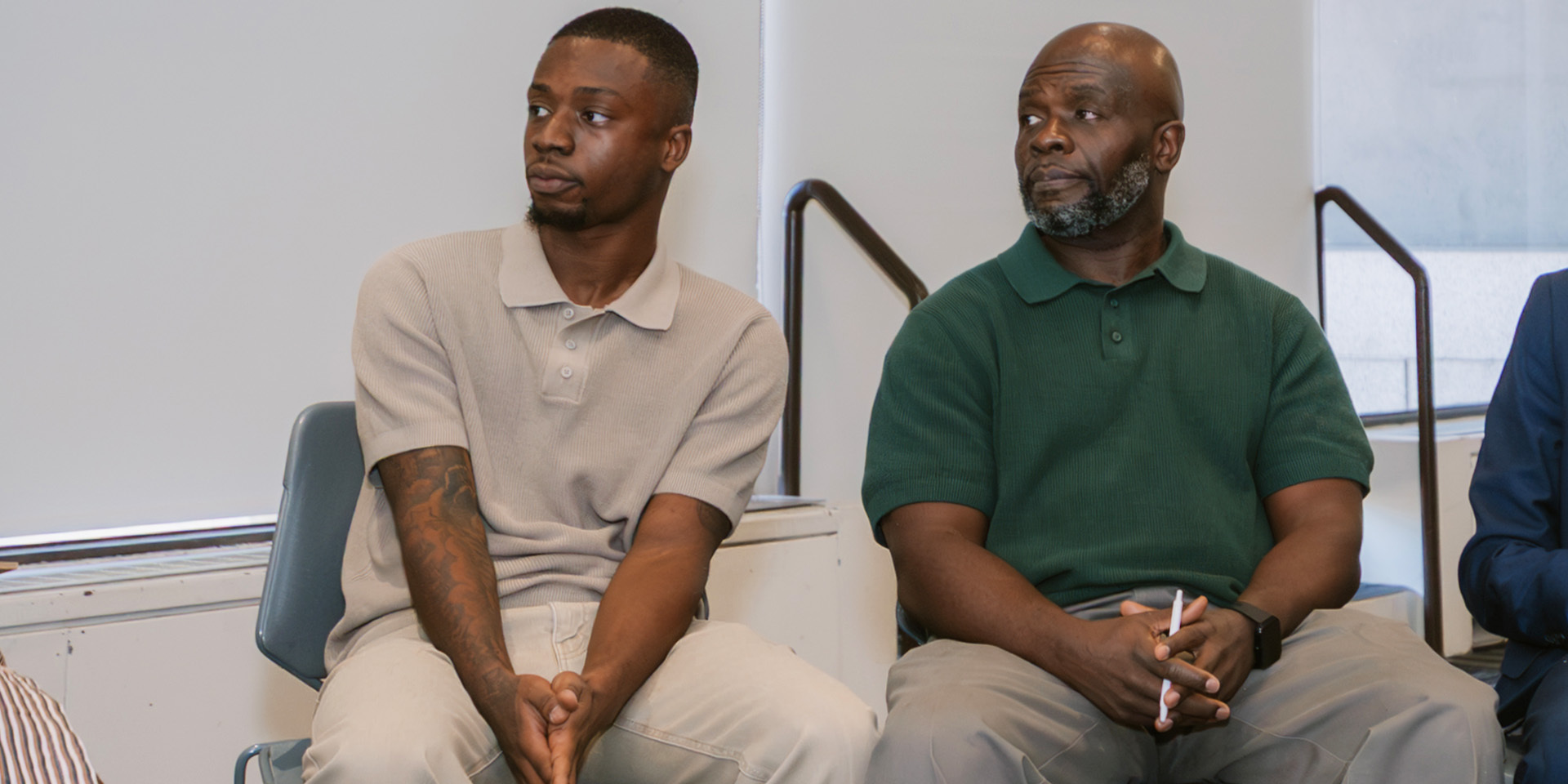
There aren’t many people who can say that they’ve had an audience at the United Nations. But at 20 years old, CJ Jones has done it twice — on two different continents.
Last year, he flew from Tuscaloosa, Alabama, to Geneva, Switzerland, to address the U.N. Permanent Forum on People of African Descent with a delegation from the Southern Poverty Law Center.
Then in October, he landed in New York City and went to midtown Manhattan. There, he spoke on a panel for Youth Voices for Justice, a collaboration between the SPLC, Children’s Rights and the National Homelessness Law Center.
Jones had traveled to the U.N. to share the story of the worst thing that had ever happened to him. In 2022, he was forced out of his Alabama high school and denied a college scholarship because of a lopsided and unjust disciplinary system that disproportionately punishes and sidelines Black students.
But he had not come to the U.N. to wallow in the suffering and losses that decision had caused him. He had come to fight.
“I’m not a quitter,” Jones said.
In the video: CJ Jones and his father, Cory Jones Sr., recount their ordeal dealing with a drug allegation brought up by school officials in Tuscaloosa, Alabama, when CJ was a high school senior, during an October 2025 United Nations side event held in collaboration with the National Homelessness Law Center in New York.
Three years later, he’s achieved something else that he never imagined. Jones helped to get a bill passed through the Alabama Legislature that gives students the right to appeal school punishment and have legal representation — a right he never had.
“Instead of letting this event take him down, CJ has used his experience to speak up for others and bring light to systemic racial discrimination in school systems,” said Léocadia Tchouaffé, a policy and human rights fellow at the SPLC.
Jones has continued to press forward. In September, he began taking courses at a local community college. He plans to get a commercial driver’s license that will allow him to zigzag across states on cross-country missions with the hope of one day striking out on his own.
“It’s something I always wanted to do,” he said. “Get my own 18-wheeler, be a dispatcher for myself and own my own business.”
For Jones, it’s a new beginning in a years-long ordeal that could have derailed his life. For generations, Black youth like Jones — particularly in the Deep South — have been overly criminalized, pushed out of school without due process and given harsher punishments than their white counterparts, as detailed in the SPLC’s Only Young Once reports.
Arbitrarily suspended
Tuscaloosa school officials suspended Jones in November 2022 after they found a small amount of marijuana in a car parked on school grounds. They took punitive action against him even though he had only been a passenger in the car and they had found no evidence that he consumed or was in possession of marijuana — and despite the glaring fact that police had charged another student for the offense.
Without a right to appeal the decision or have a lawyer present, Jones languished in suspension for more than two months. He missed required classes and was barred from baseball practice.
Eventually, school administrators ordered him to finish out the year at an alternative school program. These schools typically lack adequate teachers and resources, becoming a dumping ground for students who are seen as difficult or disruptive.

In Alabama, Black students are disproportionately pushed into alternative school programs. An AL.com analysis of Alabama educational data found that in the 2018-19 school year, Black students were almost twice as likely to face every type of classroom removal as their white counterparts. Jones lost a college scholarship to play baseball, a sport that he loves, and the opportunity to graduate with his friends and classmates.
With the help of his father, Cory Jones Sr., the younger Jones fought back. His parents home-schooled him through an online program so he could finish out his senior year by earning his high school diploma. He filed a lawsuit against Tuscaloosa City Schools, alleging that he had been “unlawfully and arbitrarily suspended.” The case is still pending.
Jones Sr. made clear that he saw the connection between administrators’ attempts to push his son out of public school and the school-to-prison-pipeline, which forces mostly Black and Brown children and children with disabilities out of schools and into the justice system through suspensions, expulsions and other punitive measures.
“I saw what the system could do to your child,” said Jones Sr., speaking alongside his son at the Youth Voices for Justice panel discussion last month. “I’m reliving the memories of what we had to go through and what happened, and how they were going to take my son’s life to fill a prison.”
Moving forward
Before Alabama passed HB 188 on May 8, 2024, it was the only state in the Southeast that did not have statutory due process protections for students facing long-term suspension or expulsion. Before the law’s passage, each school district set its own policies. Bills filed to standardize due process in schools in the 2023, 2022 and 2021 legislative sessions had all failed to pass.
Advocates, legislators and private citizens like Jones and his father who publicly shared their experiences on a national and global stage worked tirelessly for years to eventually make it possible.
This Nov. 7 should have marked the U.S.’ fourth Universal Periodic Review at the U.N., a measure the U.N. Human Rights Council undertakes every five years to review each member state’s record on human rights. The Trump administration pulled out as a U.N. Human Rights Council member state — a reminder of the necessary work ahead as numerous federal civil rights protections come under fire or challenge from the current administration. A growing number of agencies are federally deputized to question, detain and arrest people with broad discretion in communities across the country.
“The world is watching,” said Tchouaffé, the SPLC policy fellow. “The SPLC being involved in this international advocacy is part of a larger role of us pushing back against the policy decisions of this current administration. Advocating for and with CJ on racial injustice, as well as pushing for more equitable policy, is extremely important because SPLC has always seen plainly that racial inequities are in fact human rights violations.”
For Jones, the worst moment of his life became an opportunity to create change, to become an advocate and to consider the many who have fallen by the wayside.
“I think about the people who have gone through worse than me,” he said. “I have my days when I just sit and think about it and I get stuck, but my life is moving forward. I’ve moved forward.”
Image at top: During a panel for Youth Voices for Justice in New York City in October 2025, CJ Jones, left, and his father, Cory Jones Sr., speak about CJ’s experience being pushed out of high school in Alabama after he was falsely accused of marijuana possession. (Credit: Matthew Echelman)