
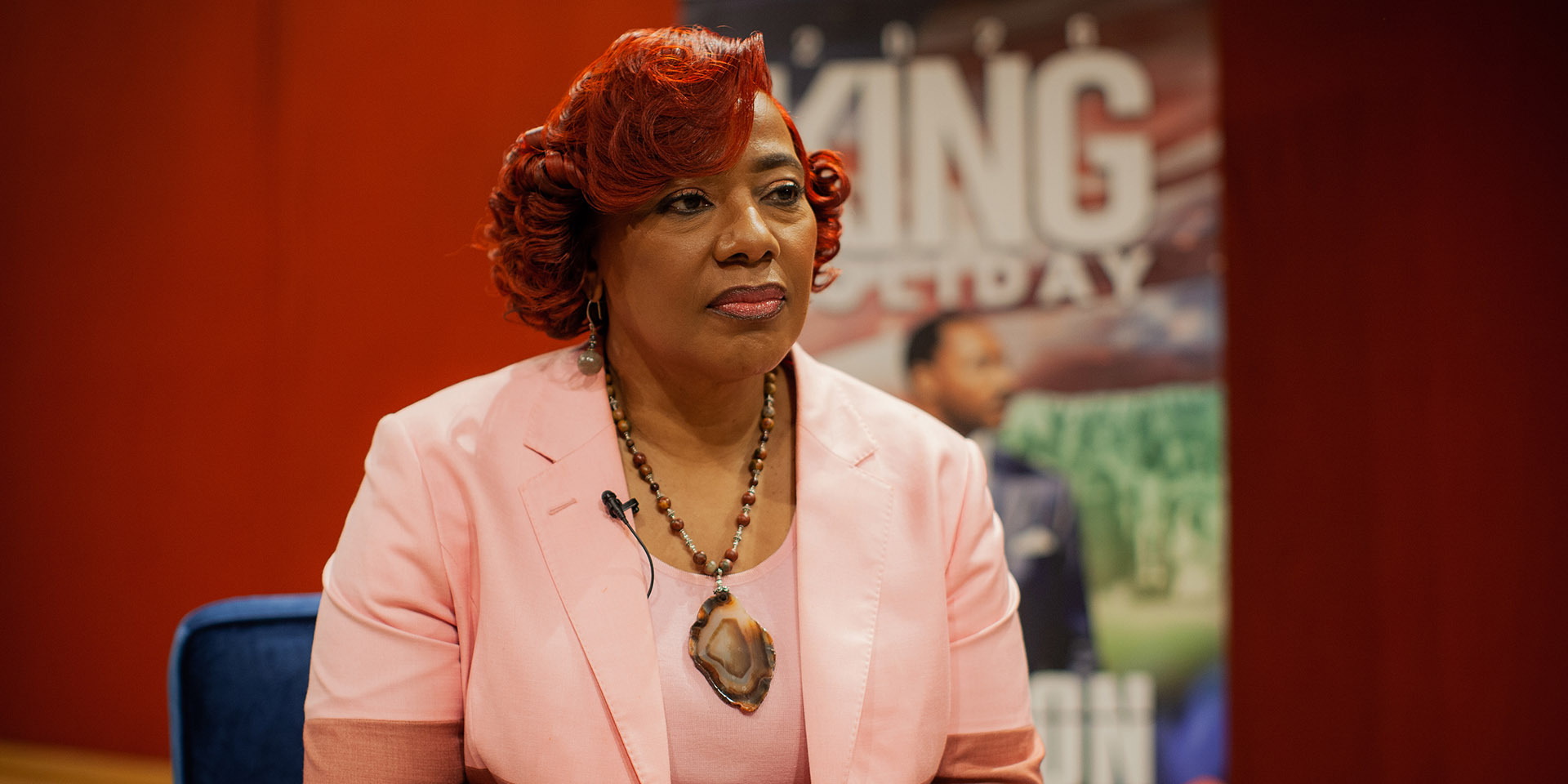
In any setting, Bernice A. King commands attention. Whether she is on the dais or waiting in the wings, her presence and confidence exude a resolve forged during a lifetime in the spotlight.
As the Southern Poverty Law Center set up video equipment for an interview with King at the end of a long day of speeches, podcast interviews, soundbites and sit-down interviews, her voice — with its deep, distinctive cadence reminiscent of her father’s — cut through the chatter.
“Quiet on the set,” she said, laughing, as her team got boisterous in the cozy, secluded theater at The King Center in Atlanta’s Sweet Auburn neighborhood earlier this month.
Being the most visible child of one of America’s famous couples on the week everyone remembers their names is hard work for anyone. Yet King was kind and warm, even though the SPLC was conducting what must have been her 20th interview of the day. The King Center will honor the legacy of the Rev. Martin Luther King Jr., whose birthday is today, with a week of in-person, virtual and hybrid programming for all ages.
“Every year from 1969 until now, we’ve commemorated my father’s birthday in a substantial way,” King said. “Even before there was a national holiday, we in Atlanta were doing King Week — and King Week was like 10 days at the time. Because of all of that, year after year, it’s become a part of who I am.”
This year, The King Center will celebrate the 41st annual Martin Luther King Jr. Day with the theme “Mission Possible 2: Building Community, Uniting a Nation the Nonviolent Way.” The scheduled events include community workshops, film screenings, community service events and a service at the Ebenezer Baptist Church, where King co-pastored with his father, the Rev. Martin Luther King Sr.
During the week of festivities, The King Center will honor a diverse group of people and organizations including singer/songwriter Billie Eilish, Oscar-winning actress Viola Davis, Sesame Workshop, former White House Press Secretary Karine Jean-Pierre and The Lebron James Family Foundation, among others.
The hustle and bustle of the week thrills King, as it’s the most external way to promote the legacy of her father and mother, Coretta Scott King.
“It’s gotten to the place now where it’s kind of second nature,” King said. “I was obviously born into this and raised in it. And I don’t know any other life. I don’t know how to wake up and not be the daughter of these great people because what they lived and what they taught is so essential.”
In the video: Bernice A. King sits for an interview with SPLC investigative reporter Caitlin Cruz during the 2026 King Holiday Observance press conference at The King Center in Atlanta on Jan. 8, 2026. (Credit: Myisa Plancq-Graham)
Defending her parents’ legacy
While the week’s celebrations are about honoring the work and legacy of King’s parents, her job as the CEO of The King Center is to protect their image and lives’ work. A relatively new way she has defended their legacy is by getting AI-generated images of her father removed from the internet. Just two months ago, OpenAI agreed to pause generated video depictions of the deceased civil rights figure.
“While Daddy was a public figure, he was not an elected official, and his image is not public domain. He was a private citizen,” King said in a partial statement in November. “The words, work and legacy of my father as a champion of social justice who was killed in a state-sanctioned assassination warrant protection. For me, many of the AI depictions never rose to the level of free speech. They were foolishness.”
During her interview with the SPLC, King elaborated on how using AI can seem like a shortcut at first.
“I recognize that there’s certain things it’s inappropriate for, and I have to set those boundaries,” King said, referencing the generated videos of her deceased parents. “We could be setting ourselves up for some dangerous situations because AI does not have moral intelligence or divine intelligence. I want us to understand we have divine intelligence. God didn’t create AI in his image after his likeness and put his spirit inside of AI.
“AI doesn’t have heart and soul,” King said.
She said that ultimately her life’s work of nonviolence is about returning the soul to the person. One way she has found to make that connection is through the pulpit. King was first called to the ministry at 17, but for eight years she pushed away the call.
“I needed to finish being a teenager and I needed to grow up,” she said. “Frankly, I didn’t want to be Martin Luther King’s daughter, preacher. It is like if that’s all I’m going to be, I’m in trouble because they’ll never know Bernice.”
‘For me, identity was important’
King graduated from Spelman College, a historically Black institution of higher learning for women in Atlanta, before enrolling in dual graduate degree programs in divinity and law at Emory University. It was a tough undertaking. Theology classes went smoothly, but law school coincided with a death in her family. King was put on academic probation twice, and all she could see in her mind’s eye were headlines like “MLK’s Daughter Flunks Out!” over and over again. She said the pressure caused her to consider taking her own life.
“Because, for me, identity was important. Law school was Bernice’s identity. Preaching? Theology? That was Martin Luther King. [Law] was something I could claim my name to,” she said. “But I heard that voice again, ‘People are going to miss you. You have a call.’ Everything changed at that moment. That was the moment when I decided to go see Pastor Joseph Roberts at Ebenezer [Baptist Church] to tell him that I was ready to go through whatever the process is to become a licensed minister.”
King gave her first sermon on the eve of her 25th birthday in 1988. It felt “unbelievable,” she said. The sermon’s topic was Zacchaeus the Tax Collector, but what sticks in her mind is her family’s reaction.
Coretta Scott King said her youngest child had her father’s gestures. Ambassador Andrew Young, former mayor of Atlanta and former leader of the Southern Christian Leadership Conference (also known as Uncle Andy in the King house), was “crying and crying and crying” through the sermon. “He asked her, ‘Did Bernice ever listen to Martin? Because she sounded just like him,’” King recalled.
“I don’t know how that happened when I was trying to get away from all of that, and I hadn’t even really studied much of my father at all,” King said. “I took one course in theology school. That was it. I purposely stayed away from his sermons, because I wanted my own voice.”
‘People always make comparisons’
Finding her voice has meant finding her way back home.
“I’ve made a conscious decision to embrace it and be intentional about that,” she said. “Not because they’re my parents, but because after 62 years, almost 63 years, I recognize that what they taught us is a more excellent way to live and to be in community with people who are part of my human family.”
The work of teaching nonviolence and supporting her family’s legacy remains her central focus.
“It comes with challenges because people always make comparisons,” she said. “What helps me there is when my mother used to tell us growing up, ‘You don’t have to be me, you don’t have to be your father, but whatever you do in this life, be your best self.’ So my job is to be the best Bernice, not to be Martin Luther King Jr.
“I’ve heard people around me through the years try to push that,” King said. “And I back off of that because he was called for his time. I’m called for my time.”
Still, like her parents, this time calls for advocating for access to the ballot box for Black communities.
“My father left us something that I think is important for democracy. He wrote in Where Do We Go From Here: Chaos or Community? that ‘the nettlesome task is to discover how to organize our strengths into compelling power so that the government cannot elude our demands.’ I don’t think we’ve done any of that kind of work to organize our strengths into compelling power,” King said. “We organize around passion, not strengths, so we have to start looking at that and what that really means.”
As protests continue across the country, King worries about the crucial right to assembly and protest (including Kingian nonviolent action) at the heart of so many movements from her parents’ time and her own.
“We have to make a conscious, intentional decision that even if I have to sacrifice life, job, security, I’m not going to stand by and allow the right to protest to be taken from us,” she said. “That’s the greatness of America. It’s the right to be able to protest.”
Image at top: Bernice King sits for an interview with the Southern Poverty Law Center during a press conference Jan. 8, 2026, at The King Center in Atlanta. (Credit: Myisa Plancq-Graham)