
Editor’s note: This is the fifth and final story in the “Crossing the Line” series about efforts in the Deep South to redraw voting districts in a way that disenfranchises Black and Brown voters.
Kate Donovan earned tenure at Rochester, New York’s St. John Fisher University in 2019.
After completing her doctorate in 2013, Donovan taught statistics and political science to undergraduates, watching her pupils go off to do what she described as “really good work in the real world.”
Yet she was still in academia. Although tenure was the payoff for years of academic grinding, she still wanted more. She wanted to do some of that “good work” herself.
Then a notice advertising a position at the Redistricting Data Hub (RDH) popped into her inbox. The job posting for a support specialist at the nonpartisan organization wedged its way into her brain.
“My father was like, ‘You’re leaving a tenure job for what was supposed to be a 15-month position at the Redistricting Data Hub?’” Donovan said. “And I said, ‘Yes, that is actually what I’m doing.’”
The 15-month position turned into nearly six years, with Donovan now serving as RDH director.
“I think that we foresaw that there was going to be a need for data infrastructure for redistricting, although we maybe didn’t totally understand quite how significant that need was going to be in this particular moment,” she said, referencing the mid-decade redistricting fight that has taken place in state legislatures across the country.
The mission of the nonpartisan RDH is to make public the data, tools and knowledge necessary for identifying gerrymandering — the tailoring of voting districts to enhance candidates or causes of one party over the other — and work to provide anyone who wants to create their own voting maps with all the data and tools they need. The hope is that an electorate capable of seeing how far voting districts have strayed from a fair and equitable baseline would be better informed about how important their vote is in selecting candidates at every level.
The RDH partnered with the Southern Poverty Law Center to make that user-friendly and accessible data available at all levels, from national elections to local contests, so communities can meet the moment. This was critical for states like Mississippi, where election results are often available only as cumbersome PDF files, creating a roadblock to easy data analysis. A similar moat has been created around the data in neighboring Alabama. There, a statewide file of voter data is available, but at a burdensome cost of $37,000 that dissuades the average voter from accessing it.
Putting people back into the process
It’s not just the average voter that the SPLC is hoping to empower to help the effort against gerrymandering. The need for expertise exists in every field, but none so dramatically as in the arena of voting rights law over the last decade.
In 2013, the Supreme Court upended voting rights jurisprudence in Shelby County v. Holder, gutting a part of the landmark Voting Rights Act of 1965 (VRA). The court ruled that the watershed civil rights legislation’s provision known as preclearance — which required jurisdictions that previously discriminated against minority voters to submit potential changes in voting practices to the Department of Justice to check for repeated discrimination — was no longer necessary. A Supreme Court decision in a 2021 case made it even harder to bring racial discrimination cases under another provision of the VRA. And, in the current term of the nation’s highest court, a group of white voters are challenging Section 2 of the Voting Rights Act, seeking to undo long-standing rules about how mapmakers ensure racial minorities get the opportunity to elect leaders of their own choosing. The possibility that Section 2 gets eliminated entirely looms large as well. (Read more about that case, Louisiana v. Callais, in Part 1 of our “Crossing the Line” series.)
The SPLC sees the need to broaden the redistricting expert pool as critical to its mission of expanding everyone’s access to the ballot box, said Fred McBride, senior adviser for voting rights at the SPLC.
The Race and Redistricting Expert Project (RREP) is one answer, training people from all backgrounds to go into the voting rights field as experts after a 14-month program with real-world assignments.
“We are happy in our partnership with the Redistricting Data Hub because something we are very concerned about at SPLC is data literacy,” said McBride, who also heads up the RREP’s curriculum alongside SPLC legal and support staff.
“Don’t get me wrong: There are other organizations that have done trainings for a week or a few days,” McBride said. “But you can’t teach racially polarized voting in a day, and you can’t teach someone how to draw and analyze a plan [in a day].”
‘An interest in fairness’
Like RDH, RREP is a nonpartisan effort.
“Our interest is in the communities and the voters, not the candidates,” McBride said. “Our participants have come from across the United States, not just our five SPLC states,” referring to the Deep South states of Alabama, Florida, Georgia, Louisiana and Mississippi where the SPLC focuses most of its work.
“And we never asked for partisanship or any affiliation,” he said.
Ultimately, voting rights are about access to the ballot.
“We hope that our individuals have an interest in fairness,” McBride said. “That’s all we ask.”
The first class had more than 80 applicants. Of those, 24 were chosen.
One of them was James Syme, a 36-year-old professor who splits his time between California and Mexico. He spent his childhood on campaign trails for “not-popular candidates in Wyoming” with his mom, he said. It fused his twin loves of mathematics and politics and led to a doctorate focused on redistricting.
For Syme, RREP was a godsend.
“I applied immediately,” he said.
Syme said he wants to use the training to do expert testimony for legal cases. He also wants to work directly with community groups on the ground.
“I think finding the groups and organizations who work with communities that may be underrepresented, who haven’t thought about this before, or who have thought about it before or maybe are disorganized, maybe there are ways I can support,” he said. “I can bring certain skills that I’ve developed over the years to help or answer questions that they might want to ask about [redistricting].”
For J.C., another candidate who was accepted into the program, applying to RREP was a step toward a second career. After working as a tenured university professor for more than two decades, they wanted to shift their focus for the second half of their life.
“I feel like democracy is in crisis right now,” they said. “But I really feel like since I have this skill set that’s important and useful and that not a lot of people have, I want to be as useful as I can be in whatever way I can to promote democracy.”
J.C., who prefers to be identified in this story only by their first and last initial, said they had previously consulted on a state redistricting commission. While there, they realized that their math skills could be further honed, along with the legal know-how provided by a program like RREP.
“The pace of expert work is so much more intense and unpredictable than the pace of my academic research, so part of the reason why I’m retiring is to make more space to do this work,” they said.
Transparency through education
McBride said people who are against voting rights try to make the redistricting process seem difficult and complicated. But the average member of the public doesn’t need a doctorate in statistics or demography to understand the basics of the general concepts used in redistricting — and gerrymandering in particular.
“We want communities to become, not data scientists, just more appreciative of it and use data in their speech when they’re speaking to elected officials,” McBride said. “Use it in their op-eds and any report or submission they want to make on redistricting changes in their communities. Use information you receive from us and the Redistricting Data Hub.”
It’s about making every member of the public more informed at a time when government data seems to be moving further out of reach, McBride said.
“I’ve been doing this for 27 years and I still learn something every day,” he said.
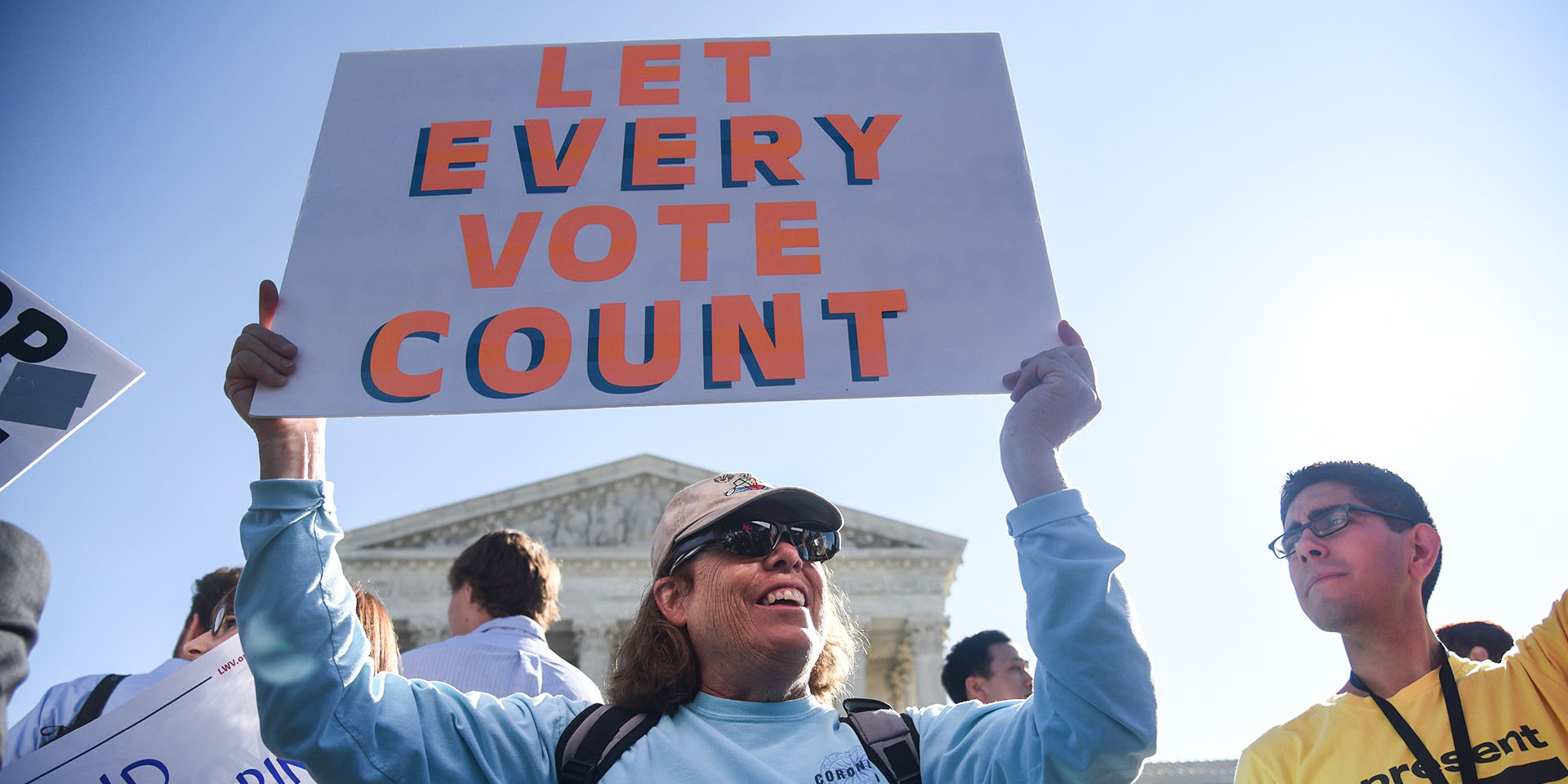
Image at top: In a photo from Oct. 3, 2017, demonstrators gather outside the U.S. Supreme Court building in Washington during oral arguments in Gill v. Whitford to call for an end to partisan gerrymandering. (Credit: Olivier Douliery/Getty Images)
Related Content
-

Georgia still litigating effects of 2021 redistricting on communities of color
-

Florida’s redistricting can weaken voting power of communities of color
-

Alabama continues fight against court-ordered state Senate district voting map
-

Redistricting war pales in shadow of pending Supreme Court ‘Callais’ decision