
Even in our bleakest moments, we must never forget to celebrate the significant national history of resistance in our country. The survival of our democracy depends on victory over forces of bigotry, exclusion and injustice.”
— Bryan Fair, the SPLC’s interim president and CEO
A gentle breeze swept across the rippling waters flowing over the round, black granite table that is the centerpiece of the Southern Poverty Law Center’s Civil Rights Memorial in Montgomery, Alabama, on March 5, as a crowd gathered to honor the legacy of the civil rights martyrs whose names are inscribed on its face.
The event marked the 61st anniversary of Bloody Sunday, the most violent day of the Selma-to-Montgomery march that would shock the nation and catalyze the passage of the Voting Rights Act of 1965, which outlawed racial discrimination in voting.
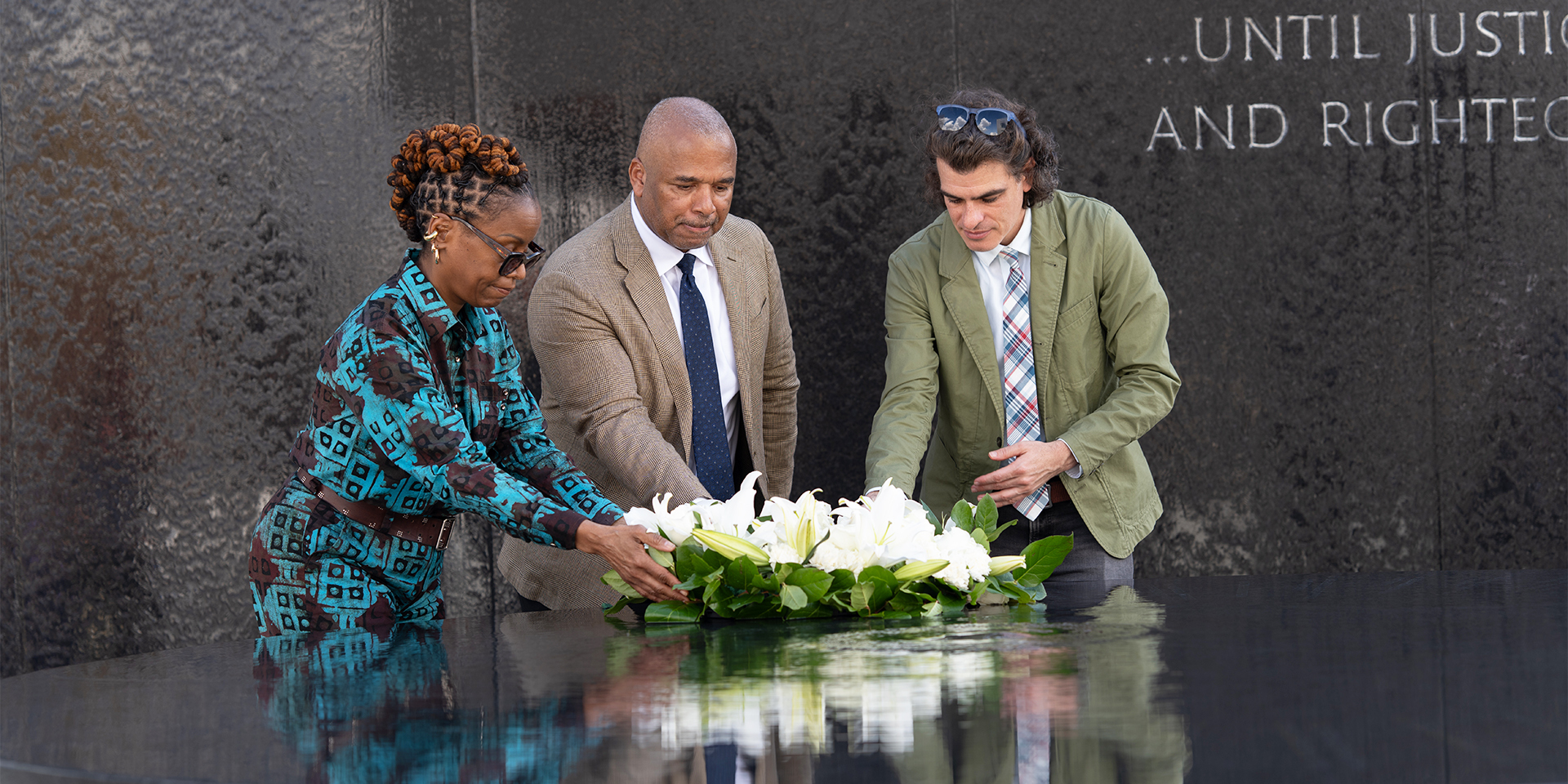
Under a bright sky, members of the crowd of about 50 people joined the SPLC’s leadership in laying an ivory wreath along with long-stemmed, white roses on the Memorial as water flowed over the inscribed names of 40 people who were killed during the height of the Civil Rights Movement — that time between the U.S. Supreme Court’s Brown v. Board of Education school desegregation decision in 1954 and the assassination of Martin Luther King Jr. in 1968.
“For millions of people throughout our history, our nation has not been the sweet land of liberty,” said Bryan Fair, the SPLC’s interim president and CEO. “Millions of people born or who have made lives here have never known belonging that is equal status in our country. For them, the American exceptionalism claimed has been a cruel hoax.”
Fair’s words on this sunny day resonated against the dark cloud of frustration, fear and uncertainty that has gripped many people in the country as voting and other civil rights, along with the principles of freedom and democracy, continue to be tested in the nation’s current political environment.
“There are elected officials across the region who are determined to reverse decades of progress by suppressing our votes,” said Karen Baynes-Dunning, chair of the SPLC’s board. “Whether it’s redrawing congressional maps to limit the representation of Black and Brown voters, closing polling places to make it harder for people to vote or using fear and intimidation to keep people at home on Election Day, the goal of these officials is clear — to hoard their power and shut the rest of us out of the political process.”
The ceremony gave those in attendance an opportunity to reflect on the continuing struggle for civil rights, ensuring that the hard-fought victories of the martyrs are not lost to future generations.
“Even in our bleakest moments, we must never forget to celebrate the significant national history of resistance in our country,” Fair said. “The survival of our democracy depends on victory over forces of bigotry, exclusion and injustice.
“This is our time for fierce resistance using all the tools in our toolkit to defeat those who would deny our communities their full dignity and equality,” Fair said. “We must build a collective vision, a strong coalition and define a bold strategy to reverse the hate, the assault on the poor, the assault on democracy and voting rights, and on due process and free speech.”
Fair concluded his remarks by urging listeners not to be passive in the face of continuing injustices.
“Most of all, we must not be silent,” he said.
The speakers, including Seth Levi, the SPLC’s chief program strategy officer, celebrated the legacy of the late U.S. Rep. John Lewis. The civil rights icon — who was badly beaten and seriously injured on Bloody Sunday in 1965 — died at 80 years old in 2020. For many years Lewis, a former Freedom Rider and bold civil rights activist, led an annual congressional pilgrimage, sponsored by the Faith & Politics Institute, to the Memorial and other civil rights sites in Alabama.
The SPLC continues to honor Lewis’ work, stirring up “good trouble” while working to ensure that all American citizens have free and fair access to the ballot box.
During his speech, Fair encouraged members of the crowd to reach out to their political representatives and express their discontent over the Safeguard American Voter Eligibility, or SAVE, Act that would create additional eligibility requirements and purge eligible citizens from voter rolls, making it harder for people to vote.
The SPLC ceremony coincided with the beginning of the annual Selma Bridge Crossing Jubilee to commemorate the ordinary, everyday people who marched from Selma to Montgomery for the right to vote in March 1965. Those foot soldiers, Lewis among them, joined together to push back against injustice and to secure voting rights for not only Black people but all Americans, regardless of race, religion or creed.
The Memorial, dedicated in 1989, recognizes people who were murdered because they were active in the Civil Rights Movement, were killed as acts of terrorism meant to intimidate civil rights activists, or whose deaths, like that of Emmett Till, demonstrated the brutality Black people in the South faced, helping push the Movement forward.
The Memorial was designed by Maya Lin, who found inspiration in the paraphrase from Amos 5:24 that King — one of the martyrs whose name is inscribed on the Memorial — used in his “I Have a Dream” speech: “We will not be satisfied until justice rolls down like waters and righteousness like a mighty stream.”
On the Memorial’s circular, black granite table, water emerges from the center and flows evenly across a timeline, reminiscent of a sundial, that chronicles the major events of the Civil Rights Movement and records the names of 40 men, women and children who were killed during the struggle. Behind the table, a thin sheet of water flows down a 40-foot-long curved, black granite wall on which the words “Until justice rolls down like waters and righteousness like a mighty stream” are inscribed.
“Part of our work together must be remembrance,” Baynes-Dunning said. “Today, we honor those foot soldiers who marched before us and remember that their persistence made the dream of an inclusive democracy more real. And tomorrow, we carry the spirit of history with us as we renew the fight for that dream once more.”
Image at top: From left: SPLC Board Chair Karen Baynes-Dunning, Interim President and CEO Bryan Fair and Chief Program Strategy Officer Seth Levi lead the wreath-laying ceremony at the Civil Rights Memorial in Montgomery, Alabama, on March 5, 2026. (Credit: Hillary Hudson)