

The Southern Poverty Law Center (SPLC) is dedicated to safeguarding civil rights and building a more equitable and just society. Rooted in the South, where the legacy of the Civil Rights Movement continues to shape the struggle for racial equity, we partner with communities to dismantle white supremacy and strengthen intersectional movements to advance transformative policies and human rights for all.
Our work includes providing subject-matter expertise and technical assistance to partners, stakeholders, and state and local officials to drive impactful initiatives that ensure a future where Black and Brown communities are not only represented but deeply respected as part of a thriving democracy. We focus on:
- Strengthening Democracy and Voting Rights: Expanding Access & Improving Engagement
- Dismantling White Supremacy: Ensuring Inclusive Education
- Ending Unjust Imprisonment: Disrupting the School-to-Prison Pipeline
- Eliminating Poverty and Economic Inequality: Protecting Social Safety Net Programs
Eliminating Poverty and Economic Inequality
Congress has long recognized the importance of food security programs, especially for children. Most food security programs like the National School Lunch Program; Women, Infants and Children (WIC); and Supplemental Nutrition Assistance Program (SNAP) have been primarily funded by the federal government. However, following the passage of the “One Big Beautiful Bill” in July 2025, a huge portion of the financial burden for these programs will now shift to the states — increasing their administrative costs from 50% to 75% in FY27. In FY28, states will be assessed for additional costs based on the program’s error rate.
1.4Mestimated number of Georgians, living at or below the federal poverty level, who depend on monthly SNAP benefits
In FY27, Georgia’s total SNAP obligation is estimated to increase by $80 million — simply to maintain the current service levels. Due to the program’s high error rate, the state’s additional cost-sharing will be delayed until at least FY29. However, based on current projections, costs could be as high as $677 million.
An estimated 1.4 million Georgians, living at or below the federal poverty level, depend on an average monthly benefit of $187 to purchase groceries. Nearly 70% of participants are families with children, and more than 28% are families with members who are older adults or individuals with a disability.
In addition to SNAP, Congress created the Summer EBT pilot in 2011 and made it permanent with broad bipartisan support in 2022. The program is designed to fill the gap when school is out: More than 28 million children receive free or reduced-price school meals during the year, but only about one in six are reached by traditional summer meal sites. In Georgia, roughly 411,000 children live in poverty, and more than 1 million are eligible for Summer EBT, yet the state does not participate. Based on USDA estimates, Georgia is leaving roughly $139 million in federal food assistance and an overall economic impact of $208 million to $250 million on the table each year that could help families buy groceries and give children a hunger-free summer.
It is a fundamental moral obligation, not an optional expense, to ensure that Georgia’s budget choices do not leave children, seniors, or families in need to go hungry.
Recommendations
- Fully fund Georgia’s increased share of SNAP administrative costs mandated under the federal One Big Beautiful Bill Act, without reducing eligibility, benefit levels or access to the program.
- Protect SNAP, WIC and school meal programs from state-level cuts or restrictive policies adopted to offset the federal cost shift.
- Provide adequate funding for the operation of summer nutrition programs and academic-year breakfasts for school-aged children, including seeking appropriate matching funds from the USDA annually, or as available, to support vital programs.
- Direct all relevant local and state agencies to partner with schools, community organizations and health providers to identify and enroll eligible but unenrolled children and families in SNAP, WIC, Summer EBT, and other anti-poverty programs.
- Require annual public reporting on participation, hunger indicators, and use of federal nutrition dollars to ensure Georgia is maximizing available federal funds for food security.
Eliminating Poverty and Economic Inequality
A key indicator of a thriving society is the health of its people. Access to affordable and quality health care is key to a family’s economic security. Sadly, medical bills remain one of the leading factors in a person or family’s decision to file bankruptcy. Eradicating poverty starts with improving access to affordable health care.
Yet access to and affordability of health care coverage remains a significant barrier, particularly for Black people. Around 28% of those currently uninsured, or more than 300,000 Georgians, would gain coverage if Medicaid were expanded to the federally supported level of up to 138% of the federal poverty level. Additionally, countless low-income Georgia residents, including children, have been unjustly removed from Medicaid rolls due to procedural failures.

Report
Why Georgia Can’t Wait for Economic Justice
An SPLC report highlights how 13% of the Georgia population does not have health insurance and the ample opportunity for policymakers to prioritize people and families.
Georgia is one of only 10 states that have not expanded Medicaid coverage to those falling into the health care access gap — despite it being cost-effective to do so. Benefits of Medicaid expansion include increased access to health care for people of color and people with disabilities, the preservation of rural community hospitals, and improved access to the basic health resources for communities that have been shut out of health care systems.
Medicaid expansion could also save Georgia’s rural hospitals struggling financially and at risk of closure. Driving factors for the crisis are a combination of rising costs of providing care and expenses related to uninsured community members. Easing their financial burden would prevent a health care desert by keeping the hospital and its well-paid jobs in the community, as well as boosting the local economy and schools.
To make matters worse, the One Big Beautiful Bill Act passed in July 2025, declined to extend the tax credits for health care premiums paid toward plans accessed through the Affordable Care Act (ACA) marketplace. As a result, health care costs are set to skyrocket in 2026 for the 1.5 million Georgians enrolled in an ACA plan, 93% of whom depend on the premium tax credit subsidies to make health coverage affordable. As an example, a 60-year-old couple living in Lawrenceville, earning $85,000, will see their monthly premium for a Bronze Plan increase from $89 to $2,159. Further, because insurance providers anticipate that the unaffordable price jump will force many to drop out of coverage, they have increased costs in the private market as well.
Recommendations
- Provide tax credits for hardworking Georgia families to ensure coverage and meaningful access to basic medical care.
- Authorize the expansion of Medicaid in a way that enables it to accept the federal funding available to do so, with coverage for adults with low incomes at least up to 138% of the federal poverty level and without added work requirements.
- Bundle Medicaid assistance with housing assistance to help people with low incomes who have disabilities get back on their feet.
- Improve state administration of Medicaid, including enrollment and redetermination processes, call centers, and associated IT services.
- Reduce costs and barriers to access, especially for low-income Black and Brown residents that live in rural, high-poverty counties.
Eliminating Poverty and Economic Inequality
The lack of affordable housing options devastates Black and low-income Georgians, amplifying the state’s urgent housing crisis. Local, state and federal officials in Georgia have an opportunity — and an obligation — to expand access to secure, affordable and stable housing to prevent the ongoing displacement of unhoused adults and children from their communities.
In 2023, the Georgia State Senate released a Study Committee Report on Unsheltered Homelessness, providing recommendations to address this pressing issue. In 2024, the SPLC’s Sheltering Injustice report exposed the devastating impact of criminalizing homelessness, which disproportionately harms people with disabilities, LGBTQ+ individuals, and Black Georgians. These punitive and costly practices perpetuate fear and trap vulnerable populations into cycles of incarceration and instability.

Report
Sheltering Injustice
This report spells out steps Georgia can take to stop ongoing harm and presents alternatives to criminalization that would allow people experiencing homelessness to start on a path toward housing and financial stability.
To start, Georgia must foster collaboration across agencies and support evidence-based programs, such as cash assistance, anti-discrimination policies, and tenant rights protections. Any policy change considered must center the voices of unhoused Georgians, particularly students and teachers, and invest in solutions that have been shown to benefit the vulnerable populations by building a bridge out of poverty.
Recommendations
- Create an Inter-Agency Council on Homelessness, ensuring directly impacted Georgians have a seat at the table to drive solutions.
- Reinforce the dignity of its residents by allocating U.S. Department of Housing and Urban Development (HUD) funds to ensure quality, affordable housing for Georgians — regardless of their economic, physical or mental health status.
- Address the needs of local unhoused populations and the drivers of homelessness by investing in alternative strategies, such as affordable and secure housing, which has proven successful nationwide.
- Reject criminal penalties for people experiencing homelessness who establish encampment areas or solicit assistance.
- Clearly define the rights of unhoused individuals and families to minimize interactions with law enforcement and unnecessary and harmful jail time.
Strengthening Democracy and Voting Rights
The fight for voting rights is also the fight to preserve democracy itself. Therefore, it is crucial that every level of election infrastructure be fully funded and fully trained. Additionally, every level of government must actively protect the fundamental right to vote. Without decisive action and sustained effort, the right to vote remains under assault — especially in communities of color — and the future of our democracy hangs in the balance.

Story
Georgia Voter Challenges: Know Your Rights
Since the passage of Senate Bill 202 in 2021, voter challenges against Georgia citizens have run rampant. Fortunately, most of the challenges have been dismissed.
Extremist forces in Georgia are putting our democracy at risk by enacting laws that reflect conspiracy theories, not facts. Two recent examples include the weaponization of policies, such as the infamous SB 202 (passed in 2021), which prevented people from supporting voters by giving them water bottles, and the recently adopted SB 189, which allows bad actors to use inaccurate information to challenge voter eligibility. These policies suppress voters and undermine our democracy by targeting young voters, voters of color, individuals with disabilities, and unhoused voters while overburdening election administration with unfunded mandates and inadequate infrastructure. This systemic attack on voting rights is a crisis and demands urgent action.
Recommendations
- Increase funding and training for election administration.
- Pass a Georgia Voting Rights Act to counter attacks on voter access.
- Authorize automatic and same-day voter registration.
- Allow for permanent vote-by-mail requests with prepaid postage for ballot returns.
- Create county-wide election hubs that allow voters more flexibility and access.
Dismantling White Supremacy
Since 2020, Georgia has been at the epicenter of a national political crisis driven by conspiracy theories, propaganda and disinformation; this culminated in escalated threats of violence during the 2024 election. In cities across our state, political intimidation — and more than 80 bomb threats and swatting incidents — disrupted the democratic process by endangering voters, officials, poll workers and volunteers.
The SPLC leads the Georgia Anti-Political Violence Coalition in countering these threats and empowering communities to embody democratic ideals. Through violence prevention and resilience trainings across metro Atlanta and Georgia’s Black Belt and election threat scenario preparation, we prepare voting rights advocates to mitigate and respond to election disruptions that directly or indirectly increase the risk of political threats or harm.
We support survivors of political violence through the Community Advisory, Resource & Education (CARE) Centers launched by the SPLC’s Intelligence Project and the Polarization & Extremism Research & Innovation Lab at American University. Using an approach centered on public health, CARE Centers provide on-site training, support and resources to those impacted by hate, discrimination and supremacist ideologies, as well as target groups susceptible to radicalization.
Recommendations
- Create legal protections for election workers, officials, volunteers and voters to ensure Georgia’s electoral process remains safe and accessible.
- Invest in strengthening community resiliency; promote and provide training on de-escalation practices; and combat extremism.
Strengthening Democracy and Voting Rights
Every Georgian deserves the right to vote, regardless of past involvement with the criminal legal system. Yet Georgia’s policies, which block the right to vote, are more restrictive than those of 24 other states. Since the 1980s, Georgia’s constitution has weaponized the vague and discriminatory standard of “moral turpitude” to strip voting rights from people with felony convictions who are in prison, on probation or on parole. As a result, Georgia disenfranchises its residents at a rate of 3.1% of the voting-age population, or more than 200,000 Georgians, which is higher than the national average of 2%. Black Georgians are disproportionately affected. Over 5.2% of Georgia’s Black voting-age population, or more than 100,000 people, are denied the right to vote, a stark indicator of the systemic racism embedded in these policies.

Story
Georgia Justice Project’s work to enfranchise voters
The Southern Poverty Law Center is helping to fund GJP’s voting rights work through the Vote Your Voice program with a grant.
Georgia thrives when every voice is heard, and every citizen can fully participate in the democratic process. Mass disenfranchisement has been used to silence thousands of voices, deny representation, and perpetuate inequality. We must end this injustice to strengthen democracy.
Recommendations
- Address historical racial bias by removing legal barriers to enfranchisement.
- Revise the state Constitution — and adopt any necessary companion legislation — to enable the restoration of voting rights to individuals with past criminal convictions upon release from prison, regardless of outstanding fines, fees, or restitution.
Ending Unjust Imprisonment
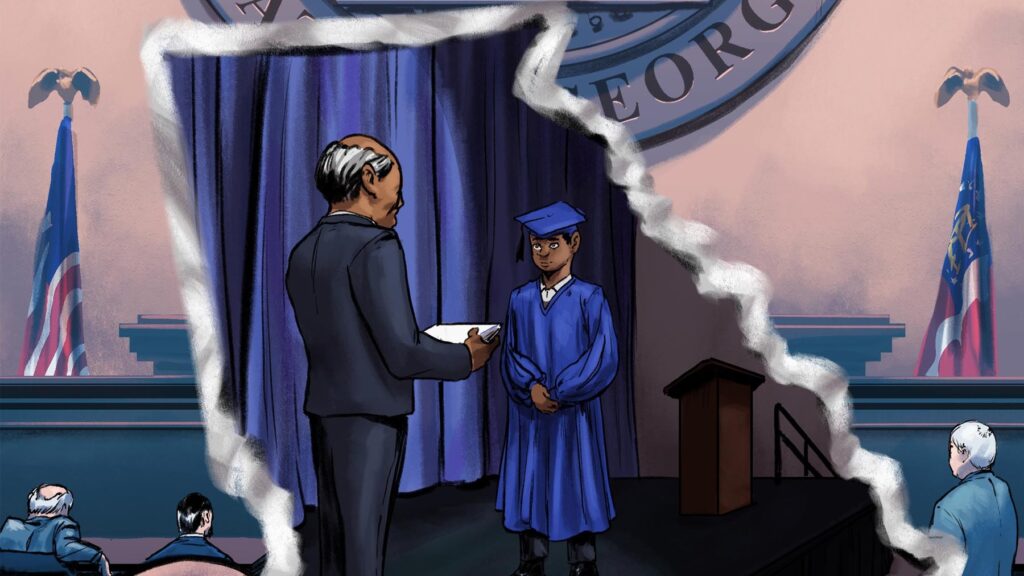
It costs Georgia taxpayers $217,517 annually to incarcerate a child — the equivalent of 19 students’ tuition at the University of Georgia. Georgia’s youth incarceration policies prioritize punishment over rehabilitation and are rooted in decades of biased political decisions and white supremacy. Our system is engineered to be one of the toughest in the country; this has created stark racial disparities, pushed children out of schools, and caused well-documented harm to young people in detention. The egregious nature of these harms requires federal intervention.
Report
Georgia’s youth legal system overemphasizes punishment
In Only Young Once: Dismantling Georgia’s Punitive Youth Incarceration System, the SPLC investigates the policies and practices producing harm and racial disparities in Georgia’s youth legal system.
The SPLC’s Only Young Once report provides a clear, evidence-based roadmap for transforming Georgia’s broken system into one that prioritizes fairness, effectiveness, and rehabilitation. While Black children in Georgia’s schools make up 37.5% of students, they also make up well over half of all out-of-school suspensions, expulsions, and assignments to alternative schools. Our state’s zero-tolerance policies often lead to the suspension of students for minor infractions, such as vaping, which resulted in over 22,000 disciplinary actions during the 2022-23 school year. Further, in Georgia, Black youth comprise over 60% of all youth court referrals, delinquent adjudications, youth who are incarcerated, and youth sentenced in adult court.
Georgia should redirect resources toward transformative policy reforms to empower young people to thrive and lead productive lives. Additionally, Georgia’s economy and residents would be best served by an investment in pathways that foster opportunity, growth, and equity for all children, rather than isolation and criminalization. The first step must be to address the overemphasis on punishment that results in dual harms — pushing Black children out of traditional schools at a disproportionate rate and promoting the prosecution of children as young as 13 as adults for certain offenses.
Recommendations
- Make nonviolent and low-level offenses non-jailable for youth. Make technical violations and status offenses non-jailable and not arrestable for youth.
- Fund diversion programs for youth as an alternative to incarceration. Examples include community-based alternatives, school-based policies and programs that prioritize rehabilitation, counseling, tutoring, and drug use treatment services.
- End the assessment of court fines and fees for children.
- Ensure schools enforce fair and consistent due process hearings and end the use of zero-tolerance policies.
Dismantling White Supremacy
In Georgia, some politicians and activists are working systematically to narrow what students can learn and who is allowed to feel safe in school. After passing a “divisive concepts” law that chills honest teaching about race and racism, state leaders have moved to dismantle diversity, equity, and inclusion (DEI) efforts across the education pipeline. The University System of Georgia has barred the inclusion of required diversity, equity and inclusion statements in hiring, and lawmakers continue to push anti-DEI policies in K–12 schools and public colleges, with threats to cut funding from institutions that do not comply.
It is by no accident that we are witnessing this attack after several years of racial reckoning. Our children deserve an honest education about race and racism in this country. Attempts to quash these conversations are attacks on democracy, justice and community, and they do not allow us to deal frankly with our past or future. Students must learn the full picture of U.S. history, especially when it does not live up to our shared values. We must acknowledge both truths — that while our country was founded on the ideals of liberty, freedom, and equality, it was, simultaneously, being built on slavery, exploitation, and exclusion.
These same forces are also targeting LGBTQ+ students, especially trans and nonbinary youth, with bills that seek to restrict everything from their access to affirming health care to what can be said about them in the classroom, which facilities they can use, and whether they are allowed to play on teams with their peers. When lawmakers use schools as a staging ground to punish young people for who they are, they endanger students’ mental health, safety and educational futures and force families into impossible decisions about where and how their children can attend school. At the same time, new laws expand anonymous reporting and school “threat management” systems in ways that, without strong safeguards, risk intensifying surveillance, and discipline for the very students already most targeted at school, disproportionately affecting the ability of low-income students to retain their financial aid.
Recommendations
- Reject the politicization of education. Instead, embrace the importance of encouraging students and youth to learn about Black history and the diversity of the United States, including an honest account of its histories, races, and cultures.
- Support the dignity of LGBTQ+ individuals, particularly youth. Reject any policies that further harm children by censoring their personal expression, denying them access to educational materials, or otherwise put them at greater risk of bullying or self-harm.
- Retain the independence of local libraries as safe havens within their communities.
- Increase funding and support for public schools and provide policy changes to reduce racial and socioeconomic inequities