
Investigative Update Summer 2025
GoyimTV relies on other mainstream and extremist sites for hateful content
Missouri Minutemen and white nationalist Active Club learning from each other
Sovereign citizens put public servants and safety professionals at risk
New York politics used to promote misinformation, hard-right war against Muslims
Earlier this year, President Donald Trump announced that he was unilaterally restoring Confederate names to all nine military bases that had been renamed through a bipartisan process to honor American heroes instead of Confederate traitors. Trump’s June 10 announcement flies in the face of the democratic process through which Congress and a nonpartisan naming commission found new names for the bases. Hearing this news, Americans may ask why the military had bases named after men who committed treason. These memorials to Confederates emerged from a successful propaganda campaign that former Confederates launched after the Civil War.
Defeated on the battlefield, former Confederates believed they could nonetheless secure a victory for white supremacy — the true Confederate cause — if they won a “war of ideas.” To win this war, they fought on multiple fronts. They organized social clubs, rewrote school curricula and published propaganda in film and literature. As the fourth edition of the Whose Heritage? report, released this spring, explains, Confederacy supporters also erected over 2,000 memorials nationwide. Their goal was to replace Americans’ memory of the Civil War as a struggle between slavery and freedom with Lost Cause mythology, a revisionist history that erases the struggle between slavery and freedom as the central meaning of the Civil War. By the end of World War I, the United Daughters of the Confederacy (UDC), a leading pro-Confederacy group, boasted over 100,000 members. In 1994, exactly 100 years after the UDC was founded, white nationalist Michael Hill founded the neo-Confederate League of the South (LOS), an organization advocating white supremacy, Christian theocracy and Southern secession. In 1996, it launched a “Dump Beasley” campaign to defeat South Carolina Republican Gov. David Beasley over his support for removing the Confederate battle flag from the state Capitol.
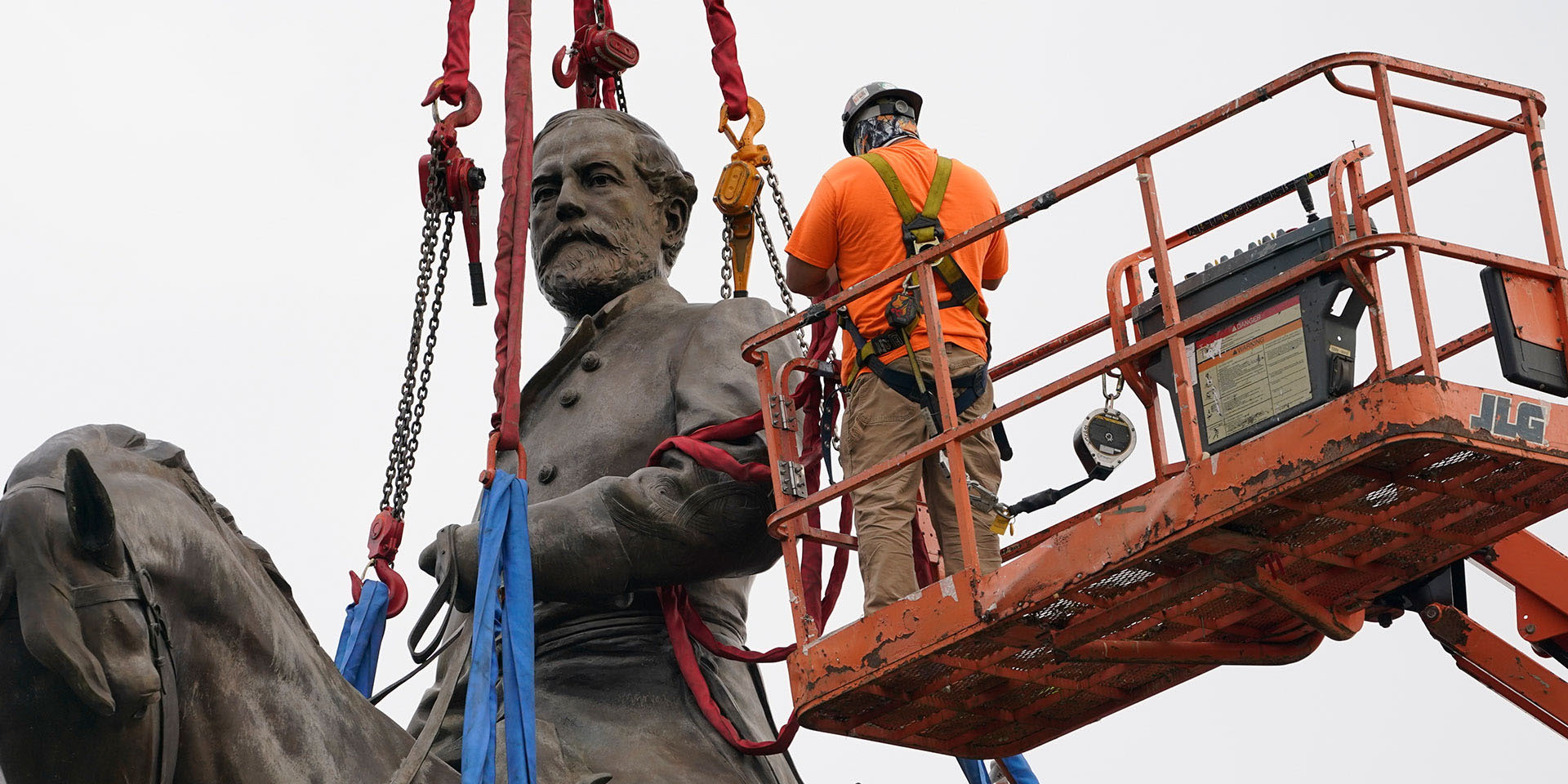
In 2015, public sentiment turned following the racially motivated murder of nine worshippers in June at a Black church in Charleston, South Carolina. The following month, Gov. Nikki Haley signed a law removing the Confederate flag from Capitol grounds. That year, 15 Confederate memorials came down, followed by 17 in 2016, 64 in 2017 and 169 in 2020. By 2021, UDC membership had dwindled to fewer than 18,000. In 2023, the U.S. military removed the names of Confederate leaders from nine military bases. Civil War reenactment — much of which reinforces Lost Cause myths — has been in decline for decades.
In the last five years, the LOS and other neo-Confederate groups have seen a major decline in membership, funds and power. The LOS now has only two operational chapters and was unable to organize its annual meeting in 2024. The Southern Poverty Law Center counted 14 neo-Confederate groups in 2022; by 2024, only four groups remained. While on-the-ground activism has waned, there has been a resurgence of Lost Cause ideology in the halls of state and federal government.
Lost Cause mythology is central to Trump’s movement. He romanticizes the gender and racial hierarchies of the Old South, valorizes Confederate leaders and symbols, and demonizes those who would remove Confederate memorials as “angry mobs” trying to “wipe out our history.” The Confederate anthem “Dixie” played at Trump’s Madison Square Garden rally on Oct. 27, 2024, an event filled with racist harangues and ridicule.
On several occasions, Trump has identified Confederate memorials with his movement’s values. In summer 2020, he proclaimed, “Our nation is witnessing a merciless campaign to wipe out our history, defame our heroes, erase our values and indoctrinate our children.” He added: “Angry mobs are trying to tear down statues of our founders, deface our most sacred memorials” — a remark that identified Confederate insurrectionists as “our founders.”
In July 2023, the Florida State Board of Education, appointed by Gov. Ron DeSantis, announced a new state history curriculum that follows Lost Cause mythology. The curriculum requires teachers to tell students that “slaves developed skills which, in some instances, could be applied for their personal benefit.” A major tenet of Lost Cause ideology is the racist myth that enslaved people were largely content and benefited from slavery.
In February, months before the president’s June 10 announcement of restoring Confederate names to military bases, Secretary of Defense Pete Hegseth changed Fort Liberty back to Fort Bragg. Because bipartisan legislation prevented Hegseth from choosing a Confederate name, he renamed Fort Liberty after Pfc. Roland Bragg, who earned the Silver Star and Purple Heart during the Battle of the Bulge in World War II. Announcing the restoration of the Confederate name, Hegseth tweeted, “Bragg is back!” Sen. Jack Reed of Rhode Island, ranking member of the Armed Services Committee, said Hegseth had “insulted the Gold Star families who proudly supported Fort Liberty’s name, and he has dishonored himself by associating Private Bragg’s good name with a Confederate traitor.”
Many hard-right members of Congress are also pursuing Lost Cause and neo-Confederate goals. As historian Nancy MacLean has written, attacks on public goods such as health care, education, housing and services including libraries and parks are rooted in white supremacist resistance to integration. Americans are witnessing such resistance through federal level efforts to eviscerate Medicaid and Medicare, despite public support for these programs, and as Trump signs executive orders weakening the Civil Rights Act of 1964.
With the Lost Cause mythology ascendant, the landscape for telling true history that inspires racial and economic justice can look bleak. Still, even in the early 20th century during the Jim Crow era, activists scored victories against the “Lost Cause.” Today, community groups continue to challenge Lost Cause mythology, taking public history into their own hands. In June, students in Augusta, Georgia, erected a plaque commemorating the city’s Black history. Community members in Savannah, Georgia, are working to memorialize the city’s history of slavery, while artists in Murray, Kentucky, hope to commemorate Murray’s Underground Railroad history with a mural.
In 2023, advocates helped replace an offensive piece of Lost Cause propaganda in Colfax, Louisiana. The town of Colfax was the site of the bloodiest instance of racial violence during Reconstruction, when a white mob murdered 150 Black citizens. In 1951, the state put up a marker calling the event a “riot” and condemning “carpetbag misrule” — Lost Cause code for the idea that the North had overstepped in trying to establish civil rights for formerly enslaved people in the postwar South. In 2023, Colfax replaced the “Lost Cause plaque,” erecting in its place a larger memorial that provides a detailed, accurate account of the event, putting it in the context of Reconstruction and Jim Crow. Avery Hamilton, a descendant of one of the Black Louisianans murdered in the massacre, and Dean Woods, a descendant of one of the perpetrators, came together to raise funds for the new plaque.
Americans who believe in democracy, public good and racial justice must continue to counter Lost Cause propagandists in their “war of ideas.” Finding the Lost Cause mythology ascendant in government, Americans can nevertheless insist on restoring and celebrating the historical memory of their communities. The memory of past struggles for freedom and equality can inspire Americans to fight once more for a “government of the people, by the people, for the people.”
Image at top: In a photo from Sept. 8, 2021, a crew in Richmond, Virginia, removes a statue of Confederate Gen. Robert E. Lee on Monument Avenue. (Credit: AP/Steve Helber, Pool)