When the anti-LGBTQ+ hate group Family Research Council (FRC) hosts its annual political conference on Oct. 17 at a Chino, California, megachurch led by Christian nationalist pastor Jack Hibbs, it will come during a year in which the Christian right made inroads into using tax-exempt church resources to influence politics, with the possibility of more progress to come.
The Pray Vote Stand Summit comes on the heels of the Internal Revenue Service’s July decision to allow pastors to endorse political candidates from their pulpits without jeopardizing their tax-exempt status. The IRS decision came in a document filed in a court case brought by National Religious Broadcasters and several churches.
Religious critics of the decision include the Interfaith Alliance, which warned the move would create a “grave threat to healthy boundaries between government and religion” and claimed the decision would “heavily politicize the pulpit, and could turn some religious institutions and organizations into thinly-veiled fronts for partisan groups and candidates.”
The Christian right has long sought to overturn the Johnson Amendment, a provision of the tax code that sought to keep charities and churches from using their tax-exempt resources to benefit specific candidates. Since the 1970s, much of the Christian right’s influence has come through its close association with the Republican Party and its ability to turn out conservative voters. Since the 1990s, groups like the FRC have created a cottage industry to convince fundamentalist Christians that they should be more politically active and that a “biblical worldview” primarily aligns with the Republican platform.
But operating as a nonprofit corporation inherently comes with tradeoffs. On the one hand, churches operate as corporations that pay no state or federal taxes and are not required to disclose their donors or how much money they spend on programs and salaries. On the other hand, churches cannot fund partisan campaigns and have been prohibited from making endorsements until the recent IRS decision. Proponents of the Johnson Amendment say that to do otherwise would open churches to corruption and put them in a privileged position of being allowed to influence elections without having to disclose their sources of funds or expenditures.
Hibbs has endorsed candidates from his pulpit, and in 2024 he encouraged his congregants to vote Republican. Similarly, of the 68 endorsements FRC Action issued in 2024, all were for Republican candidates. According to tax records, the group is a “related organization” of the tax-exempt Family Research Council, which registered as an “association of churches” in 2020. The Pray Vote Stand Summit organizers may further test the boundaries of the tax code, as the Christian right continues its campaign to use tax-exempt resources to influence politics and limit transparency.
Asked about challenges to the Johnson Amendment, Zev Mishell, national programs associate at Interfaith Alliance, said: “If right-wing organizations are successful at dismantling the Johnson Amendment, they will be able to funnel what are ordinarily partisan political donations through houses of worship to support their political causes. Rather than protecting freedom of religion, these actions risk turning houses of worship into tax-deductible partisan lobbying organizations. That would be a disaster for our tax code, but it would also undermine religious institutions as common meeting points that are inclusive to a wide diversity of people.”
Rally for conservatives
The Pray Vote Stand Summit was previously called the Values Voter Summit, but it was renamed in 2021. The event is a coproduction of the “church” FRC and its political arm FRC Action, which is registered as a tax-exempt 501(c)(4) social welfare group. In a statement about the renaming, the FRC announced that the conference was intended to help conservative Christians push back against “leftists” in politics. “From pronoun police, to indoctrination in our classrooms, to the [COVID-19 pandemic] lock-down of our churches, to the vaccine mandate in the workplace, the core values and ideals that birthed America are at risk of being overrun by political and cultural Leftists,” Family Research Council President Tony Perkins said.
Pray Vote Stand has generally served as a strategy session for Christian-right political activism, bringing together representatives from anti-LGBTQ+, anti-Muslim, anti-immigrant and antigovernment political groups to engage with conservative politicians and potential voters. In 2017, the Southern Poverty Law Center detailed how the anti-LGBTQ+ movement used the summit to articulate a social and political attack on transgender people to politically wedge the community from supporters. In 2023, the SPLC documented how attendees shared political messaging strategies about the successful use of “parental rights” framing of issues to challenge anti-racist and LGBTQ+ inclusive education practices in public schools.
The 2025 summit is cosponsored by AFA Action, the political arm of the anti-LGBTQ+ hate group American Family Association, and Truth & Liberty. Hatewatch previously reported that AFA Action CEO Walker Wildmon endorsed the racist and antisemitic “great replacement” conspiracy theory, which is linked to multiple instances of mass gun violence, in a July podcast. Truth & Liberty is led by Christian supremacist Andrew Wommack, an “apostle” in the New Apostolic Reformation movement. The movement’s theology holds that society should be governed primarily under Old Testament biblical law and administered by hard-right Christian theocrats.
In addition, the 2025 conference is cosponsored by Hibbs’ streaming video service Real Life Network (RLN). According to the group’s website, RLN was founded in 2023 to protect children from “woke propaganda,” a term used by hard-right groups to malign anti-racist and LGBTQ+ inclusive education in public schools and the media. The online service appears to be an outgrowth of another Hibbs venture, a nonprofit charitable corporation called Real Life Network Hawaii, which operates a Christian television station in Honolulu known as KALO TV.
According to that group’s federal tax returns, Hibbs became president of the network in 2018. That year, KALO TV’s five-person board of directors was mostly replaced with a group of directors and executives from Hibbs’ other nonprofit, Real Life Ministries (RLM).
Like the FRC, Real Life Ministries reorganized from a public charity to a church in 2022, after which it stopped publicly disclosing its federal tax returns. However, tax records show that 2018 was the first year RLM identified KALO TV as a “related organization” and that the takeover came after RLM recorded a $1.71 million “grant” to KALO TV. In 2019, RLN’s new executives moved the corporate headquarters of KALO TV to the same Glendale, California, address as Hibbs’ RLM. Hibbs streamed live coverage of the Pray Vote Stand Summit on the network in 2024, including speeches by several Republican presidential candidates.
Trouble with regulations
The Christian right’s trouble with federal tax regulations largely originates in the 1970s, when the IRS determined that private Christian schools that refused to admit Black students would lose their tax-exempt status. Reflecting on the battle over tax exemptions, Paul Weyrich, co-founder of the Heritage Foundation, said in the 1990s, “What galvanized the Christian community was not abortion, school prayer, or the [Equal Rights Amendment]. … What changed their minds was Jimmy Carter’s intervention against the Christian schools, trying to deny them tax-exempt status on the basis of so-called de facto segregation.”
The case against fundamentalist Bob Jones University, which refused to admit Black students, began during President Richard Nixon’s administration, but the belief that Democrats were responsible for attacking the so-called religious freedom of conservative Christians quickly took root. The false victimhood narrative became a hallmark of Christian-right activism. Since then, Christian-right political organizations have battled against federal regulations designed to enhance accountability in the political process by preventing churches — which do not have to disclose their donors or how they spend their donations — from engaging in partisan political activity.
Throughout the 2000s, groups like the anti-LGBTQ+ hate group Alliance Defending Freedom (ADF) encouraged pastors to endorse candidates in their sermons and then ask to be investigated by the IRS. According to an ABC News report in 2008, “While the ADF believes such investigations will create the opportunity to challenge [the Johnson Amendment] in court, the organization recognizes that the churches risk losing their tax-exempt status, which could potentially bankrupt them.”
The 2008 ADF campaign heavily featured future U.S. Rep. Jody Hice of Georgia, who told ABC News, “On Sunday, I’ll be endorsing [then-presidential candidate] John McCain. I believe that endorsement will be a religious statement more than a political statement. But the IRS says that for me to speak biblical truth is against the law.” As Hatewatch previously reported, after leaving Congress, Hice was hired to lead FRC Action.
In 2024, Hibbs used a sermon to endorse a Republican U.S. Senate candidate and admitted he broke the law by doing so, according to Newsweek. Hibbs and Calvary Chapel Chino Hills, the church where he is founding and senior pastor, have spent a decade attempting to influence local school board elections. Critics note the similarities between Hibbs’ anti-LGBTQ+ rhetoric and policies enacted by the board.
In 2024, Hibbs again endorsed candidates for the Chino Valley Unified School District board and saw several members of his congregation elected, including Sonja Shaw, whose takeover as board president helped shepherd a conservative agenda of anti-LGBTQ+ and anti-pluralistic policies through the board. Shaw is a confirmed speaker at the 2025 Pray Vote Stand Summit.
In 2023, conservative talk show host Larry Elder was fined $2,000 for failing to disclose income from several sources, including at least $10,000 from Calvary Chapel Chino Hills, during his 2021 run for California governor. Elder is also a confirmed speaker at the 2025 summit.
In 2022, more than 40 members of Congress sent a letter to the IRS urging a review of the FRC’s church designation and argued, “Tax-exempt organizations should not be exploiting tax laws applicable to churches to avoid public accountability and the IRS’s examination of their activities.”
A review of state board of elections filings in North Carolina, for example, shows that since 2018, FRC Action, the FRC’s political arm, has been assessed thousands of dollars in penalties for failing to file required documentation, including quarterly activity reports.
“FRC claiming to be a church strains credulity: they do not hold religious services, do not have a congregation or affiliated congregations, and do not possess many of the other attributes of churches listed by the IRS,” the 40 members of Congress wrote in 2022. “FRC is one example of an alarming pattern in the last decade — right-wing advocacy groups self-identifying as ‘churches’ and applying for and receiving church status.”
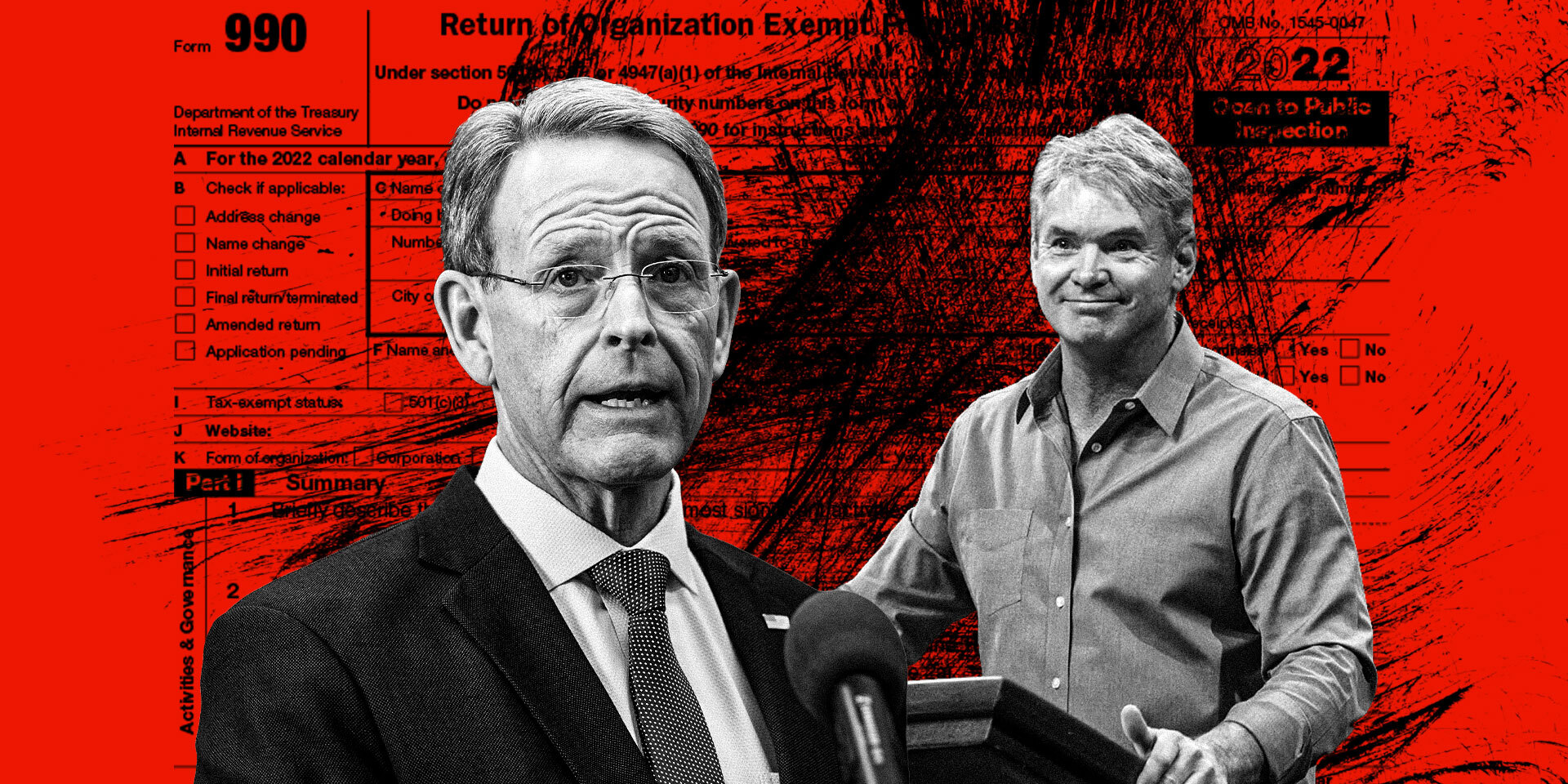
Image at top: Family Research Council founder Tony Perkins (left) and Jack Hibbs, pastor of Calvary Chapel Chino Hills in California. (Photo illustration by the SPLC; source images from Alamy and YouTube)