
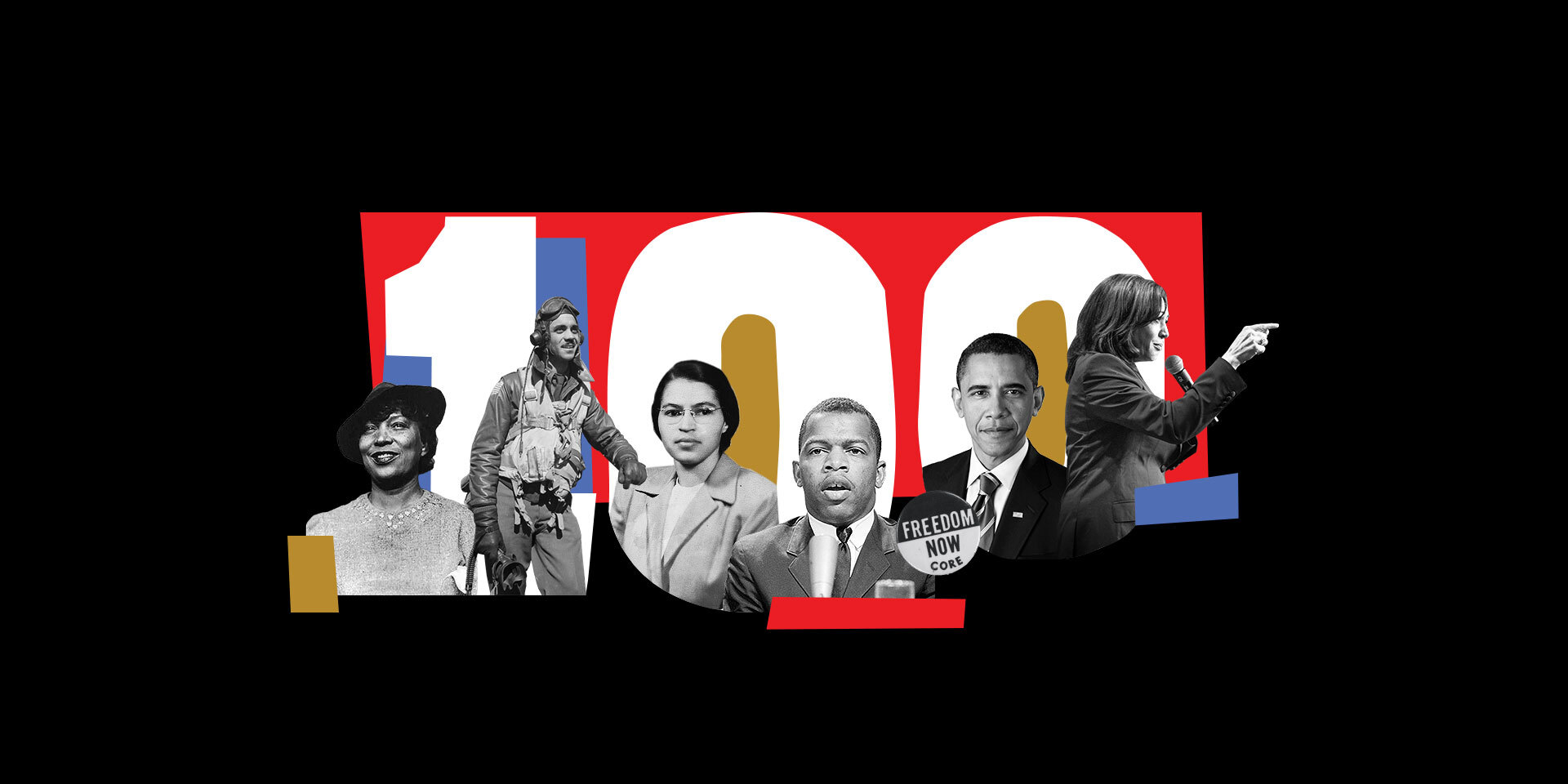
The Black historian Carter G. Woodson — who dedicated his career to the study of Black life and history — responded 100 years ago to the fact that the achievements of Black men and women were not part of our nation’s recorded history.
He founded Negro History Week, a commemoration of “the Black past.”
The inaugural celebration took place in 1926 during the second week of February — a time when Black Americans had traditionally held celebrations to honor emancipation and the end of slavery in the United States. The week coincided with the birthdays of President Abraham Lincoln, who enacted the Emancipation Proclamation in 1863, and Frederick Douglass, the formerly enslaved abolitionist and orator.
In the decades that followed, the week of acknowledgment grew steadily in popularity. The Civil Rights Movement and an awakening of Black consciousness that spread through cities and across college campuses helped transform the celebration from Negro History Week to Black History Month in the late 1960s.
In 1976, during the nation’s bicentennial, President Gerald R. Ford became the first head of state to officially recognize Black History Month. He encouraged Americans to “seize the opportunity to honor the too-often neglected accomplishments of Black Americans in every area of endeavor throughout our history.”
Below are some of the notable achievements of Black Americans that have come into being since Woodson launched the official commemoration in 1926.
1926-36
The Harlem Renaissance was a period of immense Black creativity in art, literature, music and beyond that spanned from the 1920s through the 1930s in Manhattan’s Harlem neighborhood. The area became a mecca for Black migrants from the South and a cultural melting pot in what was then coined “The New Negro Movement.” Writers such as Zora Neale Hurston, Langston Hughes and Richard Wright published acclaimed works that would lead them to become household names. Changing ideas around Black identity influenced everything from politics to theater, dance and fashion, and would leave a lasting impression on Black culture in America and around the world.
1936-46
More than 3 million African American men enlisted in the United States military during World War II between 1939 and 1945. Although they risked their lives for their nation, and to secure the freedom of white Europeans abroad, these men were forced to contend with racism among their own ranks. The U.S. military segregated Black and white soldiers into separate units, often providing Black servicemen with subpar accommodations and equipment as well as the more dangerous field assignments.
In 1941, what was then known as the Tuskegee Institute in Alabama formed the first training program for the Black military aviators who would later become known as the Tuskegee Airmen. Ultimately, in 1948, President Harry S. Truman issued an executive order to integrate all U.S. armed forces.
1946-56
In 1947, Jackie Robinson played for the Brooklyn Dodgers, integrating Major League Baseball and marking the end of 50 years of segregation in the popular sport.
In 1952, Thurgood Marshall — who would later become the first Black U.S. Supreme Court justice — argued before the court in Brown v. Board of Education that the “separate but equal” doctrine used to segregate Black and white students was unconstitutional. The court would agree with Marshall’s argument in its 1954 decision.
In 1955, Rosa Parks, Martin Luther King Jr. and several other civil rights figures in Montgomery, Alabama, began a boycott of the city’s buses that would kick off the modern Civil Rights Movement.
1956-66
In 1957, nine Black students integrated Little Rock Central High School in Arkansas. Under violent confrontation, cruel treatment and intense hostility, the Little Rock Nine, escorted by federal troops, demanded their right to an equal education and paved the way for school desegregation efforts across the country.
In 1960, Black students organized by the Southern Christian Leadership Conference (SCLC) and Congress of Racial Equality (CORE) began organizing sit-ins at lunch counters in segregated restaurants and freedom rides on segregated interstate buses that would lead to the eventual integration of public spaces, transit and transportation facilities.
1966-76
The mid-1960s throughout the 1970s saw the rise of the Black Power Movement. Firebrand figures such as Malcolm X and Marcus Garvey influenced the movement, which grew from frustration at the slow pace of legal and protest tactics utilized during the Civil Rights Movement and called on Black people, frustrated by their ongoing oppression, to demand the right to cultural, political and economic autonomy.
The young activist Stokely Carmichael coined “Black Power” as a term of pride and as a demand that spoke to the need for Black people to come together and take any measure necessary to secure their rights as full American citizens.
1976-86
Gerald Ford became the first U.S. president to officially recognize Black History Month in 1976. Two years later, in 1978, the premise of affirmative action in university admissions was challenged and upheld in a landmark decision in the Regents of the University of California v. Bakke case.
The decision affirmed that race-conscious admissions could be used as a factor in college admissions, albeit in a less rigid manner.
1986-96
In 1986, Martin Luther King Jr. Day became a federal holiday. Although President Ronald Raegan signed a bill in 1983 to designate the third Monday in January a national holiday in honor of King, who was assassinated in 1968, it wasn’t until 1986 that it was federally recognized, and not until 2000 that all 50 U.S. states officially adopted the holiday.
1996-2006
In 1996, President Bill Clinton issued an official proclamation designating February nationally as African American History Month. In 2003, the National Museum of African American History and Culture (NMAAHC) was established, although the museum would not open its doors on the National Mall in Washington, D.C., until 2016.
The NMAAHC is the only national museum devoted exclusively to the history, culture and life of Black Americans in the country.
2006-16
In 2008, Barack Obama became the first Black man elected president of the United States. His ascendance to the highest office in the land took place at a time of growing discontent among Black Americans during a period of economic uncertainty, conflict abroad and widespread police brutality at home.
In 2013, the Black Lives Matter Movement was created in the wake of the killing of Trayvon Martin. BLM would serve as a model for modern advocacy, leading up to the mass protests that converged across the country in 2020 after the murder of George Floyd.
2016-26
In 2019, the COVID-19 virus spread rapidly throughout communities around the world. Kizzmekia Corbett worked directly on this task as one of the leading scientists at the National Institutes of Health to develop and produce one of the first COVID-19 vaccines released in 2020.
That same year, Kamala Harris launched her candidacy for the U.S. presidency. Harris was ultimately unsuccessful in her bid for the presidency (she would try again in 2024). However, in 2021 she made history as the first Black woman elected vice president of the United States.
Image at top: During the 100 years since Black History Month was first celebrated, history has been made by figures such as, from left: Zora Neale Hurston; Edward C. Gleed, one of the Tuskegee Airmen; Rosa Parks; John Lewis; Barack Obama; and Kamala Harris). (Photo illustration by the SPLC; original images from New York Public Library, Wikicommons, Library of Congress, Lorie Shaull)