
Just a few feet into the Emmett Till & Mamie Till-Mobley: Let the World See exhibit sits an old-fashioned, black rotary telephone on a small, wooden display table. It’s heavy, with creamy white numbers on the shiny black enamel finish of its dial. It feels solid in your hand when you heft the receiver.
Putting that relic from the past to your ear brings forth the voice of the Rev. Wheeler Parker, instantly transporting you to Money, Mississippi. You are now on an old party line, listening to his testimony about the night in 1955 when 14-year-old Emmett Till was kidnapped and eventually lynched.
The then-16-year-old Parker is now the last living witness who saw two white men kidnap Till that night in Tallahatchie County. Parker is one of many family members and friends whose experiences are highlighted in the interactive exhibit that opened at the Southern Poverty Law Center’s Civil Rights Memorial Center (CRMC) in Montgomery, Alabama, on April 28.
The exhibit tells the story of Emmett Till and his mother, Mamie Till-Mobley, and that of his kidnapping and murder. It puts his lynching into the context of 20th and 21st century civil rights movements. Created in collaboration with the Emmett Till and Mamie Till-Mobley Institute, the Emmett Till Interpretive Center, the Till family and The Children’s Museum of Indianapolis, it will be on display in Montgomery until Aug. 14.
‘A great learning opportunity’
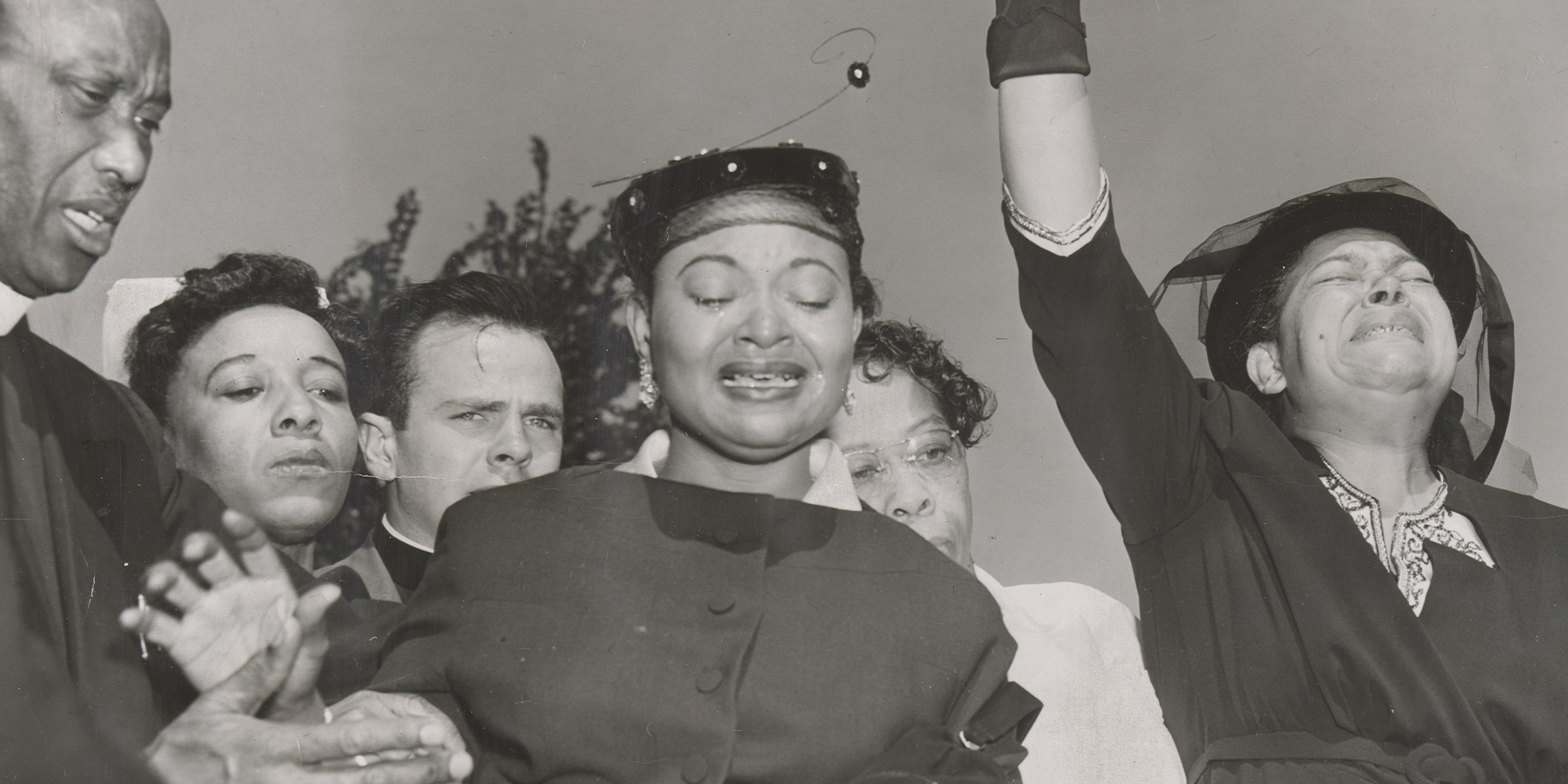
Lauren Blanding, manager at the CRMC, said the broad look at the mother and son’s experiences will allow visitors to understand the boy beyond the iconic image of Till’s open casket.
“I was born and raised in Alabama, so I knew of Emmett Till, but it was just one particular thing,” Blanding said. “Now, learning about his mom, about his family members, the connection to Mississippi, I think is a great learning opportunity. You get a broader and deeper understanding of their lives.”
The exhibit highlights Till’s short life, including his battle with childhood polio, a resulting stutter and his raucous sense of humor; how Till’s extended family has kept his memory alive since the 1955 lynching; how people can commit to social justice in their own lives; and the story of Till’s mother, who chose to give her only son an open-casket funeral to demonstrate how brutally he was murdered when the world would have preferred that she hid him away.
Jessie Jaynes-Diming, special projects associate at the Emmett Till Interpretive Center and a founding member of the Emmett Till Memorial Commission, said Till-Mobley’s story is important because of the culture of silence demanded of Black families in the South during the Jim Crow era.
“Black families were not allowed to talk about their own histories,” she said.
Till-Mobley defied this societal standard. She insisted on bringing her son’s body home to Chicago for burial. The public funeral and visitation drew thousands of mourners. She even allowed Jet, a Black-oriented magazine with a national readership, to publish photos of her, her then-fiancé (and later husband) Gene Mobley and Till’s mutilated face in the open casket.
“Mamie not only wanted the world to see what happened to her child but she wanted the world to see what was happening in this community,” Jaynes-Diming said. “By her letting the world see what happened to Emmett — and by her being strong and being supported by all the organizations that were behind her — she gave power to the other mothers who lost someone at that time.”
Till’s lynching took place during the summer of 1955, amidst the oppression of Jim Crow, when the teenage Black boy traveled to the Deep South to visit family members. The teen went into a store in Money, Mississippi, and bought some candy. Later, outside the store, he reportedly whistled at Carolyn Bryant, a white woman who worked behind the counter, as she walked by.
Based on Bryant’s word, her husband, Roy Bryant and his half-brother, J.W. Milam, went to the house of Till’s uncle, where Till and his cousins were sleeping, and demanded to see Till.
The men took Till from the home, beat him, gouged out his eye, shot him in the head, tied him with barbed wire to a 75-pound cotton-gin fan, and threw his body into the Tallahatchie River on Aug. 28, 1955.
Although the men were arrested for the murder, an all-white, all-male jury swiftly acquitted them. The men later admitted to the murder in a magazine interview but were never convicted of the crime, which became a catalyst for the Civil Rights Movement of the 1950s and ‘60s.
Till-Mobley’s actions after her only son’s lynching mobilized others to begin fighting against the unjust Jim Crow laws governing the South, including separate and unequal schools and public accommodations, anti-miscegenation laws, poll taxes and unfair voting practices.
Rosa Parks, for example, said her anger over Till’s murder inspired her just months later on Dec. 1, 1955, not to give up her seat to a white passenger on a segregated Alabama bus, leading to her arrest, which inspired the Montgomery Bus Boycott.
Till’s death inspired other young people of his time, also. The late Rep. John Lewis wrote in a posthumously published op-ed in The New York Times that Till’s lynching paralyzed him as a teenager in Alabama, but it also pushed him toward the Civil Rights Movement.
“Emmett Till was my George Floyd. He was my Rayshard Brooks, Sandra Bland and Breonna Taylor. He was 14 when he was killed, and I was only 15 years old at the time. I will never ever forget the moment when it became so clear that he could easily have been me,” Lewis wrote shortly before his death in July 2020. “In those days, fear constrained us like an imaginary prison, and troubling thoughts of potential brutality committed for no understandable reason were the bars. Though I was surrounded by two loving parents, plenty of brothers, sisters and cousins, their love could not protect me from the unholy oppression waiting just outside that family circle.”
That quote from Lewis is included in the exhibit at the CRMC.
Lewis would go on to join Freedom Riders across the South in the 1960s, lead the Student Nonviolent Coordinating Committee as chairman and have a prominent role in the Selma to Montgomery marches that culminated in Bloody Sunday before eventually joining Congress. His legacy was that of engaging in “good trouble.”
Till’s lasting legacy
In recognition of the impact of Till’s murder, Till’s name is among the first of 40 martyrs inscribed on the Civil Rights Memorial, a circular black granite table in front of the CRMC that honors the martyrs of the movement and inspires visitors to continue the march for racial equity and social justice.
“Emmett was not the only young Black child who was murdered in and around these communities,” Jaynes-Diming said. “Not only children, but men and women. So what Mamie did, she shone a light that supported them and gave value and gave them a voice to let the world see what was happening to Black families in these communities and to release that power that [white people] had over them to go to work and survive and go home and just deal with it. She lifted that off the Black community, off the Black mothers.”
In 2007, the Emmett Till Memorial Commission delivered a formal public apology to the Till family. Shortly afterward, historical markers went up to commemorate locations critical to the story of Till’s lynching. One such marker was for the remote location where Till’s body was pulled from the Tallahatchie River at Graball Landing in Glendora, Mississippi.
The first three historical markers at the site were shot multiple times before a bulletproof marker was erected. The Emmett Till & Mamie Till-Mobley: Let the World See exhibit includes one of the defiled markers with 10 bullet holes, along with a short film.
It only took 35 days for the sign featured in the exhibit to be peppered with bullet holes. The one it replaced had been hit 317 times, which is why the latest marker was created to be immune from firearms.
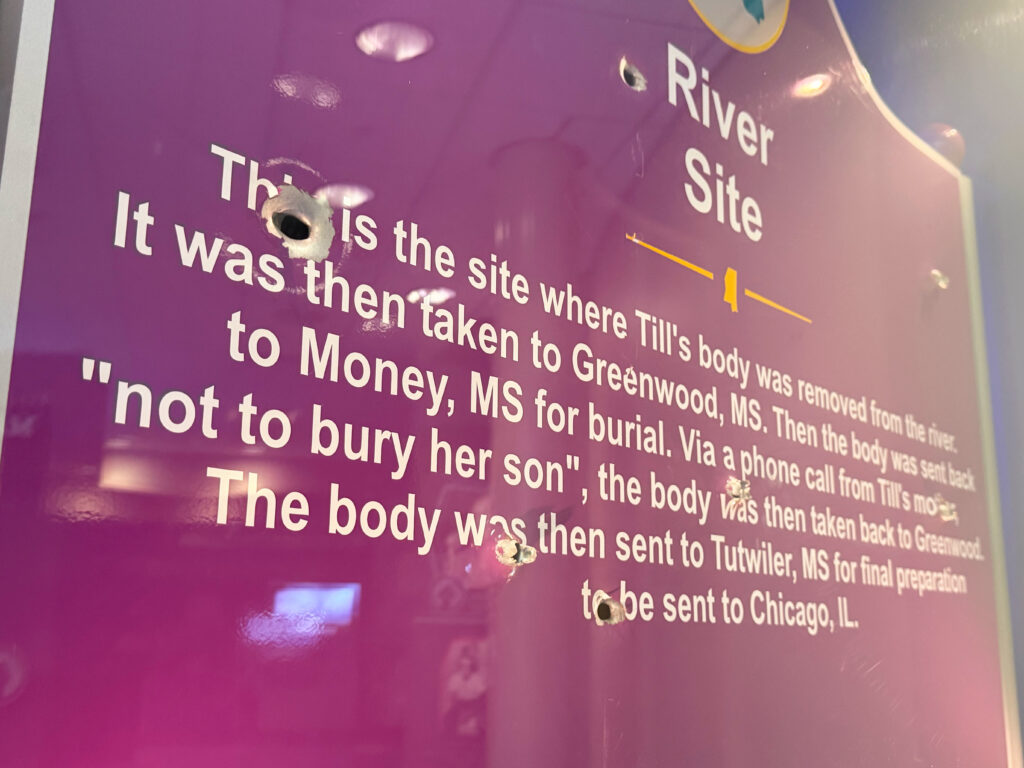
“As far as I know it’s the only bulletproof marker for a historic site that exists in the country,” said Patrick Weems, executive director at the Emmett Till Interpretive Center. “We are not going anywhere. Every time they go down, we’re going to figure out a way to put them up.”
Usually, the broken land markers would end up in a basement storage facility. Now they find new life as part of the touring exhibit, allowing people to understand that Till’s story reverberates today.
“We’re not only changing the physical landscape with these markers, we’re changing the cultural landscape at the same time,” Weems said. “There are still folks who still don’t want this story to be told. They want to erase it. They want to shoot it. They want to steal it. They want to take it off the physical and cultural landscape.”
Instead, the story of the mother and son who changed the world will continue to spread.
“Truth, when carried with courage, can change the future,” Weems said.
Emmett Till & Mamie Till-Mobley: Let the World See
April 28–Aug. 14: The touring exhibit Emmett Till & Mamie Till-Mobley: Let the World See tells the story of Emmett Till and how his mother, Mamie Till-Mobley, worked in pursuit of justice, healing and reconciliation.
Museum Hours:
Tuesday-Saturday, 9 a.m.-5 p.m. The last admittance each day is at 4:15 p.m.
Admission:
Adults: $5; Children (8-18): $2
The museum is closed on all major holidays.
Image at top: Mamie Till-Mobley at the funeral of her son, Emmett, on Sept. 6, 1955. (Credit: Smithsonian Libraries and Archives, CC0, via Wikimedia Commons)