
Editor’s note: This is the third story in the “Crossing the Line” series about efforts in the Deep South to redraw voting districts in a way that disenfranchises Black and Brown voters.
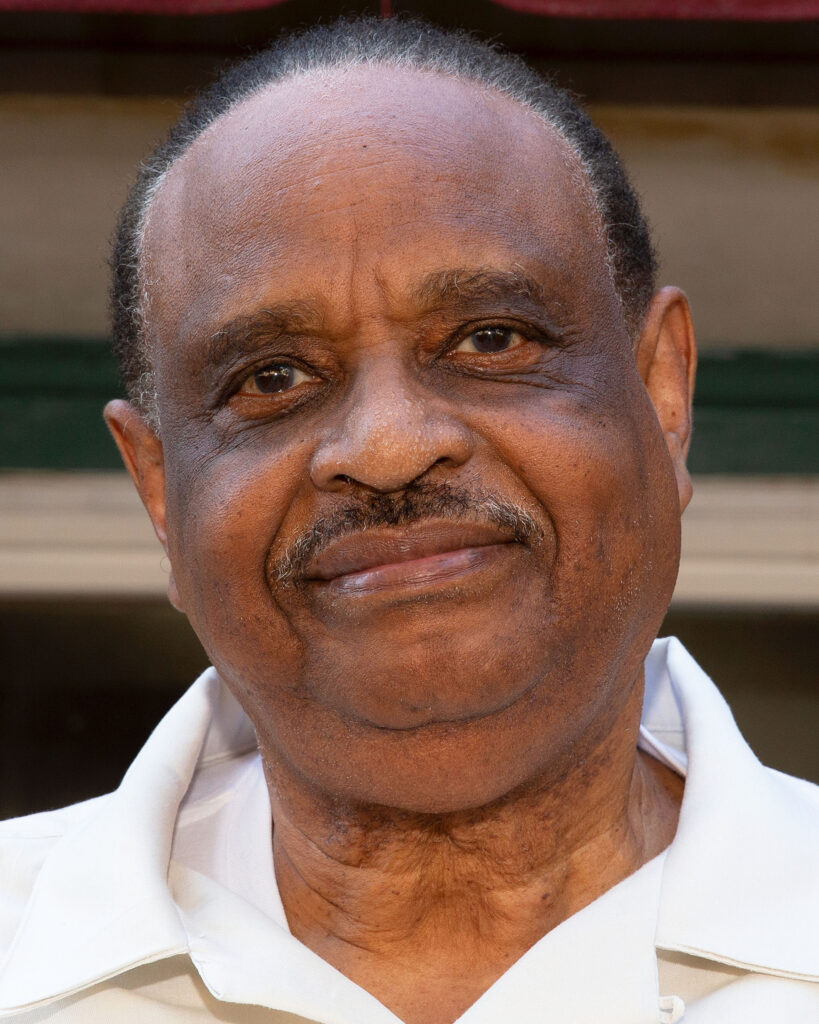
Just blocks from the sprawling Florida Capitol grounds, hidden behind a tall live oak tree draped in Spanish moss, is a squat, two-story, red-brick building. Inside sits the Tallahassee insurance offices of Al Lawson, a 77-year-old Black man from rural northern Florida. Lawson, who stands 6 feet, 7 inches tall, is a former college and professional basketball player. He is amiable and quick to offer a smile to those who walk into the warm but dated office space.
Lawson has been a fixture of Florida politics since the 1980s. Over most of four decades, he represented northern Florida in both chambers of the state Legislature.
But Lawson wanted to go national. He ran twice for the U.S. House of Representatives, losing in 2010 and 2012 in his north Florida district. Then, in 2014, a U.S. district judge threw out the existing congressional district maps.
“During slavery, most of the African Americans lived along that north Interstate 10 corridor,” Lawson said during an interview at his office in November. “All those counties in there — Madison, Jefferson, Gadsden, Leon, Columbia County, all the way down to Duval County. After slavery, a lot of ’em went north. But a lot of ’em lived in that area, but they wasn’t hardly getting any representation.”
After the lawsuit was settled and the maps were redrawn, Lawson’s potential new path to Congress stretched across the state, from the panhandle to the Atlantic Ocean. It encompassed rural areas covered in southern pines and urban areas surrounding Jacksonville along I-10.
Lawson wanted to represent the people in what voting rights experts refer to as an opportunity district — one that is drawn in a way that gives Black voters a chance to elect representatives of their own choosing.
With Black voters making up nearly two-thirds of registered Democratic voters in the freshly redrawn 5th District, the Florida Supreme Court posited in 2015 that a Democratic candidate was likely to win the general election.
The state’s highest judicial body was correct: In 2016, Lawson beat his Republican opponent roughly 64% to 36%. He would go on to represent the 5th District, filled with the descendants of Black people who chose to stay in northern Florida after the Emancipation Proclamation was issued, for six years.
That is, until the Florida Legislature stepped in again. Lawson was gerrymandered out of his seat during the reapportionment — the redistribution of legislative seats based on population changes every 10 years — following the 2020 census. The 5th District — its voters split up and added to four majority-white voting districts — would no longer run atop the Florida Panhandle.
Now, the state is in a race to draw new congressional voting maps mid-decade without new census population data, likely flouting the state’s constitution.
As Common Cause Florida Executive Director Amy Keith bluntly put it: “Florida has a long, dark history of redistricting.”
Lawson’s story illustrates the appetite that conservatives have for gerrymandering the Sunshine State at any turn, even though partisan and racial gerrymandering is illegal.
In the video: Former U.S. Rep. Alfred Lawson traces Florida’s long history of denying Black voters the opportunity to elect leaders of their choosing. (Credit: Juan Manuel Barrero Bueno)
‘A moment of self-reckoning’
As the result of a highly contentious ballot recount in the 2000 presidential election, Florida elections were already under a microscope.
Lawmakers at the state and national level instituted a number of reforms. The most crucial reform at the state level was passage of the Fair District Amendments — now known as amendments 5 and 6 to the Florida State Constitution — through petitions that registered voters initiated.
Amendments 5 and 6 outlaw partisan and racial gerrymandering and declare that districts must be contiguous, must be as equal in population as possible, and must take advantage of existing boundaries. Amendment 5 applies to state legislative districts and Amendment 6 applies to congressional districts. There had to be two separate petitions because of a quirk in the process of how to amend Florida’s constitution.
“After the 2000 election in Florida, there was an intense interest in repairing our elections, making sure everything was fair and safe,” said Jonathan Webber, Florida state policy director for the Southern Poverty Law Center, which works to protect democracy and voting rights across the Deep South, including Florida. “It really was like a moment of self-reckoning for everybody in the state of Florida. This grew out of a bipartisan movement to make our elections more fair, more transparent, and more people-focused instead of politician-focused.”
Amendments 5 and 6 both passed with about 63% of the vote in 2010.
Keith, of Common Cause Florida, which was part of the coalition that supported the amendments, said gerrymandering happened under both political parties.
“We have a very long history of gerrymandering in this state,” Keith said. “I think people in Florida do fundamentally understand that gerrymandering is part of why our representation is broken. It doesn’t surprise me that Floridians are opposed to this.”
Indeed, most Floridians are against gerrymandering. In September, Common Cause Florida found that 66% of Floridians support having Congress ban maps that favor one political party over another. Two-thirds of voters also support having Congress ban mid-decade redistricting, the likes of which have been attempted across the country from Texas to California. (A national poll in November showed a slight majority of Americans support redistricting to help boost wins in the midterm elections.)
Under the guidance of amendments 5 and 6, an ecstatic Lawson won his election to Congress in 2016. Lawson joined an elite club: Only 12 Black people have represented Florida in the U.S. House of Representatives. The state elected one Black man to Congress in 1870, but he was not in office for long. Jim Crow laws quickly took effect, codifying racial segregation and disenfranchising Black voters.
Black lawmakers didn’t win seats again until 1992, when a federal court stepped in by drawing new congressional districts.
Lawson would focus on farming and agriculture, the environment and gun safety. He was reelected in 2018 and 2020.
Then, the first wave of the COVID-19 pandemic rocked Florida, upending the once-a-decade census, reapportionment and redistricting process in the Sunshine State.
A ‘very ugly partisan fight’
The pandemic gave the state’s Republican-controlled Legislature a chance to remove community engagement from the redistricting process. Previously, a show-and-tell “road show” took place around the state. During these in-person sessions, citizens were able to weigh in on the maps that lawmakers had drawn, using new census data. Instead of opting for the kind of videoconferencing via Zoom and other online platforms that is common today, conservatives severely scaled back the operation.
Eventually, the Legislature produced maps showing newly drawn congressional districts in March 2022.
“Then we get to the final passage day, and on the floor of the house, they’re debating the final maps for a final vote, when Gov. Ron DeSantis tweets out that he’ll veto the map,” Webber said, adding that the governor cannot veto the state legislative map. “Literally throws the whole floor into chaos. Members are talking about it on the floor and saying, ‘Oh, I guess we should vote no.’ ‘Yeah, what do we vote?’ So a bunch of Republicans flipped on their own maps.”
A months-long process went up in smoke because of one tweet. The maps — which included Lawson’s district — passed by a slim margin. DeSantis vetoed the congressional map, the only one he’s legally allowed to veto, and called a special session.
The Legislature was back to square one.
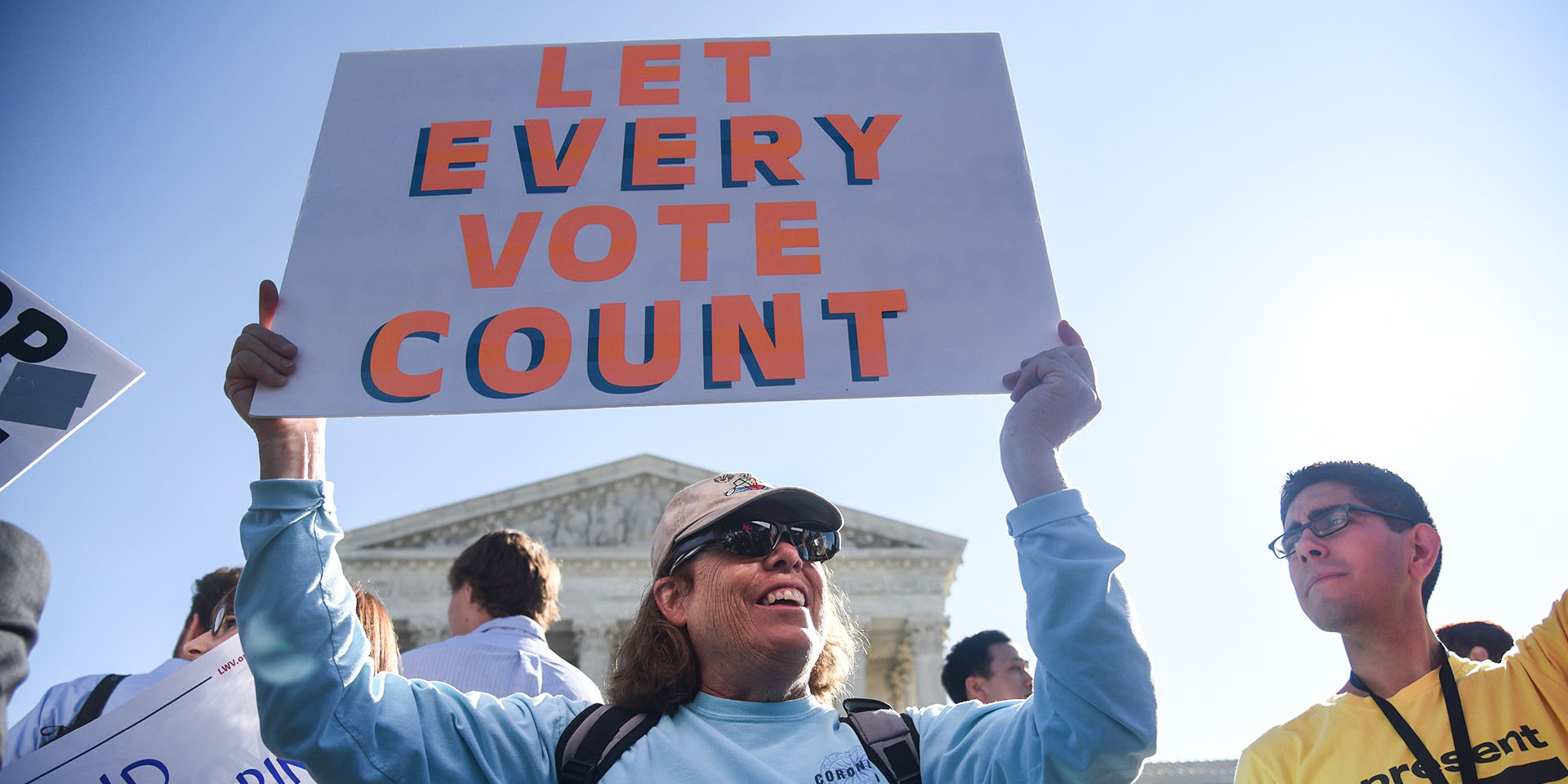
Webber described a “very ugly partisan fight” at the state Capitol after the DeSantis-approved maps went public. Florida state Democrats who wanted a fairer process held a sit-in on the House floor, chanting and praying in an attempt to stop moving the racially unfair maps forward.
The chants of “Stop the Black attack” and “We will not be denied” were futile. The resulting maps, which broke up Florida’s northern 5th District, were sent to DeSantis’ desk for approval in April 2022.
In the proposed maps, Black voters were split, moved into four different voting districts across the top of the state where they comprised at most 32% of the voting population in a district. This made it highly unlikely for them to be able to elect a candidate of their own choosing against white majorities in each gerrymandered district.
“We’ve got generation after generation who lived in the same neighborhood, the same houses sometimes, up in these small towns in north Florida,” Webber said. “We’re talking about old historic Black communities in North Florida, especially along the Georgia-Florida border. There are direct descendants of formerly enslaved people, and that’s who the governor disenfranchised.”
The legacy of discrimination against Black voters in Florida harks back to the Florida of more than 50 years ago.
“The thing that bothers me from growing up in this area is that over about a 200-mile radius, there’s no representation for African Americans as big as the population of African Americans,” Lawson said. “And it was done deliberately.”
By April, DeSantis’ map passed. Lawson’s district was gone, shunted over to the predominantly white Jacksonville region where it remains today.
“It was very disappointing,” Lawson said, recalling the news. “And the reason why I was disappointed is not so much for myself, but that after all this time the only representation that African Americans have had in CD 5 was for the six years that I was there. That was thoroughly disappointing.”
Lawson, who worked with DeSantis during their overlapping tenure in the U.S. House, expected more from someone with his background.
“You’re talking about a guy who’s an Ivy League graduate,” Lawson said. “But this governor, he’s more into the politics of who is going to be Speaker of the House.”
Lawson ran for Congress one more time, in Florida’s current 2nd Congressional District. It is the broken-up section of the old 5th Congressional District that contains Tallahassee. In 2022, U.S. Rep. Neal Dunn defeated Lawson roughly 60% to 40%. (Dunn announced on Jan. 13 that he would not seek reelection.)
“I was real thankful for [those six years] because my sister told me, a poor country boy from Midway who has been in the House, the [state] Senate, I wasn’t supposed to make legislation,” he said.
Florida’s voting maps that included Lawson’s old district continued to be mired in lawsuits until the summer of 2025.
‘Unhealthy for democracy’
Florida has been under Republican control since 1998.
There was a brief blip where Florida Gov. Charlie Crist flipped from Republican to independent for the last two years of his governorship, but for 27 years the Republican Party has remade the state in its image.
“They’ve impacted everywhere,” Webber said. “Every nook and cranny of Florida statute has been impacted by this one-party rule. I think that’s unhealthy for democracy. I think it’d be bad. It doesn’t matter which party. Push and pull is what makes democracy great. Without that push and pull, at least from one other party, you get bad idea after bad idea. Mid-decade redistricting is emblematic of that because there’s no one there to say no anymore.”
And now, Florida has formed a special committee to start the redistricting process again. There’s no new census data, just the promise of new congressional maps on the horizon for the country’s third-largest state. Florida House Speaker Daniel Perez told local media he plans to have a vote during the regular 60-day session, forgoing the need for a special session at the start of the summer.
It might not matter what the House leadership wants. DeSantis announced earlier this month that he does want a special session to focus on mid-decade redistricting — even though the decennial reapportionment process will begin again in 2030.
As Webber put it, “This is actually bad for democracy, not just good for you personally. This is bad for the country and bad for our state.”
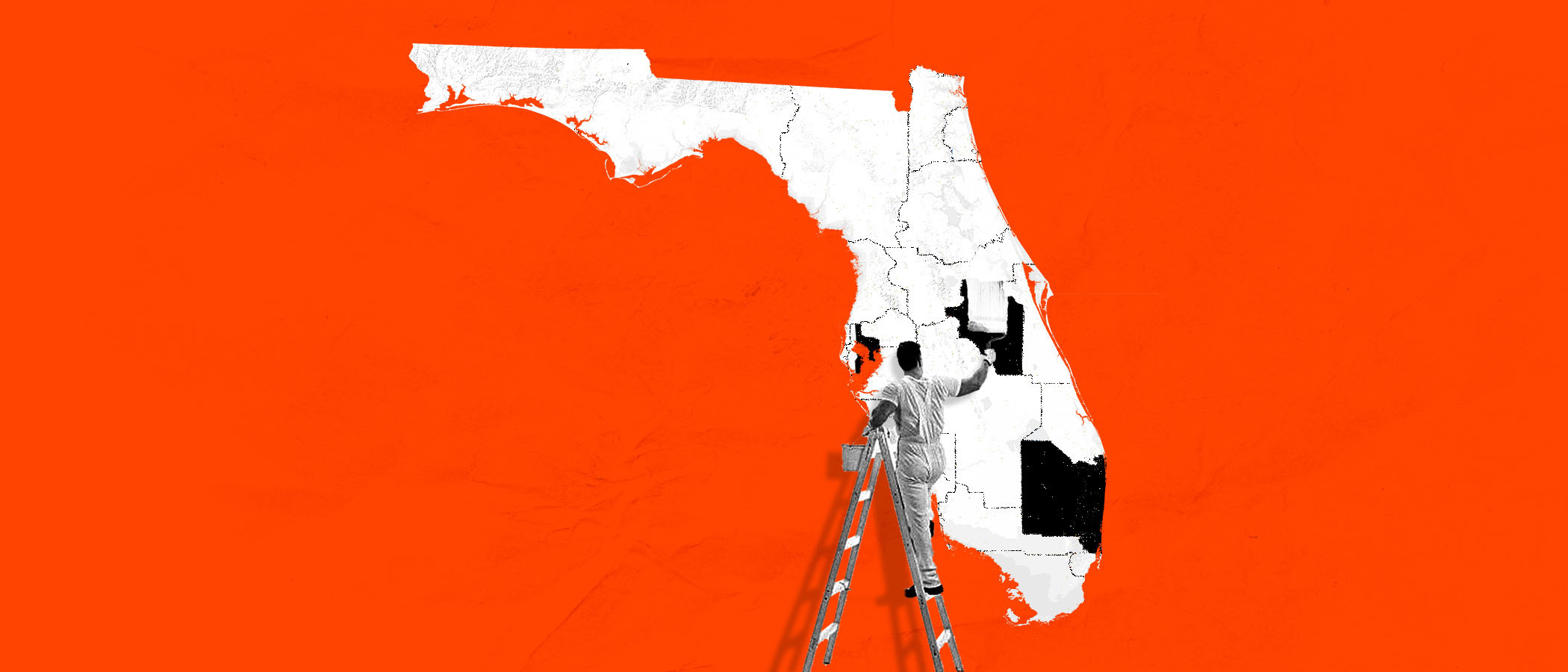
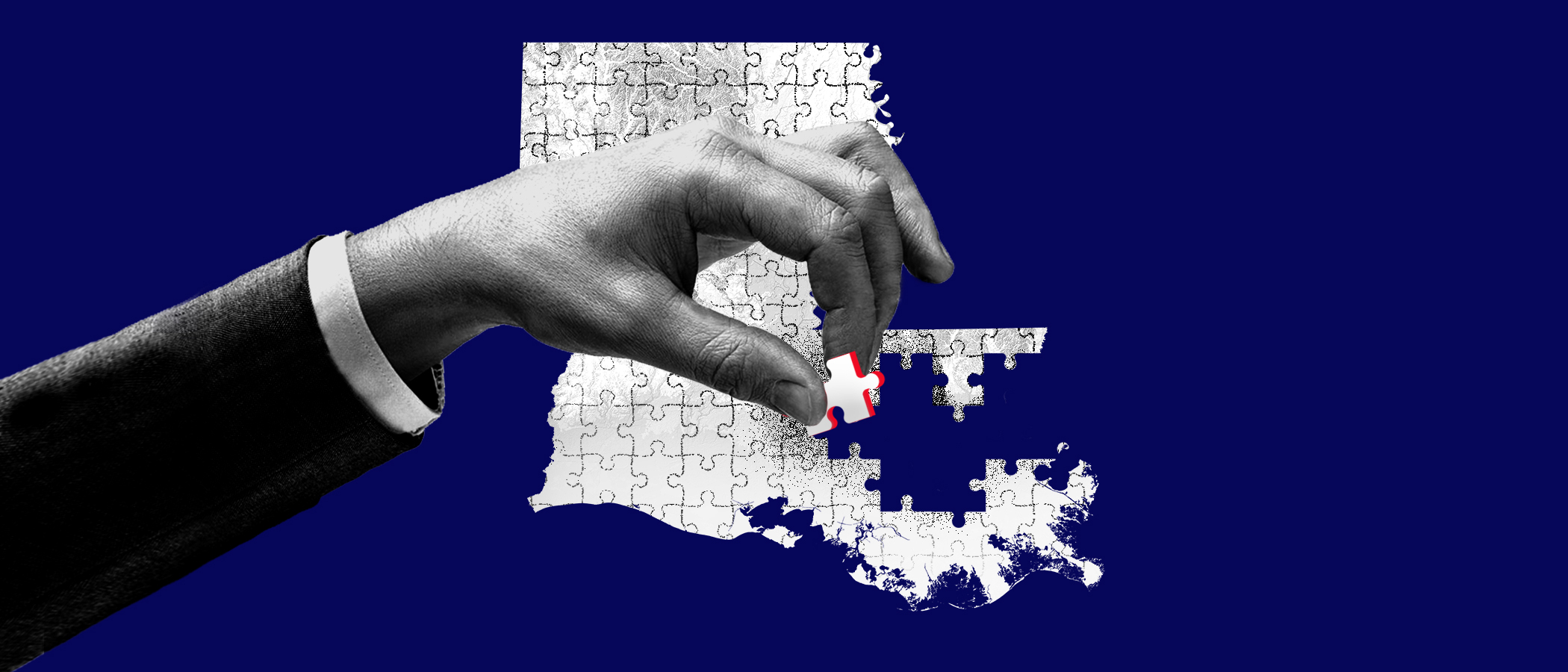
Illustration at top by the SPLC.
Related Content
-
Data hub works with SPLC to train public on fairness in redistricting efforts
-
Georgia still litigating effects of 2021 redistricting on communities of color
-

Alabama continues fight against court-ordered state Senate district voting map
-
Redistricting war pales in shadow of pending Supreme Court ‘Callais’ decision