
For weeks this summer, Doris Glasper’s taps were dry.
She had paid her rent and utility bills. She knew that much.
But her apartment complex’s owner had not. He owed more than $100,000 to JXN Water, the city’s water authority, and the residents of Blossom Apartments were suffering the consequences.
The 70-year-old grandmother shares a three-bedroom apartment in Jackson with her daughter, two granddaughters and 3-year-old grandson. She knew a full house without water was a recipe for disaster. To make matters worse, it was in the thick of August’s oppressive heat.
The simplest tasks — washing dishes, cleaning up around the house, cooking meals — became complicated. The toilets couldn’t flush properly. Bathing now required a bucket. The bulk of their drinking water came from donations.
The floodwaters that inundated the city’s water system and led to its collapse on Aug. 29, 2022, may have long receded, but the damage done to the city’s water infrastructure and its residents is still being felt. Blossom is one of 15 apartment complexes marked for water shut off due to the landowners’ nonpayment. The same owners — whom tenants paid to cover water service — say they cannot afford to settle six-figure debts with the city’s water authority that ballooned after the area’s water treatment plant failed.
Without running water, the apartments fail to meet the city’s housing and safety codes. Now, hundreds of residents — through no fault of their own — face the threat of eviction and displacement.
In August, the Southern Poverty Law Center filed a federal lawsuit against the state of Mississippi for withholding millions of dollars in emergency aid owed to Jackson that could help vulnerable residents like Glasper.
“This is still a very real crisis that is effectively evicting people from their homes,” said Crystal McElrath, a senior supervising attorney for the SPLC’s Economic Justice litigation team. “Now folks have to scramble to put down deposits and rental application fees while they’re also looking to buy bottled water and feed themselves because of this.”
‘We need help’
In the lawsuit, SPLC attorneys argue that the state of Mississippi intentionally discriminated against residents in its capital. Special processes and conditions were created making it difficult for Jackson — Mississippi’s largest city populated by mostly Black and poor residents — to secure adequate relief in the city’s time of urgent need.
“It’s hard on me right now,” Glasper said while boiling water to clean her kitchen. She is a plaintiff in the SPLC suit.
“I woke up this morning in tears,” she said, her voice strained with emotion. “I was laying in my bed crying, and I’m stilling crying.”
Her only recent ray of hope, she said, came from a visitor representing a nonprofit group who had knocked on her door the day before. The visitor offered bottled water and help finding potential housing.
“We need help,” Glasper said. “I need help.”
Disaster and neglect
In the immediate aftermath of the August 2022 flooding that brought on the collapse of Jackson’s water infrastructure, more than 100,000 residents went without clean water for months. Pipes burst, homes flooded, taps went dry.
When water began to sputter in their spouts, rust-colored liquid filled their glasses. The state issued a boil-water advisory throughout the city in September 2022. It remained in place until January 2023 — though the state’s health department still advises people who are pregnant or have young children to use bottled or filtered water for drinking and cooking.
The water system’s failure might have shocked many, but it surprised few in Jackson. Since 2016, more than 750 boil-water notices have been issued there. For decades, Jackson city leadership warned Mississippi officials that the capital’s water system was in grave need of repair. Yet state legislators have blocked or complicated the city’s attempts to seek assistance from Mississippi agencies or to raise money through taxes.
Almost $36 million in federal relief funds granted to Mississippi in 2021 through the American Rescue Plan Act (ARPA) — a year before the water system’s failure — have still not been released to city administrators, according to the SPLC’s federal complaint filed on Aug. 21, 2025, three years after the infrastructure crisis began.
“Access to clean drinking water is a birthright,” said Waikinya Clanton, the SPLC’s Mississippi state office director. “This anniversary serves as both a stark reminder of how quickly basic services can vanish when communities are systematically disinvested in and a call to action that the fight for water justice continues. There is no social justice where there is no economic and environmental justice.”
The ARPA relief funds granted to Jackson won’t cover the estimated $2 billion cost of overhauling the city’s water system. But the money would help Jackson begin the work necessary to repair its water production infrastructure and provide much-needed housing assistance to residents, like Glasper, whose lives have been uprooted by the ongoing crisis.
Discrimination under color of law
Following the passage of ARPA in March 2021, the U.S. Department of the Treasury issued $350 billion to states from the Coronavirus State and Local Fiscal Recovery Funds (SLFRF) program. Mississippi was allocated $1.8 billion of those funds, and Jackson — separately — received $42 million in SLFRF funds directly from the federal government.
The Treasury Department determined the relief money could be used to invest in water, sewer, broadband infrastructure and housing relocation assistance, as well as improve access to clean drinking water and support storm and wastewater infrastructure. It also instructed administrators that funds should be used to “aid the communities and populations hardest hit by the crisis.”
Mississippi received the first half of the $1.8 billion in SLFRF funds in May 2021 but failed to allocate any money for almost a year. In early 2022, the state Legislature allocated $400 million for water and sewer projects to the Mississippi Department of Environmental Quality (MDEQ) and $50 million to match assistance for those cities receiving less than $1 million in SLFRF funds.
Then, in April 2022, Gov. Tate Reeves signed Mississippi Senate Bill 2822 into law. This created the Mississippi Municipality and County Water Infrastructure (MCWI) grant-matching program to disperse the $450 million in funding for the state’s water projects.
But instead of getting funding moving for the state’s largest city, the law limited Jackson’s ability to secure much-needed money.
Larger cities, like Jackson, could apply for funding under the program with a one-to-one match using the money they received directly under ARPA, while smaller municipalities that received less than $1 million could request two-to-one matching.
Jackson requested funds during the first round of MCWI applications. But in the second round — when 76% of applicants submitted — the matching requirement was waived. First-round recipients were barred from applying for additional funding in the second round.
The SPLC suit maintains that the MCWI program implemented a scoring system to rank eligible applications and award funding that failed to take into proper consideration the extreme and longstanding vulnerability of Jackson’s water infrastructure.
Of the scoring system’s 100 points, a maximum of 15 points could be gained based on a municipality’s lack of access to clean water. Yet up to 24 points could be awarded to projects that were underway or would begin in six months and could be completed by Dec. 31, 2026.
Some of the work on Jackson’s system could take more than a decade to complete.
Additionally, analysis of median income and the unemployment rates of people in an applicant municipality’s service area determined nearly a quarter of awardees’ points. This meant that projects in other parts of the state could gain twice as many points in one category if the median income in that area was slightly lower than Jackson’s, even if the area already had access to clean and reliable drinking water.
“Jackson’s struggle reveals an uncomfortable truth,” Clanton said. “That in America, the most essential elements of human dignity — clean water, functioning infrastructure, and self-determination — remain privileges rather than rights for too many communities of color.”
Decades on, still waiting
MDEQ awarded Jackson $35.6 million in SLFRF money for water projects on Nov. 4, 2022. Then, in April 2023, the Mississippi Legislature passed a bill that removed from the grant matching program the scoring requirements used to evaluate the city. That bill, Mississippi SB 2444, would provide an additional $41 million to fully fund all applications submitted during the second and final round of applications.Again, those that applied in the first round were blocked from applying for additional funds.
Jackson’s need is significant. No other Mississippi city’s water system demands billions of dollars in repairs. Yet its calls for aid have gone largely unanswered. Meanwhile, the state has also thwarted the city’s own attempts to raise money.
In 2022, Reeves — who served as Mississippi treasurer from 2004 to 2012 — boasted that the state bond commission he served on denied to take up millions in bonds the Legislature approved for water infrastructure repairs in Jackson. Reeves has also rejected any proposal to compensate the capital city for lost tax revenue from large areas of tax-exempt, state-owned land and real estate, which could help to fund new infrastructure.
The SPLC suit states that Mississippi required the state’s treasury to hold funds awarded to Jackson — and only Jackson — in the Capital City Water/Sewer Projects Fund. It has not made clear what the city had to do to receive the money beyond a requirement that it submit a plan for approval outlining how it intends to use the funds. The city has had a water master plan since 1985.
Under Mississippi HB 1031, a companion bill to SB 282, time is also in short supply for Jackson residents. Any money that remains unused on Jan. 1, 2027, will be returned to the U.S. Department of the Treasury or revert to the state’s general fund.
“The state of Mississippi has had this money since 2021 — before the system reached its tipping point,” said McElrath, the SPLC senior attorney. “Mississippi has gone through all kinds of mechanisms and devices to withhold this infrastructure money, and as a result people have been suffering for years.
“What we’re seeing now is just a continuation of what made headlines in August of 2022,” she said. “And it’s going to continue until the state of Mississippi and the folks who are controlling these federal funds really take seriously the need for relief in the community.”
Drowning in politics
Days after Jackson experienced a major water service shutdown in March 2021, then-Mayor Chokwe Lumumba requested $47 million in emergency funding from the state to ensure the city could provide clean drinking water to residents. However, the state provided just $3 million.
“Before the crisis happened and since, the governor has put out warnings about support for Jackson,” said Nsombi Lambright, a resident of the Forest Hills subdivision on Jackson’s west side and a plaintiff in the SPLC suit. Although the city is not currently under a boil-water notice, Lambright said her family and many she knows continue to brush their teeth and cook with bottled water due to longstanding concerns about the water quality.
Lambright recalled Reeves’ 2023 state of the state address in which he called for the expansion of Mississippi’s Capitol Police force to curb what he described as “lawlessness in Jackson.”
“He had been saying he wasn’t going to give Jackson another dime until we did something about crime,” she said. “So, I took that as a warning that we were not going to get much support.”
All the while, Jackson’s poorest and most vulnerable residents suffer as the city’s water authority attempts to stay afloat and fund improvements through various emergency funding grants, utility payments and delinquent collections.
People like Glasper, the grandmother from Blossom Apartments, are running out of time. Her search for a suitable and affordable apartment with access to consistent, running water has so far been fruitless. It’s been difficult to find anything more than a one- or two-bedroom apartment for her five-person family, and Glasper worries that the coming cold weather will only prove to complicate her efforts.
For five days last month, a judge ordered that water be restored to Glasper’s apartment complex, but only to help residents move out. Then it was cut off again. It is uncertain exactly when her building will be shut down, but she said she has no doubt that day is rapidly approaching.
“With the way we’re going right now, we’re not going to have any choice but to accept what we can find and make it work,” she said.
Ultimately, Glasper and her family made the difficult decision to split up among family until they can find new housing.
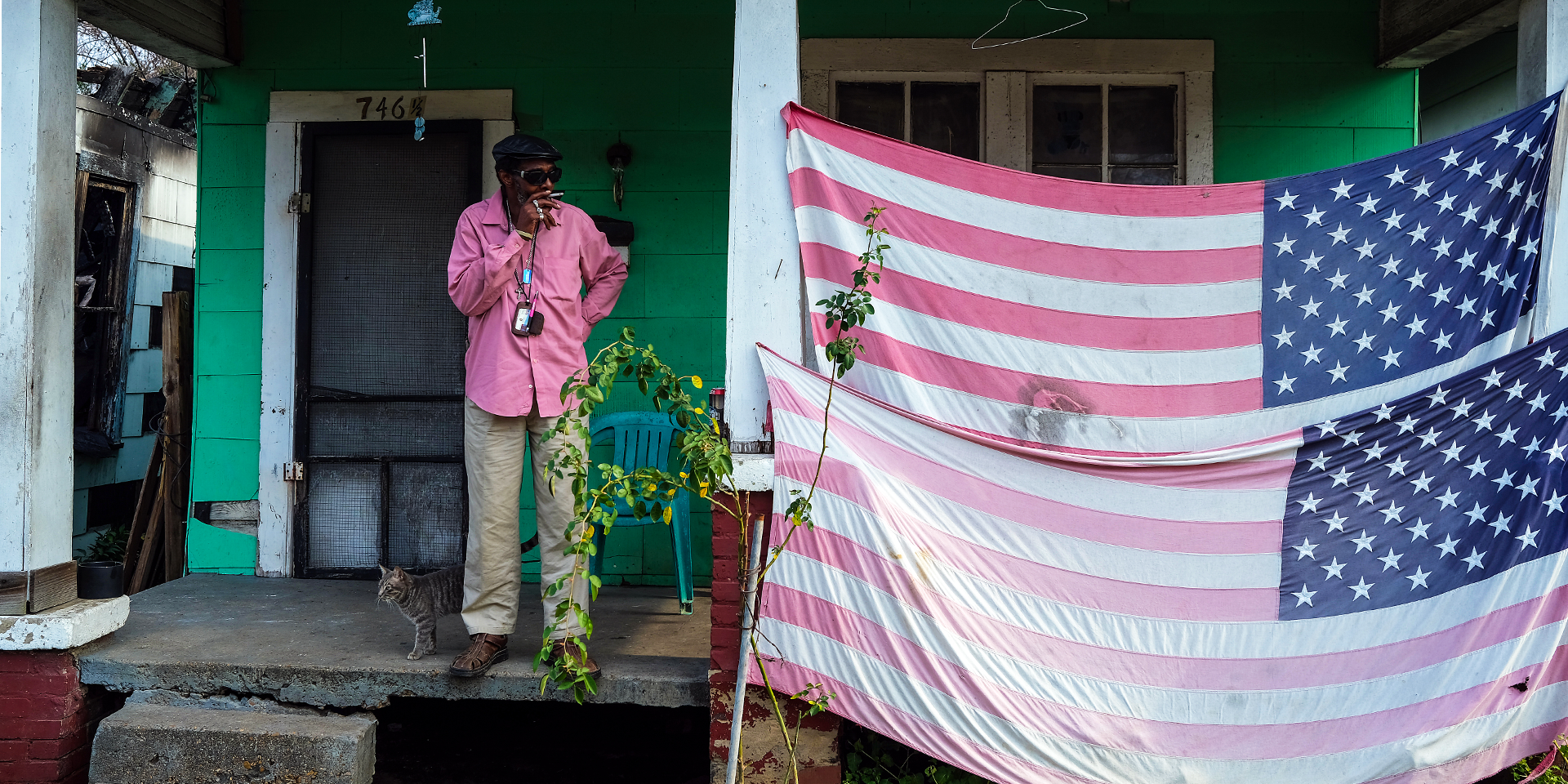
Image at top: Jackson, Mississippi, resident Lawrence Jones stands on his front porch in a photo from Dec. 10, 2022, four months after the collapse of the city’s water system. Today, residents are still contending with the damage done to Jackson’s water infrastructure, with some even facing eviction. (Credit: Joshua Lott/The Washington Post via Getty Images)