
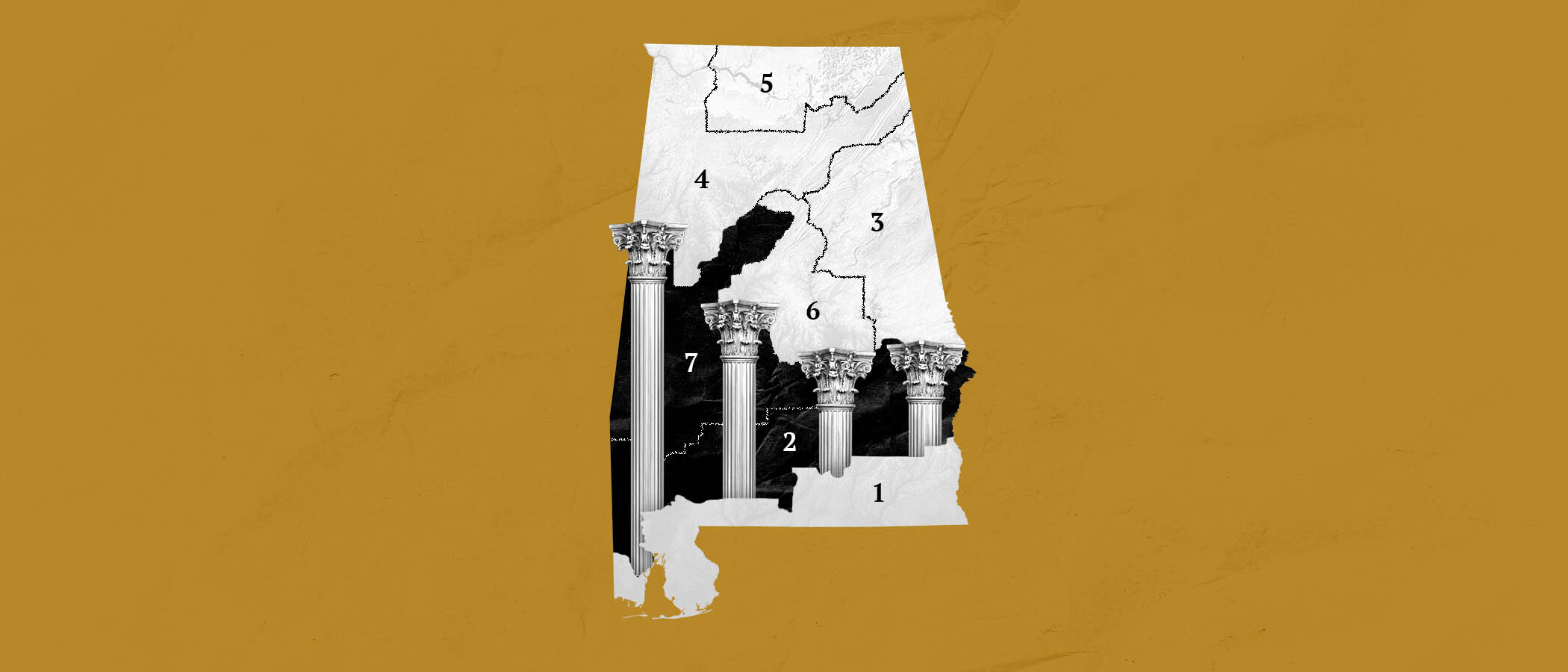
Editor’s note: This is the second story in the “Crossing the Line” series about conservative efforts in the Deep South to redraw voting districts in a way that disenfranchises Black and Brown voters.
In federal and state courts over the six decades since passage of the Voting Rights Act (VRA) of 1965, Alabama and its supermajority of predominantly white conservative legislators and politicians have staunchly defended their right to redraw voting district maps. In legislative session after legislative session, lawmakers have adopted district maps that reduce Black voting strength, effectively stealing political power from Black voters.
Closing our eyes to racial discrimination does not make it disappear.”
– Jack Genberg, senior supervising attorney with the Southern Poverty Law Center’s Democracy: Voting Rights litigation team
These maps work in two basic ways. They can be used to pack Black voters into a handful of districts that are not consistent with their actual shared social, economic or political interests, population percentages, geographic distribution or that unexplainably separates them from others with similar voting patterns. Conversely, these maps can carve up Black population centers in ways that dilute residents’ voting strength. Both schemes effectively prevent Black voters from electing people they choose to represent them.
Under the 14th Amendment of the U.S. Constitution and Section 2 of the VRA, legislatures are required to create maps that give Black voters fair political representation. But what that means has been open to interpretation in the courts.
“Discriminatory district maps that deny Black voters a fair opportunity to elect candidates of choice prevent Black communities from having a say in the policies affecting their lives,” said Jack Genberg, senior supervising attorney with the Southern Poverty Law Center’s Democracy: Voting Rights litigation team. “It shouldn’t be this hard to get states to follow the law.”
In 2021, the SPLC and co-counsel sued the Alabama secretary of state (Alabama NAACP v. Allen) and filed an amicus “friend of the court” brief in a similar case. That case challenged Alabama’s U.S. congressional map (Allen v. Milligan, formerly Milligan v. Merrill and Milligan v. Allen). Last year, federal courts again agreed that both maps denied Black voters representative political power, violating federal law.
‘They gave excuses’
Federal courts ordered Alabama Secretary of State Wes Allen to use new maps in the state’s congressional and state Senate elections after finding that the state-drawn maps diluted Black voting strength. But even after the district court and U.S. Supreme Court found that the congressional map likely diluted Black voting strength, the Alabama Legislature defied the courts.
The Legislature proposed a new map that clearly still did not provide Black Alabamians an opportunity to elect candidates of choice in a second congressional district, despite the U.S. Supreme Court and district court compelling that opportunity.
“When they [the state] refused to draw a fair congressional or state Senate map when they were offered the chance, they gave excuses and said they didn’t have to follow the judge’s order, so why would we have trusted the state to draw a fair map?” asked Evan Milligan, an individual plaintiff in both cases. “It’s a game they play to run the clock and play dumb.”
Following the state’s defeat in both cases, Allen appealed the state Senate map ruling to the 11th Circuit Court of Appeals. He then requested to stay the implementation of a new state Senate map that corrected the vote dilution pending a decision in another gerrymandered map case, Louisiana v. Callais, which the U.S. Supreme Court heard a second time on Oct. 15. The judge denied Allen’s motion to stay the state Senate map case until there is a ruling in the Callais case.
In Callais, “non-Black” plaintiffs are challenging the use of race to create voting districts under Section 2 of the VRA — which prohibits voting practices or procedures that discriminate on the basis of race — saying that the process violates their rights. Yet a ruling for Louisiana in Callais could endanger court-ordered, racially fair opportunity districts across the Deep South and beyond.
For example, depending on how extreme the Supreme Court’s ruling is in the Callais case, there are some scenarios in Alabama’s 2nd and 7th congressional districts — which gave Black voters an opportunity to elect the candidates of their choice — that are of concern to voting rights advocates. In those districts, the seats of U.S. Rep. Shomari Figures and U.S. Rep. Terri Sewell, respectively, could be placed in jeopardy.
On Nov. 21, four days after the judge selected a remedial map to be used in the 2026 election, Allen filed his intention to appeal the remedy decision in the state Senate case based on his earlier assertion that any remedial map is racially gerrymandered.
In order for Allen to win a new appeal, the appeals court would have to disregard three years of rulings against Allen’s office, including the U.S. Supreme Court’s 2023 ruling in the Milligan case, in which the court rejected “Alabama’s attempt to remake [the court’s Voting Rights Act Section 2] jurisprudence anew.” The court also ordered Alabama to create a second Black opportunity congressional district.
‘Prepared to fight on’
The plaintiffs said they are resolved to pursue the state Senate case to the end — no matter how long it takes.
“We are prepared to fight on,” said Scott Douglas, executive director of the Greater Birmingham Ministries (GBM), one of the two organizational plaintiffs in both cases along with the Alabama NAACP.
Also prepared to fight on are the SPLC’s co-counsel, ACLU, ACLU of Alabama, and the Legal Defense Fund (LDF).
Douglas keeps a tagline on his email that reads, “Alabama is a state, not an excuse.”
As a young organizer in Alabama in the 1970s, Douglas saw how pervasive apathy among people struggling just to survive led them to give up power to white outsiders who came into the state with their own agendas for improvement.
“I came up with the tagline because we should have higher expectations to make Alabama a state that is less racist, more equitable and just,” he said.
Milligan, Douglas and Benard Simelton, who served as the Alabama NAACP president for 16 years, agreed that voter suppression in the state is less prevalent across the state in areas with significant Black populations. Douglas said returning citizens — people who have been convicted of a felony but have served their sentences — are an exception because felony disfranchisement laws make it harder for returning citizens, who are disproportionately Black, to register to vote.
“The real devil we are dealing with is the total supermajority of the state Legislature,” Milligan said. “It isn’t so much that a grandma was pushed to the ground at a polling place or lives in senior housing and can’t get out to vote, but since Shelby County v. Holder in 2013, there has been a culture where voting is a hassle, or the outcome of elections are in doubt.”
In the Shelby County ruling, the U.S. Supreme Court struck down the preclearance formula in another section of the VRA that required certain jurisdictions with a history of racial discrimination in voting to seek and receive federal approval before changing their election rules.
State’s tools for stalling
Simelton has participated in numerous challenges to the state’s gerrymandered voting district maps.
In September 2025, less than a month after the court rulings in the congressional and state Senate map cases, the Alabama NAACP and organizational co-plaintiff GBM won another case the LDF and co-counsel filed on their behalf: McClure, et al. v. Jefferson County Commission. In that case, a federal court ordered the county to redraw its commission district map that had packed Black voters into only two “super” majority-minority districts. The commission has appealed the ruling.
“When the Supreme Court gutted the Voting Rights Act in 2013 and then Alabama implemented a photo ID requirement, [then-Secretary of State John] Merrill said he wanted to make voting easier and would send someone to make a photo ID for people,” Simelton said. “But he didn’t, and it made voting much harder.”
In response to the photo ID requirement, the NAACP began holding community events and sent mobile units to make photo IDs for people who couldn’t travel. But polling locations changed without warning and without information telling voters where they could go to cast their ballots.
“There was one older gentleman, in his upper 80s or 90s, who had been voting at the same location all his life, but he no longer drove so didn’t have a photo ID,” Simelton recalled. “He went to vote but couldn’t, even though everyone at the polling place knew him. His daughter contacted us to see what we could do, but it was too late.”
‘Intentional dilution of Black and Brown voting strength’
As he awaits the appellate court decision, Allen continues his strategy of stalling the implementation of court decisions and limiting the political power of Black voters.
A Supreme Court decision in Callais that would gut Section 2 of the VRA and further turn back the clock on civil rights protections for voters would be a gift to the conservative legislators who win elections solely because they engineer a gerrymandered voting district map to favor white voters.
“Closing our eyes to racial discrimination does not make it disappear,” Genberg, the SPLC attorney, said. “If the court weakens Section 2’s protections for voters of color in Callais, it opens the floodgates to the intentional dilution of Black and Brown voting strength across the South and beyond.”
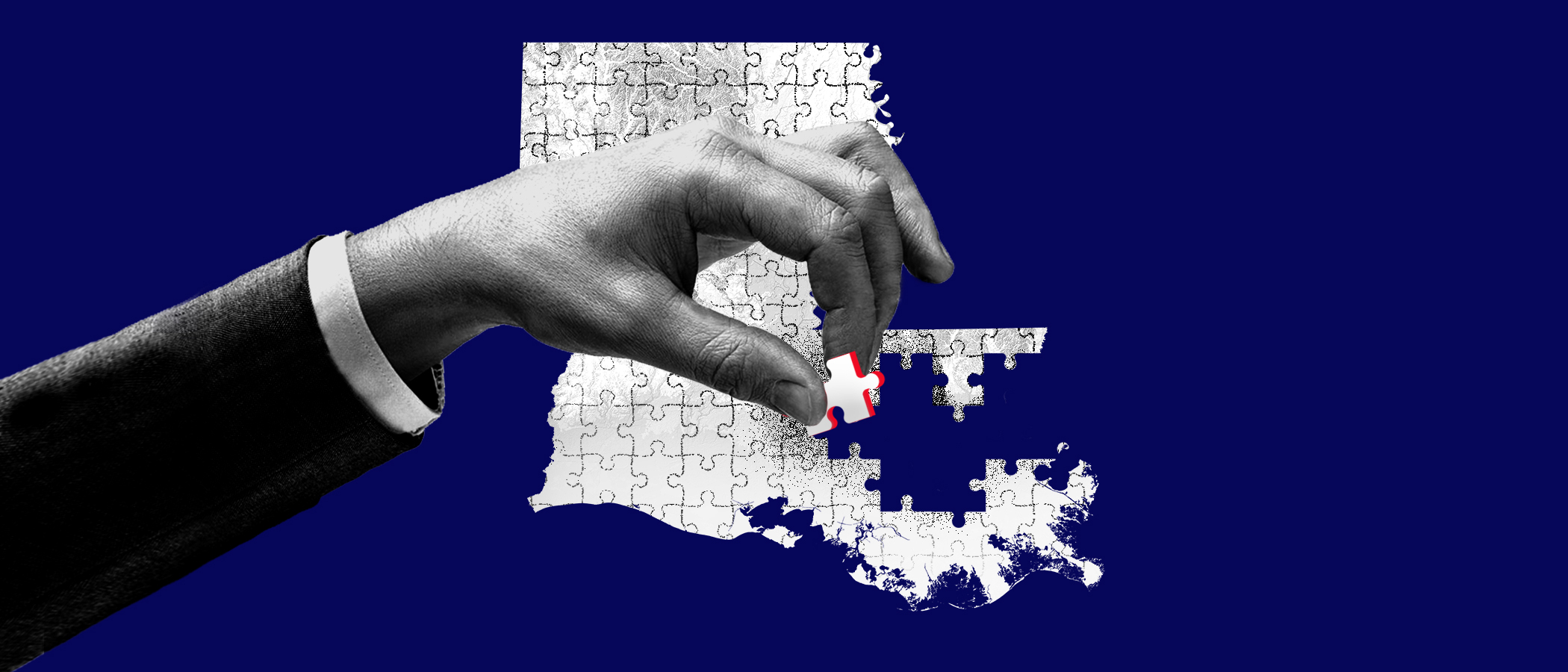
Illustration at top by the SPLC.
Related Content
-
Data hub works with SPLC to train public on fairness in redistricting efforts
-
Georgia still litigating effects of 2021 redistricting on communities of color
-
Florida’s redistricting can weaken voting power of communities of color
-
Redistricting war pales in shadow of pending Supreme Court ‘Callais’ decision