Editor’s note: This is the first story in the “Crossing the Line” series about conservative efforts in the Deep South to redraw voting districts in a way that disenfranchises Black and Brown voters.
When the Texas Legislature called a special session in the aftermath of deadly floods last year, there was plenty on the agenda, from emergency communication for natural disasters to the regulation of hemp-based products.
Nonetheless, Texas Republicans added another item after President Donald Trump sent them a clear directive to redraw the state’s voting district maps in a way that would provide his party with five more congressional seats.
The push for redistricting midway through the decade — when the constitutional practice usually only happens once every 10 years after each decade’s census reapportionment — snowballed. California announced a counter to Texas’ seat grab. Other states on both sides of the aisle declared plans to do the same. By summer’s end, the Lone Star State was the only one with brand-new congressional district lines designed to provide more Republican House seats in time for the 2026 midterm elections.
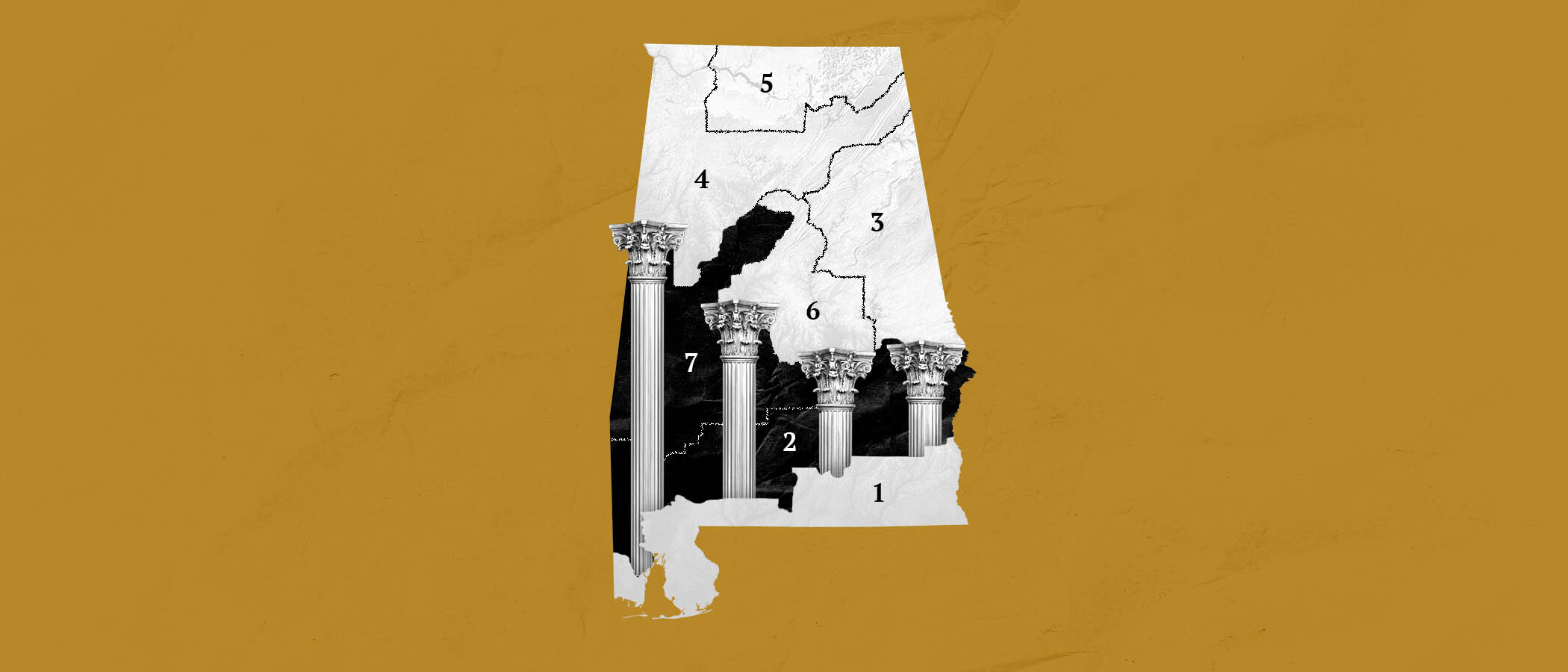
But while state legislatures across the country play with voting district maps, a U.S. Supreme Court case from Louisiana looms, carrying with it the potential to unravel minority representation in government from coast to coast and to make gerrymandering consequence-free. The case could potentially have devastating impacts on voting rights for Black and Brown people, particularly in the Deep South states of Alabama, Florida, Georgia, Louisiana and Mississippi, where the Southern Poverty Law Center focuses most of its efforts and where the legacy of the Civil Rights Movement continues to shape the struggle for racial equity.
The case, Louisiana v. Callais, seeks to undo long-standing rules about how mapmakers ensure racial minorities get the opportunity to elect leaders of their own choosing. Some white voters are now challenging these rules, known as Section 2 of the Voting Rights Act of 1965 (VRA), alleging that it violates the 14th and 15th amendments.
Ironically, the 14th and 15th amendments were ratified after slavery ended to give Black people citizenship, equal protection of the laws and the right to vote. To shore up those rights a century later, the Voting Rights Act of 1965 outlawed discriminatory voting practices — such as literacy tests — that many Southern states adopted after the Civil War to make it harder for Black people to vote. Specifically, the VRA was designed to enforce the 15th Amendment, which prohibited the denial of voting rights on the basis of “race, color or previous condition of servitude,” and it was primarily geared toward Black men after the Civil War. (Women did not get the right to vote until the 19th Amendment was ratified in 1920.)
Today’s effort to dismantle the VRA would make it harder for Black and Brown people to elect candidates of their own choosing, voting rights advocates say.
“If the Supreme Court, the United States Supreme Court, strikes down Section 2, this not only will affect congressional maps,” said Rep. Terry Landry Jr., a first-term Louisiana state legislator and former Louisiana state policy director for the SPLC. “This will affect the state legislatures. This will affect city councils. It will affect school boards. You will see a huge impact on minority representation at every level of government.”
While the redistricting fight may have started a war to see which state can deliver the most congressional seats in the 2026 midterm elections, Landry sees the Callais decision as a potential doomsday device from which there may be no coming back for minority representation.
A long, winding path to Washington
The story of what may be the most important voting rights case in a generation began in 2022. As part of its census-based reapportionment, the Louisiana Legislature drew a congressional districting map where Black voters could elect their preferred candidate to only one of the state’s six districts, even though Black people comprise one-third of the state’s population. In response, the NAACP and other parties filed suit in Robinson v. Landry (the defendant in the case was Louisiana Gov. Jeff Landry), challenging the plan under the so-called “results standard” of Section 2 of the Voting Rights Act, the primary remaining federal protection against racial discrimination in voting.
Under Section 2’s results standard, states and local jurisdictions are prohibited from imposing or applying practices or procedures that afford racial minorities fewer opportunities than other members of the electorate to participate in the political process and to elect representatives of their choice.
“The plaintiffs in the Robinson case received a favorable ruling from the district court after demonstrating that they would likely win at trial,” said Avner Shapiro, senior supervising attorney for the SPLC’s Democracy: Voting Rights litigation team and one of the authors of the SPLC’s amicus brief filed with the U.S. Supreme Court in the Callais case. “That was enough for the Legislature to say, ‘Hey, let’s not keep fighting this. Let’s just adopt a new plan that addresses the problem by creating a second majority-Black congressional district.’”
Unhappy with the new “4-2 map,” a dozen “non-African American voters” filed a federal suit — Callais v. Landry — challenging its constitutionality. The white plaintiffs claimed that the 4-2 map was an unconstitutional racial gerrymander, involving improper considerations of race over race-neutral redistricting principles.
Initially, the state defended the new 4-2 plan it had adopted.
“The 4-2 maps were voted on by a supermajority Republican Legislature,” state Rep. Terry Landry said. “The governor did not veto it. The [Louisiana] attorney general stood by it.”
However, last year, the situation changed when the Supreme Court agreed to hear the case. In taking up the case, the Supreme Court indicated it would be re-examining the constitutionality of Section 2’s results standard and assessing the extent to which efforts to comply with it may violate the equal protection clause of the 14th Amendment.
Presented with the possibility of the Supreme Court expressly declaring the results standard unconstitutional or severely curtailing its scope, Louisiana Attorney General Liz Murrill said the state was no longer going to defend the new plan. Instead of arguing the merits of the state’s map before the Supreme Court, the state joined with the plaintiffs in calling the district map unconstitutional.
Landry said the timing of the map, along with the administration’s series of flip-flops on the validity of the districts, made him think there were other motives at play in its adoption.
“The oral arguments [before the U.S. Supreme Court] did not happen until after our session ended, if I remember right,” said Landry, who along with other Black representatives makes up only about 25% of the majority-white Legislature. “Which is why we made the incredible decision to go into a special session to move the [2026 candidate qualification] dates back in anticipation of the Callais ruling. That tells me that there was forethought in getting Callais to the Supreme Court.”
‘Our last line of defense’
Although much of the emphasis on Callais has risen in relation to the 2026 congressional midterm elections, Shapiro pointed out that the effects of a decision gutting Section 2 of the VRA could have profound consequences at every level of government.
“Your vote can be undermined by the way politicians draw up a districting plan,” Shapiro said. “There are ways to transform the vote into little more than a performative act through methods that essentially dilute the vote.”
He explained that in a state like Louisiana — where voting patterns are highly polarized along racial lines, without the protections of the VRA’s results standard, Southern white politicians could potentially replace local redistricting plans with multi-representative or at-large districts to further curtail the ability of Black voters to meaningfully participate in electoral politics.
“Let’s say you replace the method for electing a city council from a system of single-member districts to one where all the members are elected at-large in a town with racially polarized voting and Black people are 47% of the population. Under this new system, Black people are still able to cast a ballot, but how much representation are they going to have? Zero.”
Shapiro said those kinds of results are not outside the realm of possibility if the results standard is ruled unconstitutional.
“The election system can transform your vote into a fairly meaningless act in the extreme case,” Shapiro said. “That’s not hypothetical. That’s basically what’s happened in the past. That’s part of the story of the South.”
At the same time, Shapiro wondered how the basic argument at the heart of Callais — that the “non-African American plaintiffs” were discriminated against — could possibly hold water before the nation’s highest court.
He also said that trying to predict how the current justices on the court will rule is a fool’s errand, even with the future of the democratic system hanging in the balance.
“It’s our last line of defense,” Shapiro said. “The fear is that we have seen this court overturn well-established precedents before, and it could happen yet again.”
‘That’s what’s at stake’
Depending on the outcome of Callais at the U.S. Supreme Court, Landry said the result could mark a step backward for his state. His best-guess scenario if the Callais decision ends Section 2 protections under the VRA is that the state adopts its old 5-1 map for the 2026 midterms.
The other possibility is more chilling.
“There’s also a slim chance — but a very realistic chance — that we go to a 6-0 map,” Landry said. “That’s what I’m afraid of.”
The possibility of having any sort of self-determination for Black voters ripped away put a more determined edge on Landry’s words as he spoke.
“I think that’s what’s at stake,” Landry said. “People think about it as being about a congressman on the federal level? No, this is going to have a trickle-down effect that will have a lasting impact for years to come. Which is why it is so frightening that the Supreme Court would even consider striking that [Section 2 of the VRA] down.”
Illustration at top by the SPLC.