
Each year hundreds of visitors, many of them young students, travel to Montgomery, Alabama, to visit the Rosa Parks Museum at Troy University.
There they learn how, on Dec. 1, 1955, Parks’ refusal to vacate her seat for a white passenger on a crowded city bus would spark a movement, one that helped usher in a new era of civil rights activism. That one act was the first drop in a deluge that would lead to the passage of landmark legislation guaranteeing equal protection under the law.
Four days after Parks’ defiant act, on Dec. 5, 1955 — 70 years ago — the Montgomery Bus Boycott began. With it, the dam of segregation began to break.
“Seventy years ago, Rosa Parks’ quiet act of defiance became a resounding call for justice,” said Lauren Blanding, manager of the Southern Poverty Law Center’s Civil Rights Memorial Center, which honors the legacy of civil rights figures and martyrs. “Her courage reminded the world that dignity cannot be denied, and equality cannot wait. As we celebrate the 70th anniversary of this bold act, her legacy challenges each of us to keep pushing for the fairness and freedom she sat down for.”
When visitors enter the Rosa Parks Museum at Montgomery and Molton streets, the site where city police arrested Parks, the doors open to reveal a replica of the bus Parks rode on that fateful day. As the voice of a narrator fills the room, visitors are invited to become bystanders and witnesses to Parks’ courageous act.
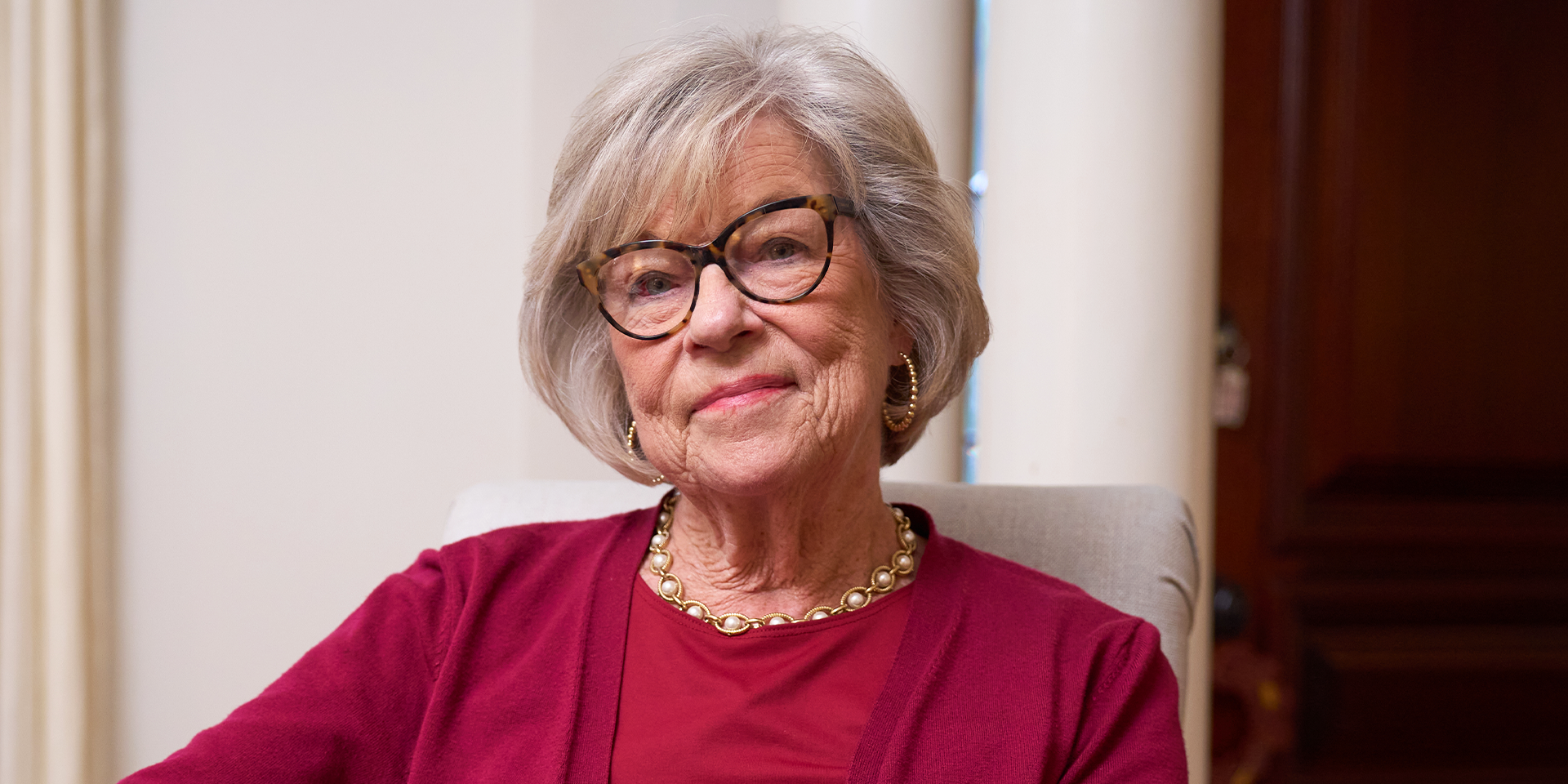
This is an experience that retired educator Melba Richardson knows well. Her eldest sister, Betty Bolton Wiens, was also riding the bus on that day in 1955. What she witnessed would have a profound impact on her.
Back then, Wiens — who died in 2010 — was a sophomore at Huntingdon College, studying art. She had boarded the bus to head downtown from her college campus for a doctor’s appointment. Wiens recalled that the bus was filled with mostly “colored”— a term that was used to refer to Black people at that time — riders and that most white riders were high school and college students.
When the bus driver noticed a white man standing, he ordered Black riders sitting in the middle seats to move.
“They all did except for one black lady. She moved from her seat closer to the window,” Wiens wrote in a 1997 essay, recalling the experience.
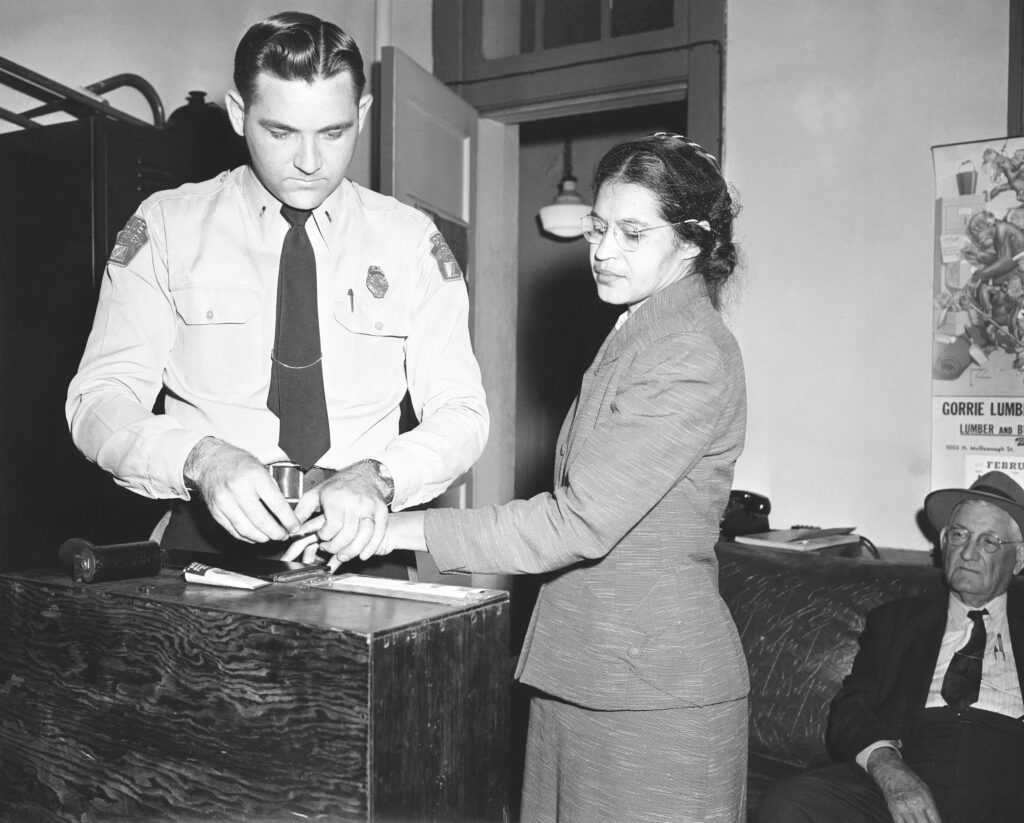
Parks’ defiance would have immediate repercussions. The white bus driver stepped off the bus and called police. Minutes later, two officers arrived to arrest her for defying the city’s segregation ordinance — even though the bus company’s rules stated that Black passengers seated in the middle and back sections of Montgomery’s buses were not required to stand so that white passengers could be seated.
“They took hold of Mrs. Parks with a hand under each of her arms,” Wiens wrote. “They took her off the bus with her feet dragging. I could never forget those tiny feet trailing this courageous lady.”
‘Stand firm on the truth’
Although Richardson and Wiens grew up in Crestview, Florida, where segregation laws also restricted the rights of Black citizens, Richardson said they had taken for granted the real costs of the racist policy. They had been raised in a religious Methodist family to believe that they were no better than the next person, but they were largely shielded from the day-to-day realities of segregation and the indignities Black people suffered.
What Wiens saw on that day shook her. She called home to relay to her parents and younger siblings what had happened. She told other students at Huntingdon — including her sister Doris, who was a freshman — sparking debates at the private Methodist college over whether segregation was a moral and just policy. Richardson said her sister complained of having nightmares.
“That began for her a mission to start a conversation at Huntingdon,” Richardson said. “And the question was, ‘Why do we treat some people differently than others?’”
As hard-fought legal protections gained during the Civil Rights Movement are being overturned and eroded in today’s political climate, Wiens’ experience seven decades ago raises the question of what obligations bystanders and fellow citizens have today to challenge unjust and inequitable policies and practices.
“Let’s be clear, there is an organized movement taking place in the U.S. to erase [this] history. They seek to not only deny the disgraceful and inhumane treatment of people — Black people, Indigenous people, immigrants, queer folks, religious minorities and more — in the U.S.; they seek to uphold white Christian supremacy — the very system that was designed to deny human and civil rights to all people,” said Lecia Brooks, interim chief of staff at the SPLC.
“The SPLC, and justice organizations more broadly, must stand firm in the truth,” Brooks continued. “We must not bend. We must continue to challenge unjust systems and build a multiracial and inclusive democracy where every person can thrive.”
‘Resounding call for justice’
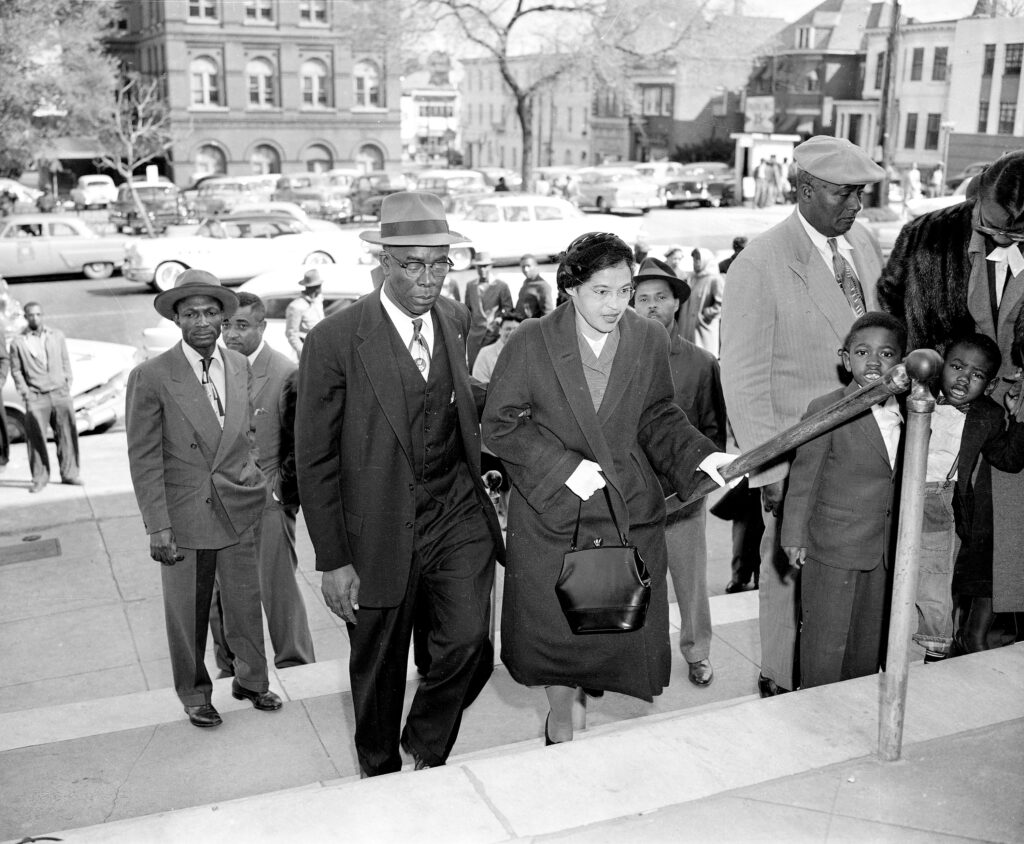
Four days after Parks’ arrest, the planning of Montgomery NAACP President E.D. Nixon, Martin Luther King Jr., Jo Ann Robinson and the Women’s Political Council, as well as students at the historically Black Alabama State College — now Alabama State University — and many others launched the Montgomery Bus Boycott. They had not intended to challenge the system of segregation itself, only the humiliation and mistreatment of Black passengers on the city’s buses. But fate took a longer view, creating the ideal conditions for the effort, experts say.
For 382 days, Black people in Montgomery, Alabama, refused to ride the city’s buses in protest. The actions of Parks, a local seamstress, prompted the boycott. Her act of defiance inspired a storm of protest and civil disobedience that would forever change the nation.
The events that followed cemented in history the teachings, activism and organizing prowess of several key figures in American history, most notably Martin Luther King Jr., who helped form the Montgomery Improvement Association during his time as pastor of Dexter Avenue Baptist Church, now named Dexter Avenue King Memorial Baptist Church.
The boycott marched on in step with a federal lawsuit argued by attorney Fred Gray that sought to desegregate public buses.
On June 5, 1956, a federal district court ruled in Browder v. Gayle that bus segregation was unconstitutional, and in November 1956 the U.S. Supreme Court affirmed the ruling, striking down laws that had required segregated seating on public buses.
On Dec. 17, 1956, the Supreme Court rejected appeals from the city of Montgomery and the state of Alabama to reconsider the decision, and three days later the order for integrated buses arrived in Montgomery. On Dec. 20, 1956, King and the Montgomery Improvement Association voted to end the 382-day boycott.
Parks has since been called the “mother of the Civil Rights Movement.” She is best known for her defiant act that set the stage for the boycott. But many people are still unaware of the breadth and depth of her activism — a notion that the Rosa Parks Museum is working to change.
Years before the famous boycott, Parks joined the Montgomery NAACP in 1943. With E.D. Nixon, she investigated cases involving not only discrimination but also police brutality, rape and murder. She became the first Alabama state secretary for the NAACP in 1946.
“Everybody knows her for refusing to give up her seat and being arrested,” said Donna Beisel, director of operations for the Rosa Parks Museum at Troy University. “But we still get a lot of visitors who don’t really understand that she was out there fighting against injustice two decades before her arrest, and for five decades after.”
The museum opened a temporary exhibit on Dec. 1 that examines Parks’ longstanding activism. Beisel said the museum is hoping to raise donations to bring the Parks collection from the Library of Congress to the museum in Montgomery as a permanent exhibit on the topic.
The museum secures most of its funding through Troy University, but there has been an atmosphere of uncertainty among many civil rights museums and organizations, as well as schools, following the current administration’s attack on what it has called a “divisive” interpretation of history. Threats to cut funding to and act against schools, museums and organizations that honestly account for the history of the U.S. have left many museum operators feeling silenced and threatened.
Beisel said the museum is not immune to these actions, nor the atmosphere they create. Some international groups that previously visited annually told Beisel that they didn’t feel safe visiting the museum at this time.
“We had a few school groups that canceled trips,” Beisel said. “Teachers weren’t told exactly why, as they’d been coming for years. We also had some international visitors who had already booked trips. So, they came but said that they would not come back.”
Despite these setbacks, some experts say this current political and cultural moment offers the ideal time to revisit the activism of Parks and others. The SPLC’s Brooks, for example, said contemporary activists must find inspiration and possibility in the instructive history of civil disobedience that the founders of the Civil Rights Movement left behind.
“It is far easier for me to take a stand against injustice today than it was for Mrs. Parks,” Brooks said. “To not take a stand in this political moment would be to dishonor the sacrifices she and countless others made on my behalf.”
Image at top: Melba Bolton Richardson at her home in Montgomery, Alabama, in November 2025. (Credit: David Naugle)