As the fastest-growing racial group in the country, Asian Americans and Pacific Islanders (AAPI) are becoming increasingly powerful at the polls.
Over the past four years, the number of eligible AAPI voters has grown by 15%, or about 2 million, much faster than the 3% growth rate for all eligible voters over the same period, according to the Pew Research Center.
The growing political influence of AAPI voters often surpasses the margin of victory in key battleground areas and is why AAPI voters are reshaping the political landscape in the run-up to next year’s midterm elections.
As a national civic engagement organization, APIAVote is working to tap into that voting power by helping AAPI communities trust the democratic process and see themselves reflected in it.
“We’re focused on educating, mobilizing and empowering Asian American, Pacific Islander and Native Hawaiian communities through voting and civic participation,” said Kevin Hirano, APIAVote’s deputy director. “Asian Americans are growing in every single state in this country. We are that margin of victory, not only in the battleground states, but in a growing number of congressional districts.”
APIAVote invests directly in AAPI-led grassroots organizations that already serve as trusted messengers in their communities. The organization has awarded grants to 30 partner groups across the country that also receive communications and technical assistance from APIAVote to reach voters in ways that reflect their local realities.
The Southern Poverty Law Center is helping to support APIAVote’s work through its Vote Your Voice program.
The SPLC established the Vote Your Voice program in 2020 with $100 million in grants available to help grassroots organizations in the Deep South build capacity and extend their voter outreach and civic engagement efforts over the next decade. Vote Your Voice Program Officer Robin Brulé said APIAVote’s thoughtful and deliberate approach to its work highlights the unique opportunities and challenges within Asian American and Pacific Islander communities.
“AAPI communities are not a monolith,” Brulé said. “They don’t represent just one culture or one place on a map. AAPI people face a multitude of barriers, from language access to misinformation and disinformation and the legacy of laws that have discriminated against Asian communities. It’s a reminder of how exclusion has always shaped who is seen as part of the American fabric and who isn’t. That’s why civic engagement matters. That’s why APIAVote is effective at what they do. They are making sure people know their rights. They understand local challenges and are ensuring people have access to the ballot in a way that makes sense for their community.”
Meeting communities where they are
Trust, Hirano said, is the first step to getting people to the polls. APIAVote aims to give local partners the funding and tools they need to help neighbors see themselves in the system, strengthening that trust.
“We hope to provide these communities with an understanding of what it means to vote and what citizenship means to the average person,” Hirano said.
APIAVote also helps people without U.S. citizenship learn how they can participate in the democratic process.
“Even if you’re not a citizen and you may not be able to vote, there are so many other things you can do,” Hirano said.
Strategic communication is a cornerstone of APIAVote’s efforts to ensure AAPI communities have access to clear, trustworthy information. That work consists of digital advertising, direct mail and translated materials that include definitions for key terms. During the last census, APIAVote translated materials into 30 languages to help community members understand questions.
“Even terms like ‘democracy’ or ‘governor’ don’t always translate,” Hirano said. “For people coming from countries where voting was dangerous, part of our work is helping them feel safe having their voices heard.”
The organization’s communications program also includes media training for partners who serve as community spokespeople.
“Media outreach is really critical, not only to support our partners directly but to create a national engine that everyone can leverage,” Hirano said.
Here are some other multistate Vote Your Voice grantees that are working to ensure equitable access to the ballot box:
Mosaic Changemakers
Mosaic Changemakers propels the power and possibility of changemakers of color across the South through programs like its yearlong Mosaic Fellowship and lifelong network of support. Participants take part in immersive retreats, virtual seminars and coalition-building workshops designed to deepen self-reflection, advance social justice and strengthen cross-community solidarity. Based in Nashville, the organization serves emerging leaders from Alabama, Florida, Georgia, Mississippi, North Carolina and Tennessee, grounding its work in the South’s distinct challenges and opportunities while preparing a new generation to drive lasting, equitable change.
Urban Strategies Inc.
Based in St. Louis, Missouri, Urban Strategies Inc. (USI) is a national nonprofit that partners with government agencies, housing authorities, community groups and foundations to support families and revitalize neighborhoods. Its work centers on five core pillars: housing stability, education and careers, economic mobility, health and wellness and community engagement. Through data-driven, resident-centered strategies, USI has served communities across more than 60 localities, helping residents achieve stability and opportunity while building stronger, more equitable neighborhoods.
Investing in young leaders and grassroots organizing
With a median voter age around 41, Asian Americans are also among the nation’s youngest electorates. APIAVote sees that as both an opportunity and a responsibility. The organization has been creating a pipeline for its youth leaders since its inception, Hirano said.
“In fact, three or four of the 14 staff that we have come from that pipeline,” he said. “So we put our money where our mouth is and ensure we’re investing in programs that focus on helping our community leaders get comfortable with their identity and use that understanding in order to build their muscle to organize and inspire others to have their voices heard on the issues that matter the most.”
In Florida, APIAVote’s investment is visible in the work of Field Organizer Hannah Locop. She began leading a statewide coalition of AAPI partners in 2021 and was able to transition into a full-time organizing role at APIAVote after the organization received Vote Your Voice funding.
Locop coordinates an ambassador program that trains college students to lead local civic engagement on their campuses. Locop offers guidance for navigating restrictive state laws on voter registration and developing practical organizing skills like scheduling phone-bank shifts and managing volunteers all while balancing student life.
APIAVote also creates spaces for AAPI community members to connect with one another, often for the first time, through trainings and programs that bring together people who might not otherwise meet.
In partnership with the AAPI Coming Together (ACT) coalition, an APIAVote grantee, Locop helped facilitate a leadership institute in Orlando that trained local residents and strengthened community connections among AAPI voters.
“I’m proud to say they then spoke to their friends and family about voting, which sounds very simple, but for a lot of folks, this was the first time they’d ever gathered with other AAPIs in their city,” Locop said. “They did not know an organization called Asian Americans Coming Together Florida actually existed.”
Florida’s political climate adds another layer of urgency to the work, she said. Locop traveled across Florida for eight months, from Jacksonville to Miami, meeting residents who felt unseen.
“People have turned their backs on us,” she said. “They think Florida isn’t worth investing in except for vacations or the lack of income tax. But AAPI Floridians want to live the American ideal of a pluralistic society where everyone can get along and buy a house. Unfortunately, that’s not the state we live in, so education is powerful. When we show people the opportunities to improve our state, something lights up in them.”
A broader movement
As APIAVote and its partners prepare for the next election cycle, Hirano said the organization is focused on sustaining movement as voters have grown weary.
“No party has any majority in terms of trust,” Hirano said. “People are tired of party politics, of being told, ‘Oh, trust us, these are our values,’ but nothing ever gets done on the issues that they care about most.”
Hirano believes the future of civic engagement depends on organizations that earn trust from the ground up through relationships built in communities and cultural spaces across the country.
“It’s going to take organizations like us and organizers like Hannah, trusted messengers who speak the language of their neighbors,” he said. “Our job is to help communities heal and remind them it’s not a time to give up.”
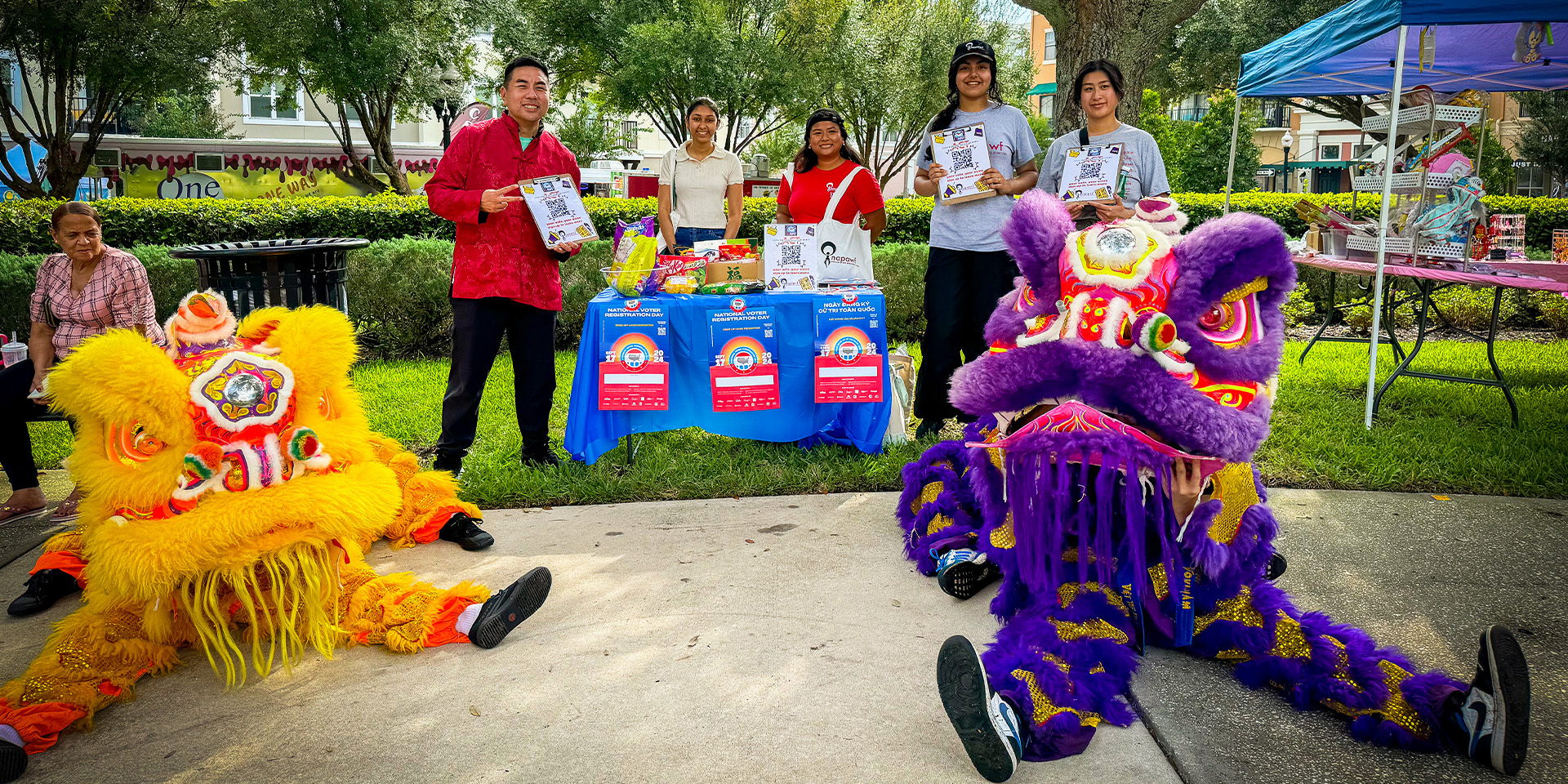
Image at top: Asian American Pacific Islanders Coming Together (ACT), a grantee of APIAVote, conducts voter education tabling during a Chinese cultural event in Central Florida in 2024. (Courtesy of APIAVote)