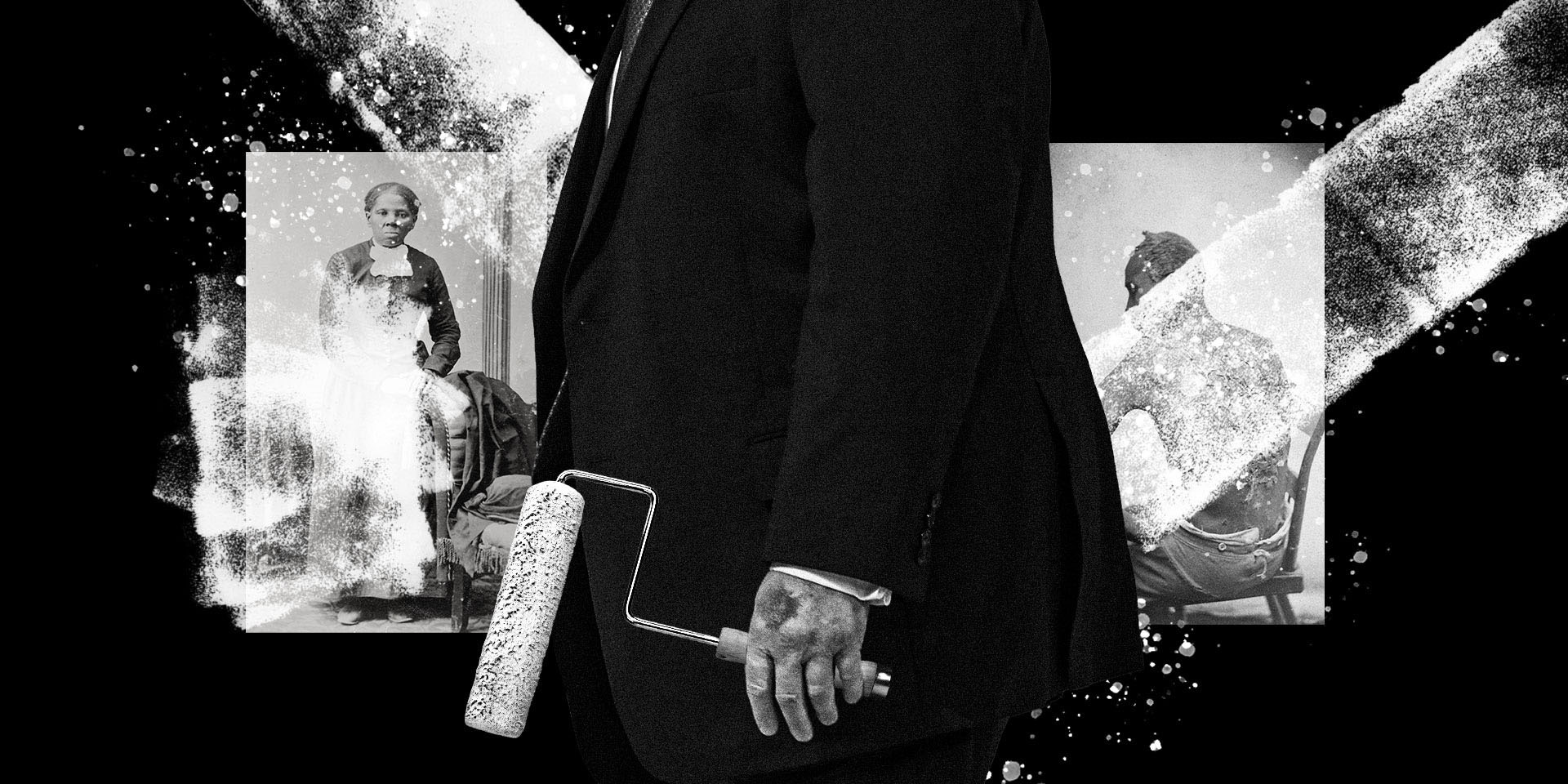
Since taking office last year, President Donald Trump and his administration have launched a full-scale attack on American history, glorifying racists and traitors and erasing not only the horrors of slavery, but also positive stories of resistance and the triumph of democracy.
The steps Trump has taken to distort American history to serve his antidemocratic agenda have been strident and harmful, but they are simply the latest in a tired, centuries-old attempt at revisionist history by those opposed to multiracial democracy. Reviewing the timeline of Trump’s attacks on American history and putting them in historical context can reveal this administration’s aims and help counter them.
In February 2025, Secretary of Defense Pete Hegseth announced, “Bragg is back!” boasting that the administration had returned the Confederate name “Bragg” to the U.S. military base that Congress had, through bipartisan efforts, renamed Fort Liberty in 2023. In a post on X, Hegseth wrote: “Bragg now. More to come.” On March 3, 2025, the administration removed the name “Moore” from a U.S. military base in Georgia, returning its former name Benning, evoking its original namesake, Confederate Gen. Henry L. Benning.
By … invoking the name of World War II soldier Private Roland Bragg, Secretary Hegseth has not violated the letter of the law, but he has violated its spirit.”
— U.S. Sen. Jack Reed, ranking member of the Senate Armed Services Committee

Hegseth’s unilateral action stands in stark contrast to the bipartisan, democratic efforts that led to the removal of these Confederate names. In 2020, with overwhelming bipartisan support, Congress mandated that the military change the names of all nine bases named after Confederates. An independent, nonpartisan naming commission found new names that honored American heroes and principles instead, and by the end of 2023, the military had removed all Confederate names.
In his first full month in office, Trump set about reversing this careful and democratic work. On June 10, 2025, Trump announced the restoration of Confederate names to all nine bases. Because the 2020 bipartisan law that called for removing Confederate names stated that no base could be renamed for a Confederate leader, Trump and Hegseth found other past servicemen with the same names as Confederate leaders, such as Bragg, Benning and Lee, and used their names instead. U.S. Sen. Jack Reed of Rhode Island, the ranking member of the Senate Armed Services Committee, called this move insulting and dishonorable.
“By … invoking the name of World War II soldier Private Roland Bragg, Secretary Hegseth has not violated the letter of the law, but he has violated its spirit,” Reed said in a written statement. “Worse, he has insulted the Gold Star families who proudly supported Fort Liberty’s name, and he has dishonored himself by associating Private Bragg’s good name with a Confederate traitor.”
On March 27, 2025, Trump issued Executive Order 14253: “Restoring Truth and Sanity to American History.” The executive order singled out Independence National Historical Park in Philadelphia for sponsoring trainings for staff that advocated “interrogating institutional racism.” In January, the Department of the Interior removed Independence Hall’s slavery exhibit, which included a memorial to people enslaved by George Washington at the site of his Philadelphia residence. The city of Philadelphia is suing the federal government over the removal of the exhibit, and citizens have put up handmade signs advocating for telling Black history.
The executive order also attacked the Smithsonian American Art Museum for featuring stories on “systems of power, privilege, and disenfranchisement.” The executive order empowered the secretary of the interior to review all federally funded spaces of public history and pushed national parks and the Smithsonian museums to erase evidence of injustice and the struggle for freedom and democracy.

In April, the Trump administration cut federal funding to the Whitney Plantation in Louisiana, one of only two historic plantations in America that educates about the history of slavery and the experience of enslaved people. The termination of the federal grant threatened to quash a new exhibit on resistance to slavery that the Whitney planned for January 2026. A letter terminating the federal grant explained that the termination complied with 14253 and that the grant was “no longer consistent with the [federal government] priorities and no longer serves the interest of the United States.”
Following the executive order, federal websites removed the names of thousands of non-white figures in American history, such as Harriet Tubman, the Tuskegee Airmen and the Navajo Code Talkers. An image of the Enola Gay, the plane that dropped the atomic bomb over Hiroshima, Japan, was flagged for removal, possibly because of the word “gay” — the name of the B-29 pilot’s mother, Enola Gay Tibbets. In addition to the Enola Gay, the military flagged several images on its websites as “DEI” (diversity, equity and inclusion) that should be removed — mostly content about war heroes who were Americans of color or other minorities.

More fallout from the executive order came on June 13, 2025, when the National Park Service placed signs throughout park grounds asking visitors to use QR codes to report any “negative history” they encounter at the parks. Two months later, Trump ordered a review of content at the Smithsonian museums for “negative history.” On Sept. 12, 2025, the National Park Service ordered the removal of “The Scourged Back,” a photo of an enslaved man’s scarred and wounded back, from display at Fort Pulaski National Monument in Georgia. In the 1860s, the circulation of this photo made white Americans painfully aware of the horrors of slavery and helped galvanize public support for the Union and for emancipation.
On Aug. 7, 2025, Trump and Hegseth claimed that they would return the Confederate memorial to Arlington National Cemetery, which the military removed in December 2023. Fortunately, this has not happened yet, despite Trump’s assurances. However, on Oct. 27, 2025, Trump restored a statue of Confederate Gen. Albert Pike to Washington, D.C.’s Judiciary Square. This monument had been removed in 2020 by Black Lives Matter protesters. Its restoration means a statue of a man who committed treason against the United States stands in the nation’s capital. What’s more, it means a statue of a white supremacist stands in a city where Black residents form a plurality.

Waging ‘a war of ideas’
While Trump’s attempts to uplift traitors and racists over heroes who fought against slavery and fascism are a threat to public memory and true history, they are just the latest in a centuries-old campaign against history by those opposed to multiracial democracy.
One year after the Civil War, former Confederate Edward Pollard wrote that what the South lost on the battlefield it could still win “in a war of ideas.” The war of ideas was a struggle for American memory, and former Confederates waged this war in multiple arenas. They erected memorials designed to remake Confederate heroes as American heroes — hence the nine military bases named for men who fought against the United States. They attacked and revised Civil War history in textbooks.
They attempted to erase slavery from American memory, particularly slavery as the cause of the Confederacy. In 1919, the United Daughters of the Confederacy (UDC) published a guide for textbooks, demanding that school districts reject textbooks that vilified Confederate President Jefferson Davis or glorified President Abraham Lincoln. Above all, the guide instructed, schools should reject textbooks that demonstrate the Confederacy fought for slavery, and ones that speak “of the slaveholder of the South as cruel and unjust to his slaves.”
Trump’s attacks on history are straight out of this old UDC playbook. For centuries, groups like the UDC and others who opposed multiracial democracy tried to erase the horrors of slavery and who fought for justice. Despite the large success of this propaganda campaign, many Americans — especially Black Americans — continue to remember and preserve the truth in their stories and their communities.
For example, in June 2025, college students in Augusta, Georgia, took public history into their own hands, working with the city to place two new historical markers, one celebrating the city’s civil rights history and one celebrating its Jewish heritage. In October, Eastern Tennessee State University unveiled a bronze sculpture of Eugene Caruthers, Elizabeth W. Crawford, George L. Nichols, Mary Luellen Wagner and Clarence McKinney — Black students who integrated the school in the 1950s. Uplifting stories like these will ensure that true history prevails and democracy triumphs.
Image at top: Photo illustration by the SPLC. Source images from the Library of Congress (portrait of Harriet Tubman), the National Gallery of Art (“Scourged Back” portrait), Getty Images (Donald Trump) and iStock.