International Holocaust Remembrance Day: Why ‘never again’ still isn’t enough
Alon Milwicki
International Holocaust Remembrance Day: Why ‘never again’ still isn’t enough
International Holocaust Remembrance Day calls on us to examine what we are teaching the next generation about how the Holocaust happened and why its lessons still matter now.
The Holocaust is a central event in human history — a kind of primal scene we return to whenever we want to picture absolute evil, unambiguous victims and perpetrators, and the outer limits of what humans can do to one another. Because of this, the way we teach and invoke the Holocaust is vital: It can either sharpen our moral vision or settle into a ritual that leaves space for complacency and distortion.
Research on the efficacy of Holocaust education shows that when lessons focus on atrocity images or on feel‑good rescue stories rather than the incremental legal changes, the erosion of rights and propaganda, students may leave with the knowledge of what happened but without tools to recognize similar patterns in their own societies. “Never again” existing as a free‑floating slogan, detached from the hard questions of how and why the Holocaust happened — and why people allowed it to happen — can create a space to disavow that it ever happened.
Holocaust denial, revisionism and distortion are not fringe relics; they are organized, adaptive industries that have expanded their reach and infrastructure in the past two years.”
After the antisemitic Bondi Beach terror attack in Australia on Dec. 14, 2025, in which two terrorists opened fire on a Hanukkah celebration and killed 15 people, U.S. Special Envoy for Holocaust Issues Ellen Germain warned that Holocaust education is not the silver bullet to combat antisemitism.
“Holocaust education has often been touted as the way to fight antisemitism. We thought if people only understood, studied, if the world knew the history of the Holocaust, there would be no more antisemitism because it was so horrific. We see now that it is clearly not the case. Holocaust education is still hugely important. It is still necessary,” Germain said. “But it is not sufficient.”
If “never again” is going to retain any meaning, it must be anchored in those “how” and “why” questions — tied to democratic backsliding, propaganda and everyday complicity — and to honest scrutiny of our own rhetoric and policies, not just condemnation of Nazis in the abstract.
What Holocaust teaching requires
The Holocaust must be taught with more depth and context than just the “never again” slogan. It was a state‑driven, transnational project to eradicate Jewish people from the world, built step by legal step and normalized in the eyes of millions of ordinary people. But focusing only on the horror of the camps and the magnitude of the death risks missing what makes the Holocaust such a brutal mirror for any society that wants to believe it is immune.
As the Southern Poverty Law Center has noted in previous reports, teaching the Holocaust must show how law, media, churches, courts and classrooms were repurposed to sort human beings into those who belonged and those who could be dispossessed, expelled or killed — and then press students to see where that same machinery is humming now. Effective teaching exposes those steps: the laws, court rulings, media narratives and religious justifications that transformed “the Jews” from neighbors into a problem to manage and then eliminate. Tropes about Jewish control of money, media or shadow government power do not disappear; they are repackaged and redeployed, which is why students must learn how these ideas became policy in the 1930s and 1940s if they are going to recognize their updated forms in the 2020s.
We must also expose the danger of forgetting and distortion: the way revisionist networks such as the Committee for Open Debate on the Holocaust (CODOH), the Institute for Historical Review (IHR), figures like Germar Rudolf, and propagandists such as Stew Peters work, right now, to turn a meticulously documented genocide into just another “controversy.”
Selective empathy in public life
The misuse of Holocaust memory is not confined to outright denial or extremists. This hypocrisy is stark when public figures use performative concern for Jewish safety and memory to justify embracing eliminationist and extremist language toward others. In Texas, for example, state Agriculture Commissioner Sid Miller shared a meme on social media suggesting that the U.S. should drop an atomic bomb on the “Muslim world.” After backlash, his office refused to apologize and framed the post as thought-provoking rather than hateful. Not only has Miller never apologized, but he continues to post anti‑Muslim memes and rhetoric to his Facebook page, and in October he posted an image that called for “humanity” to “stomp out Islam.”
While engaging in a form of religious and ethnic bigotry, Miller simultaneously decries the bigotry against other religious and ethnic groups. He has repeatedly cast himself as a fervent defender of Jewish people and Israel. His Facebook page is littered with “pro‑Jewish” rhetoric grounded in Christian nationalist imagery of Jewish people as “chosen” and instrumental to Christian salvation. His posts have even included commemorations for Holocaust Remembrance Day, but commemorating the Holocaust while endorsing discrimination against other religious groups perverts Holocaust memory and turns it into a political weapon — one that sanitizes state and popular violence instead of preventing it.
In that context, “never again” appeals ring hollow. To say that one community must be protected from bigotry while fantasizing about annihilating another is not a contradiction in spite of Holocaust education; it is a contradiction that Holocaust education is often used to hide. This kind of selective empathy treats Jewish suffering as a moral credential, not as a call to resist all projects of dehumanization and collective punishment.
Mandates without meaningful support
The burst of state‑level Holocaust and genocide education mandates shows how quickly “never again” can be turned into policy theater. More laws requiring Holocaust instruction sit on the books than ever before, but implementation ranges from intentional, well‑supported programs to perfunctory gestures satisfied by a single novel or assembly. Teachers have reported being told that as long as the school can point to something labeled “Holocaust,” the mandate has been satisfied.
Some states and districts have built strong, well‑resourced programs, but they remain the exception rather than the norm. In other words, Holocaust education is failing not because the history is unteachable, but because it is too often left underfunded, overpoliced and detached from students’ experiences and realities.
This failure is compounded by the way many of the same lawmakers backing Holocaust mandates also support anti‑critical race theory and “divisive concepts” laws. Holocaust or genocide education requirements sit alongside statutes that discourage or punish frank discussion of U.S. white supremacy, colonialism and ongoing inequities. In that pairing, Holocaust education becomes a safe, externalized story of evil that proves “we” are moral, while any attempt to trace continuities between Nazi racism and American structures of power, especially current ones, is cast as divisive or unpatriotic. Taken together, these moves suggest that symbolic gestures toward Holocaust memory are being used to shield institutions from criticism, projecting a commitment to fighting antisemitism without confronting the broader ecosystems of white supremacy and Christian nationalism that endanger Jewish people and many others.
Digital memory and a professionalized denial industry
All of this unfolds in a moment of profound instability for Holocaust memory. Survivors are dying; their testimonies are moving into digital formats — videos, interactive recordings, online archives — that can be preserved and accessed widely, but also edited, mocked or faked in the same online environments that incubate conspiracy theories and harassment.
Holocaust denial, revisionism and distortion are not fringe relics; they are organized, adaptive industries that have expanded their reach and infrastructure in the past two years. The Committee for Open Debate on the Holocaust, an antisemitic hate group engaged in Holocaust denial, has continued to present itself as a “truth‑seeking” venture while functioning as a central distributor of denial content online, promoting a fraudulent Holocaust Encyclopedia, revamping its Inconvenient History journal, and deepening ties to antisemitic publisher Clemens and Blair, which produces and sells antisemitic literature, especially by the pseudonymous author Thomas Dalton.
Recent developments show how older Holocaust denial infrastructures are being updated and formalized. In 2024, the antisemitic extremist group Network Radio held an in‑person gathering called the “Jewish Problem Conference.” The second conference in 2025 was a virtual event streamed on the social platform X that brought together prominent antisemites — including Germar Rudolf and E. Michael Jones — to present Holocaust revision and conspiracy theories about Jewish power under the guise of academic debate.
At the same time, CODOH, IHR and their allies have also increased their activity on alt‑tech and streaming sites, while new media ecosystems — podcasts, livestreams and conferences — provide fresh venues for repackaging denial under broader branding about “free speech” or “Jewish questions.” CODOH and its allies are also moving back into physically organizing, planning an in‑person Holocaust revisionism conference for spring 2026 that will bring together deniers and fellow travelers under the banner of “open debate.”
The increasingly professionalized revisionist scene is positioning itself to outlast the survivor generation and to meet confused or curious students where they already are: online, in a media environment that makes it ever harder to distinguish documented history from bad‑faith revisionism.
Uniqueness, comparison and civic responsibility
Part of the challenge is holding together two truths at once: The Holocaust was historically unique, and it is not the only or final word on genocide. Germain, the U.S. special envoy on Holocaust issues, noted that the Holocaust’s uniqueness lies in its scale, its transnational reach, its explicitly state‑sponsored nature and its “institutionalized, mechanized method of killing.” The Holocaust also occupies a singular place because of the breadth of complicity and indifference it elicited — the participation, acquiescence or silence of governments and societies beyond Germany’s borders, and a global failure to recognize or respond even as evidence of mass murder mounted.
That distinctiveness does not make other genocides less important, but it does mean the Holocaust offers an unusually detailed record for studying how modern states conceive, implement and normalize genocidal policies. The point is not to treat the Holocaust as a yardstick that other atrocities must measure up to, but to study patterns that also appear in other cases of state‑directed mass violence.
When teachers are supported to explore those patterns — not just to recount atrocities — students are better equipped to recognize when familiar tropes about “shadow control,” “disloyalty” or “replacement” are being used to justify exclusion, whether the target is Jewish people, immigrants, Muslims or any other community.
From symbolic gesture to real commitment
From this vantage point, certain things should tip us off that a state’s Holocaust education push is mostly window dressing. When new Holocaust mandates arrive alongside educational gag orders, they often signal that lawmakers want students to condemn racism “over there” while staying quiet about structural racism “over here.” When laws create commissions and remembrance days but provide no sustained funding for teacher training, vetted curricula or partnerships with credible institutions, they gesture at memory rather than investing in it. When Holocaust content is kept tightly siloed from units on slavery, Indigenous genocide, immigration or LGBTQ+ rights — and when curricula never name antisemitism, or the ways Holocaust memory is being inverted today — it functions more as civic ritual than as education.
Real remembrance is disciplined and demanding. It cannot be reduced to public statements, unfunded mandates or a week on the school calendar. If Holocaust education is going to serve as a genuine safeguard against antisemitism and other forms of hatred, it must be treated as a sustained civic investment. Jewish organizations, museums, survivor groups and educator networks have been pushing in that direction for decades, developing curricula, preserving testimony and calling for standards; what is missing in many places is the political will to match their efforts with resources and protection.
That means training and supporting the teachers who carry this work, protecting honest discussion about racism and antisemitism, and recognizing that old tropes about Jewish power and deceit do not disappear simply because students are exposed to a unit on the Holocaust. “Never again” has been repeated for decades. The current moment — marked by resurgent antisemitism, normalized conspiracy theories and organized revisionism — asks whether those words will remain a slogan or become a practice. For that practice to take hold, Holocaust education must give students the tools to recognize the cynical exploitation of antisemitism in politics, and the ways hatred of one group is often justified by invoking solidarity with another. Only then can remembrance function as the protection it was meant to provide.
For additional resources on Holocaust education, educators can turn to several leading institutions that provide robust curricula, testimony-based activities and professional development. The United States Holocaust Memorial Museum offers structured lesson plans, historical background and teaching guidelines to support accurate and developmentally appropriate instruction on the Holocaust in a range of classroom settings. The USC Shoah Foundation builds educational programs around survivor and witness testimonies, including its IWitness digital platform, enabling students to engage directly with video narratives while learning core Holocaust history and examining the roots and consequences of antisemitism. The Bard Center for the Study of Hate enhances Holocaust-related teaching by situating the Holocaust within the broader interdisciplinary field of hate studies, offering syllabi and conceptual frameworks that help students connect Holocaust history to the study of how hatred emerges, is normalized and can be challenged.
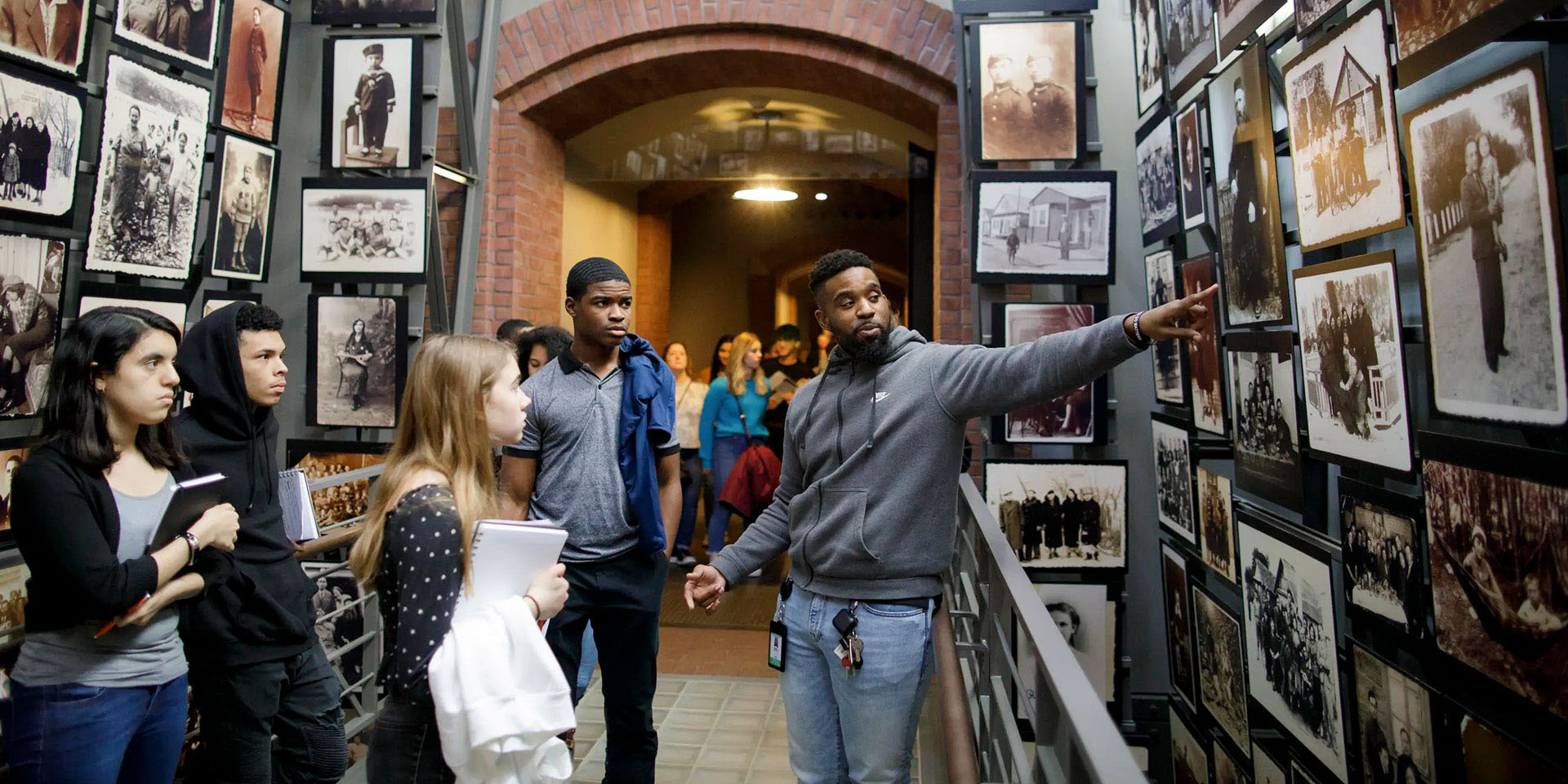
Image at top: In Washington, D.C., graduates of the United States Holocaust Memorial Museum’s Bringing the Lessons Home 2020 program visit one of the museum’s exhibits in an undated photo. The program introduces Washington-area high school students to Holocaust history and encourages them to educate their family and friends about the Holocaust. (Credit: Joel Mason-Gaines/U.S. Holocaust Memorial Museum)