
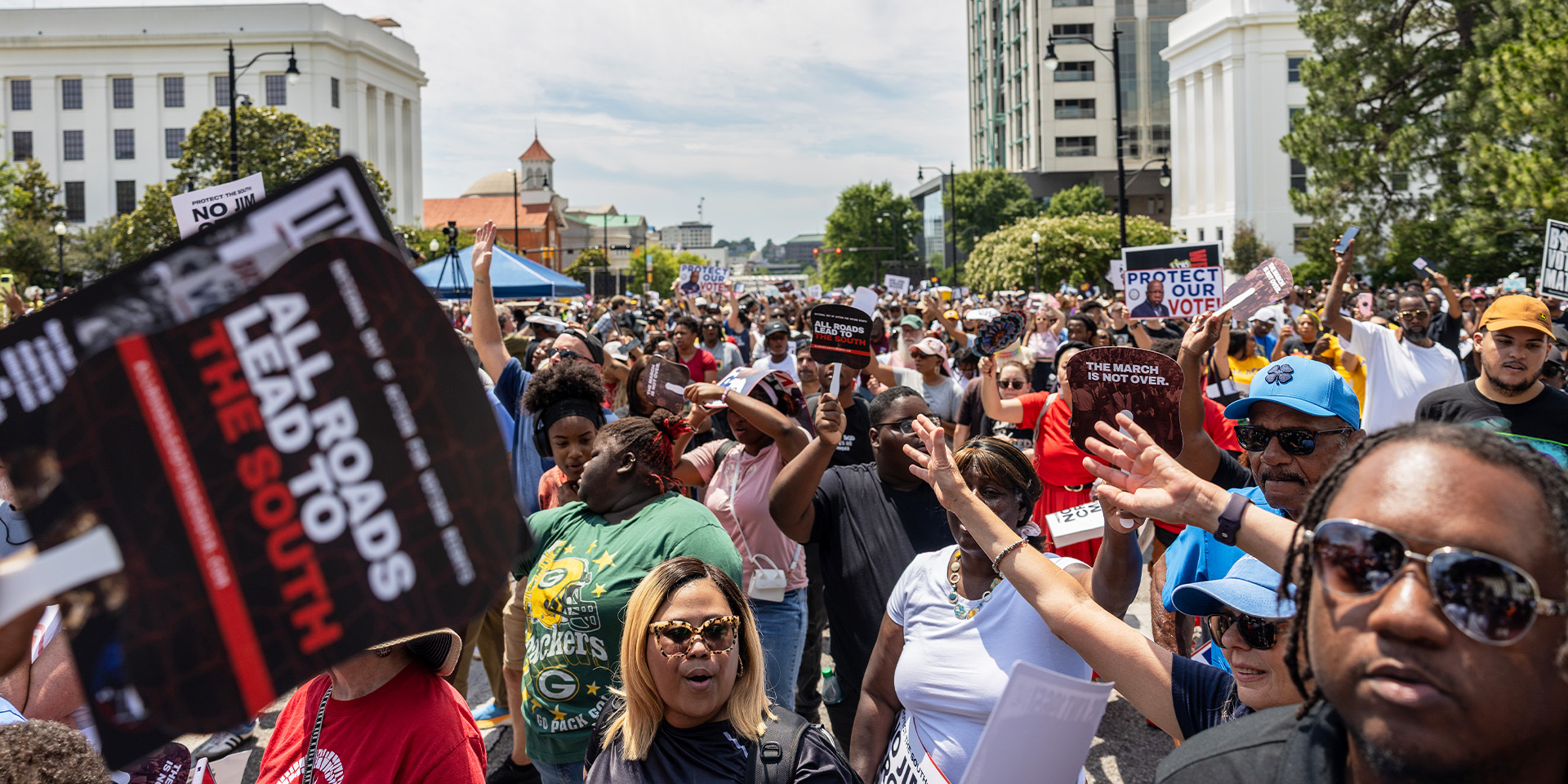
Thousands of people massed in front of the white marble steps leading up to the Alabama Capitol. Demonstrators stretched down Dexter Avenue in Montgomery, looking for shade as the warm spring sun passed its apex, eliminating the cool shadows on the street.
But this wasn’t the height of the Civil Rights Movement, the launch of a bus boycott or some other moment in time remembered only in grainy, black-and-white photographs. This was Saturday, May 16, 2026, in Alabama. Legions of people gathered in Selma and Montgomery to express their dissent after the U.S. Supreme Court spurred a scramble to weaken Black political power in Republican-led states across the South.
The court’s 6-3 ruling in Louisiana v. Callais on April 29 dealt a massive blow to a faltering Voting Rights Act of 1965 (VRA). In their decision, the justices declared that the creation of a majority-Black Louisiana congressional district amounted to an illegal racial gerrymander, violating the Constitution’s equal protection clause.
“They’re erasing the Black vote. We need that power. We need to be able to make decisions for ourselves.”
— Isaiah Watts, 21-year-old Alabama native and rally participant
The consequences of the decision spilled forth immediately. State governments across the South— the heart of the Civil Rights Movement — rushed to redraw congressional maps to dilute the power of Black voting blocs, in their attempts to win more Republican seats as state primaries and midterm elections approach.
“Let us not forget that, in this state, we were the catalyst for the Voting Rights Act,” said Tafeni English-Relf, director of the Southern Poverty Law Center’s Alabama state office, as an energetic crowd descended on the Capitol. “We’re not going back.”
Protesters streamed up and down Dexter Avenue, where congressional representatives from across the country joined legislators and advocates from Alabama, Louisiana, Mississippi and Tennessee under the banner of “All Roads Lead to the South: National Day of Action for Voting Rights.” The SPLC and hundreds of civic organizations such as the National Urban League, Black Voters Matter, Democracy Defenders Fund and the NAACP Legal Defense Fund, along with other local, state and regional groups, sponsored the rally that was livestreamed via YouTube on journalist Roland Martin’s “Unfiltered” channel.
“Sometimes I’ve wondered what I would have done if I would’ve been present and alive during the [Civil Rights] Movement,” Alabama state Sen. Merika Coleman told the crowd, its members holding signs up high with slogans that read “No Jim Crow Maps” and “Protect Our Vote” as they cheered in support.
“We’re here to tell you, you don’t have to wonder anymore,” said Coleman, who is vice chair of the Alabama Legislative Black Caucus. “This is our time right now.”
Across the states that were home to the Confederacy, the urgency of Coleman’s message has been swiftly and indelibly branded.
In Florida, Gov. Ron DeSantis had earlier called a special session of the Legislature to create a new congressional map that eliminated almost all Democratic districts. The Legislature approved the map the same day the Callais decision was announced. DeSantis signed it into law on May 4.
In Louisiana, Gov. Jeff Landry signed an executive order on April 30 that postponed its May 16 primary election to elect a U.S. representative. It also tossed out approximately 45,000 early votes that had already been cast. State senators then passed a bill that would eliminate one of the state’s two majority-Black legislative districts.
In Alabama, Gov. Kay Ivey called an emergency special session two days after the Callais decision, ordering legislators to redraw the state’s congressional maps. The goal of the session was to eliminate a second majority-Black district a federal court order had mandated only three years ago.
In Mississippi, another blow came on May 18, when the U.S. Supreme Court reversed a lower court’s ruling that the Mississippi Legislature had unlawfully diluted Black voting power when it redrew the state’s legislative maps.
In Tennessee and South Carolina, legislators have followed suit with their own attempts to consolidate power.
“They’re erasing the Black vote,” said 21-year-old Alabama native and rally participant Isaiah Watts. “We need that power. We need to be able to make decisions for ourselves.”
Scott Delaney, 63, traveled with his wife from Opelika, Alabama, to attend the rally and show his support to those who, he said, would be most affected.
“This is a country that was built on at least the idea of one person, one vote,” he said. “That your vote would matter, your voice would matter. It appears that we have people who really want to shut that down. That’s troubling for the future of our country.”
The SPLC, other civic and voting rights organizations and civil rights advocates have long opposed the weakening of the VRA. In 2015, the Shelby County v. Holder decision dealt a major blow to sections of the VRA that prohibited states with a history of racially discriminatory voting practices from making changes to their voting processes without federal preclearance.
With Callais, the court’s conservative majority has essentially determined that protection is no longer necessary, framing partisan gerrymandering as a legitimate interest and racial consideration as a discriminating influence.
“Today is not a protest, it’s a call to action,” said U.S. Rep. Terri Sewell. The Alabama Democrat represented the only majority-Black district out of seven in the state — Alabama’s population is 27% Black — until voters elected U.S. Rep. Shomari Figures to the House in 2024 following a Supreme Court decision that found Alabama’s redistricting map diluted Black voting power. “It’s not about some representation, or no representation. It’s about fair representation.”
Figures, whose new congressional district spans from Montgomery, in central Alabama, to portions of Mobile in the south of the state, joined Sewell at the rally.
Evan Milligan, Khadidah Stone and Shalea Dowdy, plaintiffs in the Allen v. Milligan case that spurred the new district that Figures now represents, were also on the dais Saturday.
If the Alabama Legislature is successful in its attempts to throw out the court-ordered map that created Figures’ district, he could lose his seat.
“People tell us that we are not who we once were, that is true,” Figures said. “But we certainly aren’t where we need to be.”
Alabama legislators were not alone on the dais. Among the speakers in support of the rally were U.S. Sens. Cory Booker and Raphael Warnock, as well as U.S. Reps. Alexandria Ocasio-Cortez and Ayanna Pressley.
The weakening of Section 2 of the VRA has had far-reaching consequences, particularly at the local level where Black voters continue to face challenges electing candidates of their own choosing, from school board members to judges and county commissioners.
The Callais ruling bolsters a push for mid-decade redistricting by both Republican and Democratic legislatures across the nation. The aggressive efforts to create increasingly partisan districts threaten to silence millions.
“We come here today, in front of this building, the temple of the Confederacy,” said Waikinya Clanton, the SPLC’s Mississippi state office director, referring to the Alabama State House where a memorial to Jefferson Davis, former president of the Confederate States of America, stands on display. “We’re not taking this lightly. They’re coming for our maps because they’re scared of our power.”
Despite the sobering reality, the energy of the crowd at Saturday’s rally felt lively and determined as people of all ages and walks of life turned out to show their support for democracy and their will to resist voter suppression.
“This is the beginning, this is not a one-and-done,” SPLC Board Chair Karen Baynes-Dunning told a group of supporters at the SPLC’s Montgomery headquarters Saturday evening after the rally.
“You can’t help but be in Montgomery and think about the living history of this city and everything that has come before,” she said, recalling the Montgomery Bus Boycott that started in December 1955 and galvanized the Civil Rights Movement, providing lessons for Saturday’s rally and fuel for the ongoing civil rights struggle.
“So much we learned from history we bring it forward,” she said, adding that the rally was a nationwide call to action. “Now is our time.”
Image at top: Thousands march in Montgomery, Alabama, for the All Roads Lead to the South rally for voting rights on May 16, 2026. (Credit: Josh Carples)