

Residents in Eatonville, Florida, were left reeling when in September they learned that the heart and soul of their historic community — more than 100 acres of land that once housed a sprawling school campus modeled on what was then Booker T. Washington’s Tuskegee Institute — was set to be sold right out from under their feet to private interests.
But how had they — members of a proud, historic and very active Black community — missed an agreement to sell 14% of the town’s land?
What’s more, while the Orange County Public Schools (OCPS) development plans for the property tout a learning center, museum and even affordable housing, much of the property would be left open for any sort of development or sale. Ultimately, the deal threatens to gentrify and erase the legacy of the community.
The Southern Poverty Law Center conducted an investigation in preparation for a lawsuit challenging the sale. During the investigation, the SPLC obtained documents, emails and notes from meetings between OCPS and Orlando-based nonprofit Dr. Phillips Charities that shed light on the deal minted last year.
The SPLC relied on those documents to form the basis of the allegations in its complaint, which was filed earlier this month. The complaint alleges that OCPS officials engaged in real estate negotiations without the public’s knowledge, including private conversations between school board staff and Dr. Phillips Charities.
During the exchanges, school board staff and Dr. Phillips Charities discussed and negotiated the terms of the sale and redevelopment of the historic Robert Hungerford property in Eatonville. A small town of about 2,500 residents, it is known as the first incorporated Black municipality in the country and the hometown of literary icon Zora Neale Hurston. It is also located just a stone’s throw from Orlando, along the Interstate 4 corridor, making its property very desirable.
The SPLC filed the lawsuit that brought the school board’s clandestine actions to light on behalf of the Association to Preserve the Eatonville Community Inc. (P.E.C.). The suit alleges that OCPS made the decision to sell the Hungerford property to Dr. Phillips before holding any public meetings. The lawsuit further claims that when the board ultimately held public meetings, they were ceremonial, solely for the purpose of taking formal votes on decisions that had already been made.
“It was wrong, period,” said P.E.C. Executive Director N.Y. Nathiri. “Why? Because of the process.”
On multiple occasions in 2024 and throughout its private real-estate negotiations with Dr. Phillips last year, OCPS did not give Eatonville residents an opportunity to participate in its deliberations and discussions over the large swath of land that accounts for 14% of the town’s area. In doing so, the suit argues, the school board violated Florida’s Sunshine Law, which mandates how official business must be conducted to ensure transparency and accountability between the state and the public it serves.
“Florida law is clear,” said Kirsten Anderson, deputy legal director for the SPLC’s Economic Justice litigation team. “Decisions to sell public property must be discussed at public meetings. The public has a right to be present and to be heard during all phases of decision-making.”
The SPLC is seeking an injunction from the court to invalidate the school board’s decision as well as the memorandum of understanding (MOU) and sale agreement it finalized last year with Dr. Phillips Charities.
“Any official action taken outside of the sunshine is invalid and without legal effect,” Anderson said.
Historic — and valuable — property
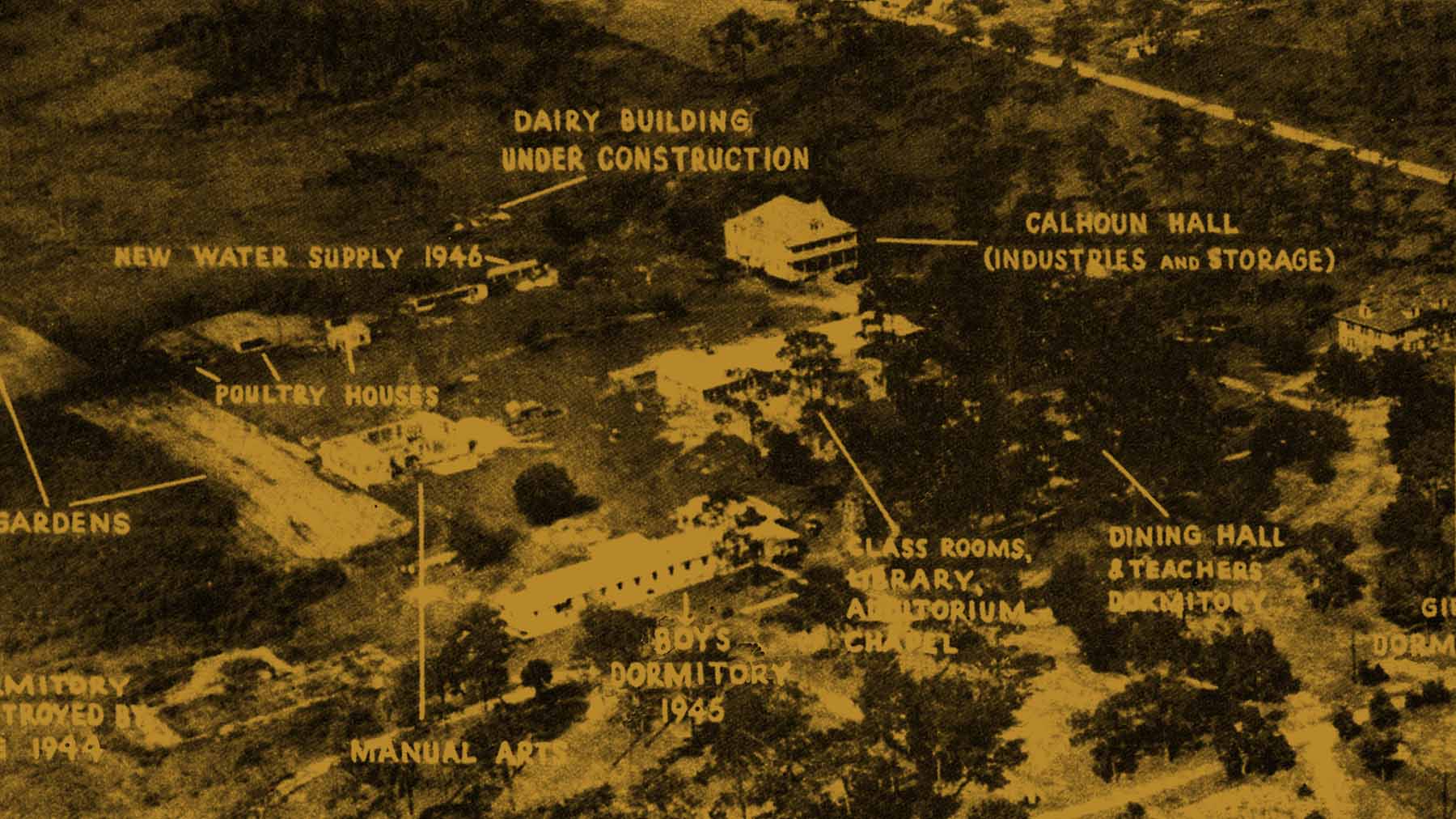
The Hungerford property initially spanned more than 300 acres, the site of the sprawling Robert Hungerford Normal and Industrial School. From the first building’s construction in 1897, it was the pride of Eatonville, established 10 years after emancipated Black men and women had founded the town itself.
“What we need to understand about Eatonville is that it’s a place dedicated to the education of Black people,” said historian Walter Greason. “It uniquely raised the standard of democracy and freedom for everyone.”
The land and the school buildings that once occupied the vast expanse had been set aside for the education and benefit of Black children and the Eatonville community. But half a century later, in 1951, a series of contentious court battles that landed in front of the Florida Supreme Court saw the property fall from the hands of the Hungerford family trust into those of OCPS.
But the court issued a deed restriction that required the Hungerford property be used strictly for the purpose of educating Black children.
In the decades since, OCPS has sold off parcels of the land. After the construction of Interstate 4 bisected the property, OCPS won permission from the court to sell off the section on one side of the highway.
The school board closed the last public high school located on the property in 2009. Since then, it has engaged in several attempts to sell the remaining land.
“The property interests of a potential buyer are not dedicated to the original purpose of the Hungerford land,” said Greason, who works with communities like Eatonville to develop strategies that use historical preservation as a means of economic reinvestment. “It sets the table for the exact process I set out to prevent — the historical and cultural erasure of one of the most important Black communities in the world.”
‘Our concern is about survival’
According to the lawsuit, in 2025 the CEO of Dr. Phillips Charities, Kenneth Robinson, wrote to OCPS Superintendent Maria Vazquez.
In an email dated June 15, Robinson expressed to Vazquez his fear that the people of Eatonville lacked the “capacity, capability, and credibility to make this a reality.” Then he offered a solution: Dr. Phillips Charities was willing to step in and resume discussions about the purchase and development of the Hungerford property if the board did not have a path forward with the town.
By August, Dr. Phillips Charities had drafted and delivered to OCPS a memorandum of understanding to negotiate the purchase of the Hungerford property. The next month, OCPS and Dr. Phillips hammered out the terms of the real estate agreement outlined in the memorandum, noting specific improvements the organization would make to the land and ensuring, in clear terms, that ownership of the land would transfer to Dr. Phillips upon closing.
Notes from a Sept. 15 meeting reveal that Vazquez met with Angie Gardner, then mayor of Eatonville, and representatives from Dr. Phillips, including Robinson. Their discussion centered on the public announcement of the deal, a plan for a public vote at an upcoming Sept. 30 meeting and the superintendent’s intent to circulate the MOU among school board members.
When Gardner and Vazquez issued a joint press release announcing the agreement on Sept. 23, Eatonville residents were shocked to learn of the proposed deal to sell the Hungerford property to Dr. Phillips. Yet by Sept. 8, weeks before issuing that joint statement, according to the lawsuit, Vazquez had counted votes from seven of eight school board members to ensure they were in favor of the deal and communicated that vote count to Dr. Phillips prior to a formal vote.
In a public meeting on Sept. 30, OCPS formally voted to unanimously approve the memorandum of understanding and designated the Hungerford property as surplus land, a necessary measure that would allow the board to sell it.
About three months later, on Jan. 6, OCPS held a work session where it presented to the public a proposed purchase agreement for the sale of the Hungerford property to Dr. Phillips. That agreement included details about provisional developments the organization would undertake that if fulfilled within certain timeframes would result in the forgiveness of millions of dollars.
It also contained a $14 million purchase price, which the MOU did not.
Somewhere along the line between Sept. 30 and Jan. 6, OCPS and Dr. Phillips negotiated the full sales price of the Hungerford land, as well as specific dollar amounts and terms and conditions, without public knowledge or discussion. Those conditions could allow Dr. Phillips Charities to ultimately end up with only $1 million out of pocket for the entire property.
According to the purchase agreement presented in January, Dr. Phillips would pay $1 million up front to OCPS and, over a period of about a decade, develop a community green space and pavilion, early learning center, town center and history museum, as well as an affordable housing development — all on a small portion of the 117-acre plot.
Yet future use for much of the property has been left undefined under the public agreement. Dr. Phillips is free to develop or divide and sell the bulk of the Hungerford land as it pleases because, ultimately, it has complete ownership of the parcel.
“Even when people make superficial concessions in the process of making an offer without protections for local Black residents, this will lead to gentrification, displacement and ultimately, over time, erasure of the legacy of Eatonville,” Greason said.
Each development target laid out in the agreement between OCPS and Dr. Phillips has its own deadline and price tag. If the organization made a “good faith” effort to hit each target, a portion of the $14 million would be forgiven — with the potential to wipe the entire debt except for the initial $1 million Dr. Phillips paid.
Several Eatonville town representatives who had been invited by the board to share brief comments at the Jan. 6 meeting pleaded with OCPS for more time and greater consideration. They also questioned why they had been left out of the process.
“Our concern is about survival,” said Wanda Randolph, an Eatonville town council member who spoke at the Jan. 6 school board work session. “I believe that we in Eatonville should have the consideration to own the property 100%,” Randolph said before asking the board for a 90-day extension so the town could submit a proposal.
“The residents of Eatonville are very emotional about the property,” Randolph continued. “It’s the largest parcel in the town. After this, there are no more [prime development] opportunities to go after.”
The following week, on Jan. 13, the school board formally voted to unanimously approve the sale of the Hungerford property to Dr. Phillips Charities.
‘We have the ability to do that work’
Eatonville’s town council had publicly expressed its interest in buying the property from OCPS. That effort arose after a private developer pulled out of a 2023 sale following significant pushback from town residents and officials. The town’s purchase proposal had fizzled out, without a clear reason as to why.
But the open meetings and records lawsuit points to actions that predate the paper trail left in 2025 that could explain why the school board walked away from the discussions. In the complaint, attorneys allege that in early 2024, when OCPS was still engaged in prior litigation with P.E.C., it failed to comply with the rules that govern so-called “shade” meetings, violating state law.
Shade meetings allow elected officials to conduct certain discussions behind closed doors, in this case with an attorney related to pending litigation. But there are conditions that dictate who can be present at these meetings and what can be discussed.
OCPS held three such meetings, on April 10, 2024; Oct. 15, 2024; and Oct. 29, 2024. In its filing before the court, the SPLC alleges that OCPS allowed unauthorized personnel to attend all three meetings, violating those conditions. Additionally, the complaint contends that the school board’s discussions went beyond what’s allowed under the law.
For example, the board’s discussions included:
- Whether to support a sale of the Hungerford property to the town of Eatonville.
- The town’s capacity to manage the land.
- Whether Eatonville had been a good partner to the school board.
- Whether the town had been good stewards of the land.
- If the school board had any obligation to return the property to the community.
According to the lawsuit, those are just a few of the unauthorized discussions that did not pertain to the immediate litigation.
OCPS has said the lawsuit is without merit. In its defense, Dr. Phillips has pointed to an advisory committee it created to ensure the community’s voices are heard.
But Eatonville residents wonder if their concerns will be considered, especially after the organization shaped its plans with OCPS in secrecy.
Nathiri, executive director of P.E.C., the plaintiff in the SPLC suit, revisited the assertion from Dr. Phillips’ CEO, Robinson, that Eatonville lacked “the capacity, capability and credibility” to develop the Hungerford property.
“You really have to spend some considerable time thinking about those words,” Nathiri said. “It’s a really harsh statement.”
“Eatonville has existed now for almost 150 years,” she said. “There is hard work to be done, but the wonder of it all is that we have the ability to do that work, we have the capability to do that work and the credibility to get it done.”
Image at top: Land in Eatonville, Florida, that once belonged to the Robert Hungerford Normal and Industrial School sits vacant next to Interstate 4. (Credit: AP Photo/Rebecca Blackwell)
More on Eatonville
-
A timeline of events in Eatonville, Florida
-

Offer for historic property alarms Black residents of Eatonville, Florida
-
Zora! Festival celebrates culture, preservation wins for historic Black community
-

National Trust for Historic Preservation names Eatonville an endangered site
-

Descendant of land donor joins effort to preserve historic Florida community
-

After beating development plan, residents work to save Florida town’s legacy
-
Historic Action: Developer of Black heritage site in Florida backs out of sales contract
-

SPLC represents group suing to preserve Florida community’s Black heritage
-
‘Sacred Ground’: Effort to preserve historic Black Florida community wins key victory
-

‘Willing to Fight’: Residents rise up against development that could erase historic Florida town’s rich Black heritage
-

Preserving Black Heritage: Florida activists fight to save historic site and their culture